Installation guide
 Owner’s manual
 Error Codes



How to remove bottom grille on GE Refrigerator?
On the GE DFE29JGDDWW bottom-mount refrigerator, the bottom grille (base grille) typically comes off by releasing its retaining tabs or removing a couple of screws (if your version uses them), then pulling the grille straight out from the bottom front of the cabinet. For model-specific access points, use the DFE29JGDDWW installation guide.
Quick steps (safe, no-damage method)
- Unplug the refrigerator or switch it off at the control (safer when working near wiring).
- Pull the refrigerator straight out a few inches if you need more hand room.
- Look along the top edge of the grille for screws; remove them with a Phillips screwdriver if present.
- If there are no screws, press the grille near the clip locations and pull outward to release the tabs.
- Tilt the grille slightly and lift it away from the bottom front.
- To reinstall, align the tabs, slide the grille into place, then reinstall screws (if used).
What you should see and what it means
| What you see at the grille | What to do | Common tool |
|---|---|---|
| 2 screws (often one on each side) | Remove screws, then pull grille forward | Phillips screwdriver |
| No screws, visible slots or clip points | Push to release clips, then pull forward | Hands (flat putty knife if tight) |
| Grille feels stuck on one side | Re-seat and release that side first | Hands, flashlight |
Why it matters
We remove the bottom grille to access and clean the condenser area, check for debris, and improve airflow. Better airflow helps the compressor run cooler and can reduce warm-temperature complaints.
Tips to avoid cracks and scratches
- Pull straight out; twisting the grille can snap plastic tabs.
- If you move the refrigerator, raise the leveling legs first and pull straight out to protect flooring.
- Use a thin plastic tool (not metal) if a clip is tight.
Last updated: February 2026
Is GE Cafe considered high end?
Yes. GE Café is GE’s premium line, positioned as a high-end option with upgraded design, features, and finishes compared with standard GE refrigerators. For your GE DFE29JGDDWW, the owner's manual also reflects Café-specific coverage (for example, extended sealed-system warranty terms on GE Café models).
What “high end” means for GE Café
GE Café is typically considered high end because it focuses on a more premium ownership experience:
- More design-forward styling and coordinated finishes
- Feature-rich controls and convenience options (varies by model)
- Premium pricing compared with mainstream GE lines
- Strong focus on fit-and-finish (handles, trim, interior layout)
- Higher-end model families often include longer coverage on certain systems (check your warranty section)
GE Café vs other GE lines (quick comparison)
| GE line | Market position | What you usually get |
|---|---|---|
| GE (standard) | Mainstream | Core features, value-focused |
| GE Profile | Premium | More features and performance upgrades |
| GE Café | High end | Premium design plus feature upgrades |
| Monogram | Luxury | Built-in style, top-tier materials and customization |
Why it matters when you are shopping parts or planning repairs
Knowing your line helps you set expectations for parts cost and repair approach. High-end models often use more electronics and specialty assemblies, so diagnosing the root cause first saves time and prevents unnecessary returns.
- For cooling or temperature complaints, start with sensors and airflow checks
- For control or display issues, confirm power resets and error codes before replacing boards
- For water and ice issues, filter and valve checks usually come first
Common parts customers replace on this model
If your DFE29JGDDWW needs service, these are common, model-matched parts we see used in troubleshooting:
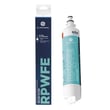
- Refrigerator water filter RPWFE (replace about every 6 months, or sooner with low flow)
- Refrigerator temperature sensor WR55X10025 (helps regulate temperatures)
- Refrigerator main board assembly WR55X46805 (controls key refrigerator functions)
Last updated: February 2026
How to read GE model numbers?
GE model numbers are a short “code” that identifies the refrigerator’s design family and configuration. For your GE bottom-mount refrigerator model DFE29JGDDWW, the DFE prefix indicates a standard-depth model series; the rest of the characters narrow down the exact features and finish.
Where to find the model number (and why it matters)
We use the model number to match the correct parts, diagrams, and troubleshooting steps for your exact refrigerator.
- Look for the model and serial label inside the fresh food (refrigerator) compartment.
- On this model family, the label is typically on the left side, near the middle of the refrigerator compartment.
- Write down both the model number and serial number before ordering parts or diagnosing issues.
- Use the model number when checking procedures in the DFE29JGDDWW owner's manual.
How GE refrigerator model numbers typically break down
GE model numbers vary by product line, but for many GE and GE Profile refrigerators:
- Prefix letters (example: DFE) identify the platform/series and depth type.
- Numbers (example: 29) often relate to size or design family.
- Middle letters can indicate feature packages.
- Ending letters commonly indicate color/finish.
Standard-depth vs counter-depth (common GE prefixes)
Based on the documentation for this refrigerator family:
| Model prefix | Depth type | What it means for fit |
|---|---|---|
| PFE, GFE, DFE, GNE, GIE | Standard depth (SD) | Typically deeper cabinet; more interior space |
| PYE, PWE, CYE | Counter depth (CD) | Shallower cabinet; more flush with counters |
Quick tips when ordering parts for DFE29JGDDWW
Using the exact model number prevents wrong-part returns and repeat repairs.
- Match the model number exactly: DFE29JGDDWW (letters matter).
- If you are replacing filtration parts, confirm the filter type listed for your model; this model uses the refrigerator water filter RPWFE.
- For cooling complaints, the model number helps us match the correct sensors and controls, such as the refrigerator temperature sensor WR55X10025.
Why it matters
GE uses similar-looking model numbers across multiple refrigerator platforms; one character change can mean different shelves, door bins, ice makers, or control boards. Reading the prefix correctly (like DFE) is the fastest way to confirm you are in the right parts list for your refrigerator.
Last updated: February 2026
What is the most common problem with GE profile Refrigerators?
The most common problems we see on GE Profile refrigerators like model DFE29JGDDWW are ice maker and water dispensing issues and temperature control problems (warm fresh food section, warm freezer, or fluctuating temps). These symptoms often trace back to the water filter and water supply components, airflow parts, or electronic sensing and control.
Most common symptoms (and what they usually point to)
- Ice maker not making ice or slow ice production: restricted water flow, inlet valve issue, or ice maker failure
- Water dispenser flow is weak: clogged filter or air in the water line
- Fresh food section too warm: evaporator fan problem, frost buildup from a defrost issue, or a sensor problem
- Freezer too warm: airflow restriction, fan issue, or defrost system trouble
- Temps swing up and down: temperature sensor (thermistor) or control board behavior
Quick checks we recommend first (before replacing parts)
- Confirm the controls are set to typical targets: 37°F fresh food and 0°F freezer
- Make sure vents are not blocked by food packages
- Clean dust from the condenser area (poor heat release can mimic cooling failure)
- If you have a dispenser, replace the water filter every 6 months or sooner if flow drops
- Check for heavy frost on the freezer back wall (a strong clue of a defrost problem)
Common parts involved on DFE29JGDDWW
| Problem area | What you notice | Part that commonly fixes it |
|---|---|---|
| Water filtration | Slow water, poor ice fill | Refrigerator water filter RPWFE |
| Water supply to ice maker/dispenser | No water to dispenser or ice maker | Refrigerator water inlet valve WR57X10098 |
| Temperature sensing | Temps inaccurate or inconsistent | Refrigerator temperature sensor WR55X10025 |
| Airflow in freezer | Warm temps, weak airflow noise changes | Refrigerator evaporator fan motor and blade WR60X10352 |
| Defrost system | Frost buildup, warming over time | Refrigerator defrost heater WR51X10131 and refrigerator defrost bi-metal thermostat WR50X10108 |
Why it matters
Ice maker and cooling complaints often share the same root causes: restricted water flow, restricted airflow, or control and sensor inputs that are out of range. Addressing the simple items first (settings, airflow, filter condition) prevents unnecessary part replacement and helps restore stable temperatures faster.
Helpful model-specific references
- Use the DFE29JGDDWW owner's manual for control settings, care steps, and feature operation.
- If you’re seeing a code or unusual behavior, the GE refrigerator error codes guide helps you match symptoms to likely systems (cooling, fans, sensors, defrost).
Last updated: February 2026