 Owner’s manual
 Error Codes





What is the most common problem with a GE dishwasher?
For the GE GDF610PSJ0SS dishwasher, the most common issues we see are poor cleaning from clogged filters or spray-arm problems, and “won’t start” symptoms tied to the door being opened or not latched during operation. Regular filter cleaning and confirming the door is fully closed prevents many service calls.
- Dirty or gritty dishes: filters need cleaning; spray arms may be blocked
- Won’t start or stops mid-cycle: door opened, cycle interrupted, or latch not fully engaged
- Beeping during operation: reminder that the door is open; it continues until Start is pressed and the door is closed
- Not draining well: drain path restriction (filter area, hose routing, or sink air gap)
- Not drying well: rinse aid empty or heat-related issue
Start with these simple, high-success steps before replacing parts:
- Clean the filters (GE recommends inspecting periodically, about every other month depending on usage)
- Remove and rinse spray arms; clear food debris from the holes
- Press Start and fully close the door to resume operation after an interruption
- If you have a sink air gap, clean it (a clogged air gap can mimic a drain problem)
- Confirm you are using automatic dishwasher detergent and refill rinse aid
If cleaning and basic checks do not solve it, these parts are frequent culprits on this model:
| Symptom | Common cause | Part to consider (model-specific) |
|---|---|---|
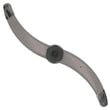
| Poor cleaning, lower rack still dirty | Lower spray arm worn or clogged | Dishwasher spray arm, lower WD22X33499 |
| Door won’t latch, unit won’t run | Door latch not engaging | GE dishwasher door latch lock WD21X10490 |
| Not drying, water not heating | Heater circuit issue | Dishwasher heating element WD05X30818 |
| Weak wash action, noisy wash | Circulation pump problem | Dishwasher circulation pump WD26X23258 |
Most “GE dishwasher problems” start as maintenance issues. A partially clogged filter or spray arm reduces water flow, which leads to poor wash performance and gritty residue. Door-latch and door-open interruptions can look like an electrical failure, but they are often resolved by proper door closure and restarting the cycle.
For model-specific operating and troubleshooting steps, follow the GDF610PSJ0SS owner’s manual.
Last updated: February 2026
Can a clogged drain cause an FTD error?
Yes. On the GE GDF610PSJ0SS dishwasher, an FTD (fail to drain) error commonly happens when the drain path is restricted, so the drain pump cannot push water out of the tub. Clearing the blockage usually restores normal draining.
- Cancel the cycle and let the unit try to drain; then check for standing water.
- Clean the filters in the bottom of the tub (fine and ultra-fine filters) and reinstall them correctly.
- If you have an air gap, remove the cap and clean it (a clogged air gap can stop draining).
- If the dishwasher drains into a garbage disposal, run the disposal to clear it.
- Inspect the sink drain; if the sink drains slowly, the dishwasher can back up.
| Clog location | What you may notice | Typical fix |
|---|---|---|
| Filters/sump area | Water standing in tub, debris visible | Clean filters and sump area |
| Air gap (if installed) | Poor or no drain, water backing up | Clean air gap |
| Disposal inlet or sink drain | Dishwasher drains slowly, sink slow too | Clear disposal/sink drain |
| Drain hose | Kinked hose, intermittent drain | Straighten/clear hose |
If the drain path is clear but the dishwasher still will not pump out, focus on the drain components:
- A jammed or failing drain pump
- A blocked or damaged drain hose
- A control issue that is not powering the drain pump
For model-correct replacements, match by model number and symptoms:
FTD is the dishwasher telling you it cannot remove water. Leaving water in the tub can lead to odors, poor cleaning, and repeated cycle interruptions, so clearing the drain path is the quickest way to get the GE GDF610PSJ0SS running normally.
For additional model-specific troubleshooting steps and drain-related checks (including air gap guidance), use the GDF610PSJ0SS owner's manual.
Last updated: February 2026
What is the average life expectancy of a GE dishwasher?
Most GE dishwashers typically last 10 to 12 years with normal household use. For your GE GDF610PSJ0SS dishwasher, regular filter cleaning, correct detergent use, and fixing small leaks early are the most reliable ways to reach (or beat) that average; see the GDF610PSJ0SS owner's manual.
- Maintenance: cleaning filters and checking spray arms keeps wash performance strong.
- Water quality: hard water can increase mineral buildup and wear.
- Loading habits: overloading can strain racks, spray arms, and the circulation system.
- Heat and drying: heavy use of heated dry can increase wear on heating components.
- Small leaks: even minor seepage can damage wiring and controls over time.
The manual recommends inspecting and cleaning the filters periodically (often about every other month, depending on usage). Keeping the wash system clear reduces strain on the circulation pump and helps prevent gritty residue.
We recommend this routine:
- Clean the filters on a schedule and anytime dishes feel gritty.
- Confirm the spray arms spin freely and holes are not clogged.
- Use dishwasher detergent and rinse aid intended for automatic dishwashers.
- Scrape off hard soils (bones, toothpicks, seeds) before loading.
- Address draining or filling issues quickly to avoid pump and control damage.
| Part area | What you may notice | Example model part |
|---|---|---|
| Wash action | Poor cleaning, debris left behind | Dishwasher spray arm, lower WD22X33499 |
| Drying/heat | Dishes stay wet, weak drying | Dishwasher heating element WD05X30818 |
| Door closing | Won’t start, door pops open | GE dishwasher door latch lock WD21X10490 |
Knowing the typical 10 to 12 year lifespan helps you decide when maintenance and a targeted repair (like a spray arm, heating element, or latch) makes sense versus planning for replacement.
Last updated: February 2026
Is GE Profile considered high-end?
Yes. GE Profile is generally considered GE’s step-up (higher-end) line compared to standard GE appliances, with more premium features, finishes, and performance options. For your GE dishwasher model GDF610PSJ0SS, the exact “Profile” branding depends on the model series and labeling shown in the GDF610PSJ0SS owner's manual.
GE’s lineup is usually grouped by feature level. Here’s the practical way to think about it when shopping parts, features, or service:
- GE (standard): core features, value-focused designs
- GE Profile: upgraded features, quieter operation options, more design choices
- Café / Monogram: premium styling and higher-end offerings (varies by product type)
- GE Profile vs standard GE: more “nice-to-have” features, not necessarily a different repair approach
For repairs, “high-end” matters less than the exact model number. Parts, wiring, and control boards are model-specific.
Common dishwasher components that vary by model family include:
- User interface and control logic (example: ui board WD21X31902C)
- Wash system design (spray arms, diverters, circulation pump)
- Drying system (heater style and control)
- Door hardware and safety interlocks
| Topic | GE (standard) | GE Profile |
|---|---|---|
| Feature set | Basic to mid | Mid to upper-mid |
| Styling | Standard finishes | More premium finishes |
| Service/parts need | Model-specific | Model-specific |
| Repair approach | Same fundamentals | Same fundamentals |
Knowing whether an appliance is GE Profile helps set expectations for features and pricing, but the model number (GDF610PSJ0SS) is what ensures you get the right dishwasher parts, troubleshooting steps, and service information.
Last updated: February 2026





