Error Codes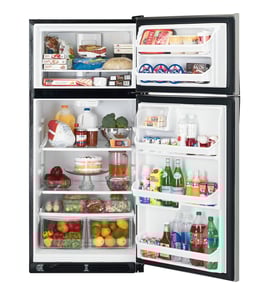

Can you adjust the height of a GE refrigerator?
Yes. On the GE GTE16DTHCRBB top-mount refrigerator, you typically adjust height and leveling using the front leveling legs (or front rollers/levelers), while the rear rollers are usually fixed and mainly help you roll the refrigerator in and out.
- Unplug the refrigerator or switch off power at the breaker before putting hands near wiring or the compressor area.
- Pull the refrigerator forward enough to access the front levelers.
- Turn the front leveling legs to raise or lower the front corners (small turns make a big difference).
- Recheck door swing and door sealing after each adjustment.
- Push the refrigerator back carefully so you do not kink the water line (if equipped with an ice maker).
A properly leveled top-mount refrigerator usually sits slightly higher in front so the doors close on their own.
| Check | What you want | What it prevents |
|---|---|---|
| Door closure | Door closes smoothly without slamming | Warm air leaks, frost, sweating |
| Cabinet stability | No rocking at corners | Noise, vibration |
| Door alignment | Even gaps at the gasket | Poor sealing, icing |
These issues are commonly related to the door seal or door switch area:
- Inspect the gasket for gaps, tears, or hardened sections.
- Clean the gasket and the cabinet sealing surface.
- Confirm shelves or bins are not preventing full closure.
- If the gasket is damaged, replace it with the correct part for this model (for example, refrigerator door gasket WR14X27234).
Leveling affects door closure, temperature stability, and frost control. A refrigerator that is too low in front can drift open, causing warm air intrusion and extra run time for the compressor.
For GE-specific steps on door alarms (often triggered by a door not closing), use how to reset the door alarm on a GE refrigerator.
Last updated: January 2026
What is the high end GE refrigerator?
GE’s high-end refrigerator line is Monogram, which is GE’s luxury brand above GE Profile and GE Café. If you own a GE GTE16DTHCRBB top-mount refrigerator, Monogram is the step-up family you would compare against for premium built-in designs, finishes, and features.
GE uses different product families to target different budgets and feature levels.
- GE (standard line): dependable everyday refrigerators, including many top-mount models
- GE Profile: upgraded features and styling (often more capacity and convenience features)
- GE Café: design-forward finishes and premium styling, often with pro-style looks
- Monogram: luxury tier; built-in configurations, premium materials, and high-end fit and finish
| Line | Typical positioning | Common refrigerator styles you’ll see |
|---|---|---|
| GE | Core value and reliability | Top-mount, bottom-freezer, side-by-side |
| GE Profile | Premium mainstream | French door, side-by-side, bottom-freezer |
| GE Café | Premium design-focused | French door, specialty finishes |
| Monogram | Luxury flagship | Built-in columns, built-in French door, integrated looks |
Knowing the product line helps set expectations for features, parts pricing, and service approach. For example, a standard GE top-mount like GTE16DTHCRBB is usually optimized for straightforward reliability, while luxury built-in units prioritize integrated installation, aesthetics, and specialized components.
If you’re comparing models because of a feature concern (like alarms or controls), start with how to reset the door alarm on a GE refrigerator.
Last updated: January 2026
What is the most common problem with GE profile refrigerators?
The most common issue we see across GE Profile refrigerators is a cooling problem (fresh food section warm, freezer not holding temperature, or temperatures swinging). On your GE GTE16DTHCRBB top-mount refrigerator, the same “not cooling” symptoms usually trace back to airflow, frost buildup, or a fan problem.
- Refrigerator warm, freezer cold: restricted airflow from the freezer to fresh food (often frost buildup or blocked vents)
- Both sections warm: compressor not running correctly, condenser airflow issue, or control problem
- Loud humming, grinding, or rattling: fan blade hitting ice or a failing fan motor
- Ice maker not making ice: water supply issue, inlet valve issue, or ice maker module problem
- Water under the fridge or in the crisper: clogged/iced drain or water line/valve seepage
- Set temps to a normal target: 37°F fresh food and 0°F freezer.
- Make sure vents are not blocked by food packages.
- Confirm the doors close tightly and the gasket seals all the way around.
- Clean dust from the condenser area and confirm the condenser fan runs when the compressor runs.
- Listen for the evaporator fan in the freezer; it should run most of the time when cooling is needed.
| Symptom | Common suspect | Example part for GTE16DTHCRBB |
|---|---|---|
| Warm temps, weak airflow | Evaporator fan motor | Refrigerator evaporator fan WR60X31522 |
| No ice or slow ice | Water inlet valve | Refrigerator water inlet valve WR57X39965 |
| Door not sealing, moisture/frost | Door gasket | Refrigerator door gasket WR14X27234 |
Cooling problems can spoil food quickly and also force the compressor to run longer than normal. Catching airflow and fan issues early is one of the best ways to restore normal temperatures and reduce strain on the sealed system.
Related help: GE refrigerator error codes
Last updated: January 2026