Installation guide
 Owner’s manual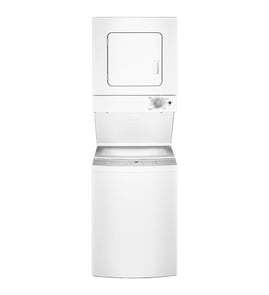




What voltage is GUD24ESSM0WW?
The GE GUD24ESSM0WW stacked laundry center uses a 120/240V, 30-amp electrical supply for the electric dryer section (two hot legs L1 and L2 plus neutral and ground). We recommend confirming your outlet and cord setup against the wiring diagrams in the GUD24ESSM0WW installation guide.
What to check at the wall (before you buy a cord)
- Verify you have a dedicated 30-amp dryer circuit breaker.
- Confirm the receptacle type: 3-prong (older) or 4-prong (newer).
- Make sure the dryer is on a 120/240V supply (not 120V only).
- Check that the cord strain relief and terminal block connections are tight and not overheated.
- Turn off the breaker before removing the terminal block cover.
Typical wiring connections (what the terminals mean)
The installation instructions describe connecting the power cord to the terminal block:
| Terminal/block point | What connects there | What it does |
|---|---|---|
| L1 | Hot line | Supplies 120V leg |
| L2 | Hot line | Supplies 120V leg |
| N (center) | Neutral (white) | Needed for 120V components |
| Green ground screw/strap | Ground/ground strap | Safety grounding |
Why it matters
Using the correct 120/240V, 30A supply helps the dryer heat properly and protects the control, timer, and wiring from damage caused by incorrect voltage or loose connections.
Last updated: February 2026
How many years should a GE washing machine last?
A GE washer typically lasts 10 to 14 years. For the washer in your GE GUD24ESSM0WW stacked laundry center, lifespan depends most on load size, detergent use, and basic upkeep like hose replacement and letting the tub dry out between loads (see the GUD24ESSM0WW owner’s manual).
Typical lifespan and what affects it
Most washers reach the 10 to 14 year range when they are used normally and maintained. These factors make the biggest difference:
- Load size and frequency: frequent heavy loads shorten life
- Detergent amount: too much detergent can cause residue and issues over time
- Water quality: hard water can increase buildup
- Ventilation and drying: leaving the lid open helps moisture evaporate
- Hose condition: replacing fill hoses on schedule helps prevent leaks
Maintenance that helps your washer reach its full lifespan
The manual for this model includes several practical care items we recommend following:
- Replace water supply hoses every 5 years
- Turn off water faucets when not in use to reduce leak risk
- Leave the washer lid open after washing to help the interior dry
- Wipe spills promptly and clean the basket with a soft cloth (no harsh cleaners)
- Use the right amount of detergent, especially with soft water
Quick checklist (what to do and how often)
| Item | Recommended timing | Why it helps |
|---|---|---|
| Replace fill hoses | Every 5 years | Reduces leak and burst-hose risk |
| Leave lid open after cycles | Every load | Reduces moisture and odor buildup |
| Check detergent amount | Every load | Helps prevent oversudsing and residue |
| Turn off faucets when away | As needed | Minimizes leak risk when unattended |
Why it matters
A washer that is kept dry, not overloaded, and protected from hose leaks usually makes it to the expected service life. Small habits (correct detergent, hose replacement, and airflow) help protect major components like the drive system, control board, and lid lock.
Last updated: February 2026
Is GUD24ESSM0WW a brand name?
No. GUD24ESSM0WW is a GE model number, not a brand name. For this stacked laundry center, the brand is GE, and GUD24ESSM0WW identifies the exact unit version so you can match the correct parts, wiring, and installation requirements in the GUD24ESSM0WW owner's manual.
What GUD24ESSM0WW means (and why it matters)
A model number is the appliance’s “ID tag.” It tells us which design, features, and parts list your laundry center uses.
- Brand: GE
- Appliance type: Stacked laundry center
- Use: Parts matching, troubleshooting steps, and service procedures
- Where to find it: The manual notes you can open the dryer door to locate the model and serial number tag
When you need the model number vs. the brand
| You’re trying to do this | Use the brand (GE) | Use the model number (GUD24ESSM0WW) |
|---|---|---|
| Find general help articles | Yes | Sometimes |
| Order the correct replacement part | No | Yes |
| Confirm fit for a switch, belt, or control board | No | Yes |
| Follow installation clearances and venting rules | Sometimes | Yes |
Common examples where the exact model matters
Even within the GE “GUD24 series,” small differences can change which part fits.
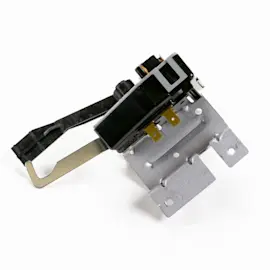
- Dryer start and safety circuits (example: dryer push-to-start switch WE4M416)
- Washer drive system components (example: laundry center washer drive belt WE12X27300)
- Washer lid locking and spin enable (example: washer lid lock WH44X10288)
- Control and diagnostics behavior (example: GE error codes)
Why it matters
Using GUD24ESSM0WW (not just “GE laundry center”) prevents wrong-part returns and helps ensure the washer and dryer operate safely, especially for installation requirements like venting outdoors and closet door ventilation.
Last updated: February 2026
What is the most common problem with a GE dryer?
On the GE GUD24ESSM0WW stacked laundry center, the most common dryer complaint we see is poor drying performance (long dry times or no heat), and the most common root cause is restricted airflow from lint buildup or improper venting. “Won’t start” issues are also common and often trace to power, the door switch, or the start switch.
Quick checks that fix many GE dryer problems
- Clean the lint screen before every load.
- Inspect the exhaust duct for kinks, crushing, or heavy lint buildup.
- Confirm the outside wall damper opens freely when the dryer runs.
- Verify the dryer is plugged in and the outlet is working.
- Check the home fuse or breaker; many electric dryers use two fuses or breakers.
- If the dryer will not start, test the door switch and start switch.
Most common symptoms and what they usually mean
| Symptom | Most likely cause | What to do first |
|---|---|---|
| Tumbles but no heat | One fuse or breaker tripped; heating circuit not fully powered | Reset both breakers or replace both fuses |
| Clothes still damp | Vent restriction; lint screen clogged; duct too long | Clean lint screen and verify venting per the installation guide |
| Won’t start | Power issue; door not sensed closed; failed start switch | Check power, then inspect dryer door switch WE4M415 and dryer push-to-start switch WE4M416 |
| Shakes or noisy | Unit not level; normal vibration; worn drum support parts | Level the unit, then inspect drum support components |
Why venting and airflow matter most
A dryer is designed to move a steady stream of air through the drum and out the exhaust. When airflow is restricted, drying times increase and the dryer can overheat, which can also lead to heat-related component failures. For best performance, rigid metal ducting is recommended, and flexible metal ducting has length limits and installation rules. Use the venting guidance in the installation guide to match the setup to your space.
When to use error codes
If your laundry center is displaying a code or flashing indicators, use the model-specific code list to narrow the problem to a circuit or component before replacing parts. See GE error codes.
Last updated: February 2026