Owner’s manual
 Error Codes



How do you remove the bottom freezer drawer on a Whirlpool refrigerator?
To remove the bottom freezer drawer front on your Whirlpool GI6FARXXF02 bottom-mount refrigerator, open the drawer fully, loosen (do not remove) the four screws that secure the drawer glides to the drawer front, then lift the drawer front up and off the screws. Use the steps and diagrams in the GI6FARXXF02 owner's manual.
- Open the freezer drawer to full extension.
- Locate the four screws attaching the drawer glides to the drawer front (two per side).
- Loosen each screw 3 to 4 turns (leave the screws in the drawer front).
- Lift the drawer front upward and pull it off the screws.
- Support the drawer front with both hands as you lift it off.
- Keep the screws in the drawer front so they do not get lost.
- If the drawer feels stuck, confirm all four screws are loosened evenly.
- Avoid forcing the glides; bending a glide can cause poor drawer alignment.
You will slide the glides out, hang the top of the drawer front on the upper screws, pull the brackets toward you to seat the lower screws, then tighten all four screws.
| Task | What you do | What to avoid |
|---|---|---|
| Remove drawer front | Loosen 4 screws 3 to 4 turns; lift up and off | Removing screws completely (harder to realign) |
| Reinstall drawer front | Seat top screws in slots; seat bottom screws; tighten | Cross-threading or overtightening screws |
Removing the freezer drawer front the correct way protects the drawer glides and helps keep the refrigerator door and freezer drawer aligned, which supports proper sealing and consistent cooling.
Last updated: January 2026
How do I reset my Whirlpool refrigerator not cooling?
For a Whirlpool GI6FARXXF02 refrigerator that’s not cooling, the most effective “reset” is a power cycle: unplug the unit (or switch off the breaker) for about 1 to 5 minutes, then restore power and allow up to 24 hours to reach stable temperatures. Use the recommended control set points in the GI6FARXXF02 owner's manual.
- Unplug the refrigerator or turn off the circuit breaker.
- Wait 1 to 5 minutes (this clears many control glitches).
- Restore power.
- Confirm the temperature controls are turned on and set to the recommended set points.
- Wait 24 hours for the refrigerator to cool completely before judging results (adding food early can slow cooling).
The manual guidance is to check airflow first before changing settings.
- Make sure interior air vents are not blocked by food containers.
- Verify doors close fully and the gaskets seal all the way around.
- Confirm the unit is not in a display or showroom mode (if your control panel has that feature).
- Listen for the evaporator fan and compressor operation after power is restored.
- If the refrigerator will not operate at all, check the outlet with a lamp and reset the household breaker if needed.
| Item | Typical expectation | Why it matters |
|---|---|---|
| Initial cool-down after power restore | Up to 24 hours | Prevents unnecessary part replacement |
| Fresh food temperature | About 33 to 40°F | Food safety and stable cycling |
| Freezer temperature | About 0°F | Ice production and frozen food quality |
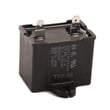
If power cycling and airflow checks do not help, a failed cooling component becomes more likely. For example, a weak start circuit can keep the compressor from starting reliably; the refrigerator run capacitor WPW10662129 is one of the model-specific parts used in the compressor start system.
A “reset” only clears control logic issues. Most no-cool complaints come from airflow restrictions, incorrect control settings, or a cooling-system fault; checking vents and using the recommended set points prevents longer warm-ups and food spoilage.
Last updated: January 2026
What is the bottom part of a refrigerator called?
On a Whirlpool GI6FARXXF02 bottom-mount refrigerator, the “bottom part” is most often called the machine compartment (or lower rear compartment). It houses key cooling components such as the compressor and condenser area, and it typically sits behind the base grille and lower rear cover shown in the GI6FARXXF02 owner's manual.
Depending on where you’re looking, people use different names for the “bottom part”:
- Base grille (toe grille): the front grille near the floor that you pull off for access
- Machine compartment: the enclosed area where cooling-system components sit
- Drain pan: a pan underneath that catches defrost water so it can evaporate
- Leveling legs and brackets: the adjustable feet and mounting points at the bottom of the cabinet
- Freezer drawer area: on bottom-mount models, the freezer compartment is physically at the bottom
Many bottom-mount refrigerators place these items low in the cabinet (often at the back):
| Component | What it does | Example part for GI6FARXXF02 |
|---|---|---|
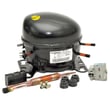
| Compressor | Pumps refrigerant through the sealed system | Refrigerator compressor W10233960 |
| Condenser coil | Releases heat from the refrigerant | Refrigerator condenser WPW10346415 |
| Run capacitor | Helps the compressor start and run | Refrigerator run capacitor WPW10662129 |
Knowing the correct name helps you find the right instructions and parts faster. For example, the manual’s door-removal steps start by having you unplug the refrigerator and remove the base grille, which is the most common access point to the lower cabinet area.
- Unplug the refrigerator or disconnect power first
- Pull the base grille straight toward you (it’s designed to pop off)
- Keep screws and brackets organized if you remove any covers
- Avoid bending tubing or wiring near the compressor area
- If you’re chasing a leak or puddle, check the drain pan and drain path first
Last updated: January 2026
How to tell if a whirlpool fridge compressor is bad?
On a Whirlpool GI6FARXXF02 bottom-mount refrigerator, a bad compressor usually shows up as poor cooling even though the unit has power, runs frequently, or makes unusual buzzing or clicking. Before condemning the compressor, we always rule out power, control settings, airflow, and condenser issues using the GI6FARXXF02 owner's manual.
- Refrigerator and freezer temperatures stay warm even after 24 hours of running
- Compressor area is very hot and you hear repeated clicking (start attempt then stop)
- The refrigerator seems to run almost constantly with little or no cooling improvement
- Lights and display work, but cooling performance is inconsistent
- Circuit breaker trips or the unit loses power repeatedly (after confirming the outlet and breaker are good)
- Confirm power and controls: The manual troubleshooting section recommends checking the grounded outlet, verifying the outlet works with a lamp, and resetting a tripped breaker.
- Clean airflow path: Dirty condenser coils or blocked vents can mimic compressor failure.
- Listen for the evaporator fan: If the fan is not moving air, the refrigerator can warm up even if the compressor is running.
- Look for frost or airflow restriction: Heavy frost behind the evaporator cover can point to a defrost or airflow problem.
- Check the start components: A weak start device or capacitor can prevent the compressor from starting.
| What you notice | More likely cause | What we check next |
|---|---|---|
| Clicking every few minutes, no cooling | Start device or run capacitor | Test/inspect start components, wiring |
| Runs constantly, weak cooling | Dirty condenser, sealed system issue, low airflow | Clean coils, verify fans, check temps |
| No sound from compressor, lights work | Control or power issue | Outlet, breaker, control settings |
If the compressor is not starting or is struggling to start, these model-compatible parts are commonly checked:
A compressor diagnosis affects cost and repair approach. Many “bad compressor” symptoms are actually caused by airflow problems, dirty condenser coils, or a failed start component, so a quick set of checks can prevent replacing major parts unnecessarily.
Last updated: January 2026