Owner’s manual
 View engine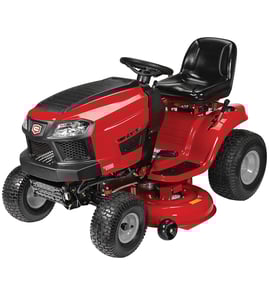



What is the average lifespan of a riding lawn mower?
A typical riding lawn mower lasts 10 to 15 years, which often works out to roughly 500 to 2,000+ engine hours with normal residential use and consistent maintenance. For your Craftsman 247203725 tractor, lifespan depends most on maintenance, mowing conditions, and how hard the deck and drive system are worked; use the Craftsman 247203725 owner's manual for the exact service intervals.
What most affects lifespan
- Maintenance frequency: oil changes, air filter cleaning/replacement, and fresh fuel habits
- Mowing conditions: steep hills, heavy weeds, wet grass, and dusty conditions shorten life
- Deck load: running the blades in tall grass stresses belts, spindles, and pulleys
- Storage: covered, dry storage reduces corrosion and electrical issues
- Operator habits: avoiding impacts (roots, curbs) protects the deck housing and steering
Hours vs. years: what “average” looks like
| Usage pattern | Typical hours per year | Typical lifespan outcome |
|---|---|---|
| Light residential | 25 to 50 | Often 12 to 15 years |
| Average residential | 50 to 100 | Often 10 to 15 years |
| Heavy residential / large property | 100 to 200+ | Often 5 to 10 years |
Maintenance habits that extend life
- Change engine oil and replace filters on schedule
- Keep the cooling fins and engine area free of grass and debris
- Maintain correct tire pressure to reduce deck scalping and drivetrain strain
- Keep the mower deck level and blades sharp to reduce load
- Replace worn deck belts before they slip or overheat; the lawn tractor blade drive belt 954-04060C is a common wear item on many deck systems
Why it matters
Most “early failures” on riding mowers come from heat, dirt, stale fuel, and overloading the cutting deck. Staying ahead of routine service protects expensive assemblies like the transaxle, mandrel/spindle assemblies, and wiring.
Last updated: January 2026
What riding mower has the least problems?
If your goal is the fewest problems over time, we recommend focusing on proven reliability signals rather than a single “best” brand. For a Craftsman tractor like model 247203725, the lowest-trouble choice is typically the mower that matches your yard size and is maintained on schedule per the 247203725 owner's manual.
What to look for in a low-problem riding mower
These factors reduce breakdowns and nuisance issues (no-starts, belt failures, uneven cutting, premature battery wear):
- Dealer and parts support: easy access to OEM parts, blades, belts, and service.
- Simple drivetrain and controls: fewer electronic features usually means fewer failure points.
- Deck design and belt routing: better belt alignment reduces slipping and shredding.
- Engine maintenance access: easy oil changes and air filter service improves longevity.
- Safety interlock reliability: consistent start/run behavior when switches are adjusted correctly.
Reliability comparison: what “least problems” usually means
Use this as a practical way to compare lawn tractors and zero-turn mowers when shopping.
| What you compare | Lower-problem choice | Why it helps |
|---|---|---|
| Complexity | Fewer electronic add-ons | Less to diagnose and replace |
| Maintenance schedule | Clear, easy intervals | Prevents most no-start and cut-quality issues |
| Parts availability | Common belts, switches, spindles | Faster repairs, less downtime |
| Fit for yard | Correct deck size and power | Reduces strain on belts and mandrels |
Maintenance items that prevent the most common “problems”
On Craftsman lawn tractors, many “problems” are wear items that become symptoms when overdue.
- Inspect and replace the deck belt when it’s glazed, cracked, or slipping; the lawn tractor blade drive belt 954-04060C is a common deck-drive wear item.
- Keep battery terminals clean and tight; weak connections mimic starter or solenoid failure.
- Check safety switches if starting is inconsistent; a worn interlock can cause no-crank or sudden shutoff.
- Level the mower deck and keep blades sharp to avoid vibration and uneven cutting.
- Clean cooling fins and keep the air filter serviced to prevent hard starting and power loss.
Why it matters
“Least problems” usually comes from matching the mower to the job and staying ahead of wear parts. Belts, mandrels, and safety interlocks are designed to be serviceable; replacing them early prevents bigger failures and reduces downtime during mowing season.
Last updated: January 2026
How do I find the model number on my 247203725?
Your Craftsman riding mower model number is printed on the product identification label (model/serial tag) attached to the tractor frame. On model 247203725, check common tag locations first, then confirm the exact characters against the diagrams in the owner's manual.
Where to look on a Craftsman riding mower
Check these spots in order; the tag is usually a sticker or metal plate:
- Under the seat pan or on the seat bracket (lift the seat)
- On the frame rail near the engine compartment
- Under the hood near the dash or steering column support
- Near the rear fender or above the transaxle area
- On the mower deck shell (less common for the tractor model tag)
What the label should show
You are looking for a model number and usually a serial number. For parts lookup, the model number is the key.
| Label item | What it’s used for | Example format |
|---|---|---|
| Model number | Matching diagrams and ordering parts | 247203725 |
| Serial number | Identifying production run details | Letters and numbers |
| Date code (if shown) | Helps confirm version | Varies |
Tips to avoid ordering the wrong parts
Once you find the tag, copy the model number exactly as printed.
- Write it down character-for-character (including any dashes or suffixes)
- Take a clear photo before the label fades further
- Use the model number to match parts like the deck belt and electrical switches
- If the label is worn, compare the tractor’s diagrams and assemblies in the manual
Why it matters
Craftsman tractors can look similar across multiple model numbers, but parts like the blade drive belt, ignition switch, and wire harness can vary by version. Using the exact model number keeps the fit correct and prevents returns.
Last updated: March 2026