 Installation guide
 Owner’s manual
 Error Codes



Are Bosch dishwashers a standard size?
Yes, Bosch dishwashers are generally built to fit standard residential openings; for Bosch model SHE53TF5UC, the installation guide shows a typical built-in cutout width range of 23 5/8 to 24 1/4 inches (600 to 616 mm). Always confirm your cabinet opening and utility clearances before ordering parts or installing.
What “standard size” means for SHE53TF5UC
Most built-in dishwashers in the U.S. are designed around a 24-inch class opening. For SHE53TF5UC, the installation guide calls out key fit targets you should verify using the SHE53TF5UC installation guide.
- Cutout width is shown as 23 5/8 to 24 1/4 inches
- The opening should be square and enclosed by cabinetry
- Plan a location close to the sink for easier water and drain routing
- The drain hose must be routed with a high loop (or air gap where required)
- Leave enough clearance to fully open the door, especially in a corner
Quick fit checklist (measure before you install)
Use a tape measure and check these items in your kitchen:
- Opening width at the front and back
- Opening height under the countertop
- Depth to the back wall, including any baseboard or trim
- Space for the water supply line, drain hose, and power connection
- Door swing clearance to nearby walls or cabinet doors
Common “standard” dishwasher sizes (for comparison)
| Dishwasher type | Typical nominal width | Common use |
|---|---|---|
| Full-size built-in | ~24 in | Most U.S. kitchens |
| Compact built-in | ~18 in | Smaller kitchens, apartments |
Why it matters
A dishwasher that is even slightly too wide (or an opening that is out of square) can cause installation problems like rubbing doors, misaligned mounting brackets, and vibration noise. Confirming the cutout range for SHE53TF5UC helps avoid rework and protects hoses and wiring.
Last updated: January 2026
Can I still use my appliance with an E22 error?
We do not recommend running your Bosch SHE53TF5UC dishwasher while an E22 error is showing because that code is commonly tied to a drain-flow restriction; continuing to use it can leave dirty water in the tub and reduce cleaning performance. Use the guidance in the SHE53TF5UC use & care manual and clear the restriction first.
What E22 usually means on Bosch dishwashers
E22 is most often related to restricted water flow through the filter area or sump, which can prevent proper draining and circulation.
Common causes include:
- Food debris blocking the filter assembly
- Standing water and debris in the sump area
- A restriction in the drain path (hose, check valve, or pump area)
- A drain pump that is jammed or failing
What to do before you run another cycle
Turn off power to the dishwasher at the breaker before checking internal components.
Start with these steps:
- Remove and rinse the filters; clean any trapped debris
- Check the sump area under the filters for glass, labels, or bones
- Verify the drain hose is not kinked and the sink connection is not blocked
- If you have a disposer, confirm the dishwasher inlet plug was removed
- Run a cancel/drain function after cleaning to see if it clears
Parts that may be involved (if cleaning does not fix it)
If the error returns after thorough cleaning, these model-compatible parts are commonly involved in drain issues:
| Symptom you notice | Likely area to inspect | Model-compatible part example |
|---|---|---|
| Water remains in tub | Drain pump area | Dishwasher drain pump 00620774 |
| Slow or incomplete draining | Drain path restriction | Dishwasher drain hose 00744881 |
| Drains then backflows | Backflow prevention | Dishwasher check valve 00611320 |
Why it matters
E22 is a performance and water-handling issue. Clearing it protects wash quality, helps prevent odors from standing water, and reduces the chance of a mid-cycle stop caused by poor draining.
For more code-specific guidance, we also recommend reviewing Bosch dishwasher error codes.
Last updated: January 2026
What is the most common problem with a Bosch dishwasher?
On the Bosch SHE53TF5UC, the most common issue we see is a drain problem: water left in the tub because the filter area is clogged, the drain hose is kinked or installed incorrectly, or the drain pump cannot move water. Start with cleaning and checking the drain path.
Quick checks we recommend first
- Cancel the cycle and let the unit attempt to drain; listen for the drain pump running.
- Remove and clean the filter area in the bottom of the tub.
- Check the sink drain/disposer for a blockage (and confirm the disposer inlet plug was removed if newly installed).
- Inspect the drain hose for kinks, crushing, or a sag that traps water.
- Confirm the drain hose routing meets the high-loop requirement shown in the SHE53TF5UC installation guide.
Parts that commonly relate to “won’t drain” symptoms
If cleaning and hose routing do not fix it, these model-compatible parts are often involved:
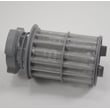
- Dishwasher fine filter 00751458 (clogged filter restricts water flow to the pump)
- Dishwasher drain hose 00744881 (kinked, split, or restricted hose)
- Dishwasher drain pump 00620774 (pump runs noisy, jams, or fails to move water)
- Dishwasher check valve 00611320 (stuck valve can prevent proper draining)
Symptom-to-cause guide (fast triage)
| What you notice | Most likely cause | What to do next |
|---|---|---|
| Standing water after cycle | Clogged filter or blocked drain path | Clean filter area; check hose routing |
| Hums but drains slowly | Pump jam or restriction | Check for debris; inspect drain pump |
| Drains into sink then returns | No high loop or check valve issue | Correct hose routing; check valve |
| No fill plus no drain progress | Control sensing issue or fill problem | Check for error codes; verify water supply |
Why it matters
A restricted drain path can trigger error codes, leave odors, and reduce wash performance because dirty water recirculates. Fixing the drain path early also helps protect the drain pump and check valve from damage.
Last updated: January 2026





