Owner’s manual
 Error Codes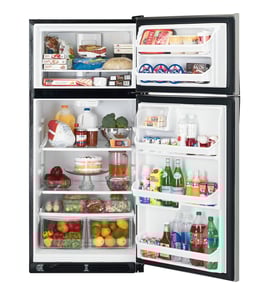



How to tell cubic feet of Kenmore refrigerator by model number?
For Kenmore model 2537480240G, the model number alone usually does not state the exact cubic-foot capacity. The most reliable way is to look up the capacity in the specifications section of the 2537480240G owner's manual; if you need a quick estimate, calculate interior volume from measurements and convert cubic inches to cubic feet.
Best ways to find the cubic feet
- Check the manual specs: Look for “capacity” or “total volume” in the specifications section of the 2537480240G owner's manual.
- Search the rating label: The label inside the fresh food compartment (often on a side wall or near the crisper area) sometimes lists capacity along with model and serial.
- Measure and calculate (estimate): Measure usable interior space and convert to cubic feet.
- Use the 253 prefix correctly: On Kenmore models starting with 253, the prefix identifies the manufacturing source family, not the capacity.
How to estimate cubic feet by measuring
- Empty the compartment enough to measure.
- Measure width x depth x height (in inches) of the usable interior space.
- Multiply to get cubic inches.
- Divide by 1,728 to convert to cubic feet.
Quick conversion table
| What you have | What to do | Result |
|---|---|---|
| Inches (W x D x H) | Multiply | Cubic inches |
| Cubic inches | Divide by 1,728 | Cubic feet (approx.) |
Why it matters
Knowing cubic feet helps us match the right refrigerator parts and accessories (like shelves, bins, and door storage) and it also helps when comparing energy use and storage needs across top-mount refrigerators.
Last updated: January 2026
What is the difference between top mount and bottom mount refrigerators?
A top-mount refrigerator like Kenmore 2537480240G has the freezer on top and the fresh-food section below; a bottom-mount flips that layout so the refrigerator compartment is at eye level. Bottom-mount models typically cost more, but can be more convenient for everyday fresh-food access.
Quick comparison
| Feature | Top-mount (top freezer) | Bottom-mount (bottom freezer) |
|---|---|---|
| Freezer location | Top | Bottom |
| Fresh-food access | Lower, more bending | Higher, less bending |
| Typical price | Lower | Higher |
| Common freezer style | Swing door | Pull-out drawer or swing door |
Which style is better for you?
We recommend choosing based on how you use your refrigerator day to day:
- If you use the freezer often (frozen meals, ice storage), a top-mount keeps it at eye level.
- If you use fresh food most (produce, drinks, leftovers), a bottom-mount reduces bending.
- If you want a simpler, budget-friendly layout, top-mount models are a strong fit.
- If you want easier organization in the freezer, many bottom-mount designs use a drawer system.
- If you are comparing capacity, focus on usable shelf and bin layout, not just total cubic feet.
What stays the same (and what to check)
Both styles use the same core refrigeration system (compressor, evaporator, condenser) and both rely on good airflow and door sealing to hold temperature.
Check these items in your 2537480240G owner's manual:
- Recommended temperature settings for refrigerator and freezer
- Airflow guidance (don’t block vents with food packages)
- Shelf and bin configuration options
Why it matters
The freezer location changes your daily ergonomics and how you organize food. Choosing the layout that matches your habits helps reduce door-open time, improves temperature stability, and can cut down on frost, odors, and food waste.
Last updated: January 2026
What is the top part of a fridge called?
On the Kenmore 2537480240G top-mount refrigerator, the top compartment is the freezer. It’s designed to keep foods frozen, support proper cold-air circulation, and (on some setups) supply ice through an ice maker or ice trays; see the 2537480240G owner's manual.
What the freezer does (and what to store there)
The freezer’s job is to hold temperatures low enough to keep food safely frozen and to help the refrigerator maintain stable cooling.
- Freeze and store meats, vegetables, and prepared meals long-term
- Keep ice cream and juice in the freezer interior for steadier temperatures
- Allow cold air to circulate by leaving space between packages
- Avoid overloading with warm food, which slows freezing and can warm frozen items
Freezer vs. refrigerator: quick comparison
| Compartment | Typical use | Best practice |
|---|---|---|
| Freezer (top) | Long-term frozen storage | Don’t overload; leave airflow gaps |
| Refrigerator (bottom) | Fresh food storage | Don’t block vents; keep doors sealing well |
Why it matters
Knowing the freezer is the top section helps when you’re troubleshooting temperature issues, organizing food for consistent freezing, or checking parts tied to freezing and ice production.
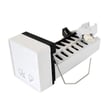
If you’re dealing with ice production issues, an ice maker component such as the ice maker mold 241798231 can be involved, depending on your configuration.
Last updated: January 2026
What size is a Kenmore refrigerator model 2537480240G?
Kenmore refrigerator model 2537480240G is a top-mount (top freezer) refrigerator. For the exact height, width, and depth for your specific unit, use the dimension and clearance information in the 2537480240G use & care guide.
How to get the right dimensions (cabinet vs. installed)
Measure the refrigerator itself and the space where it will sit; both matter for fit, door swing, and airflow.
- Measure width at the widest cabinet point (not the wall opening)
- Measure height from floor to the top (include hinge cover if it sits above the cabinet)
- Measure depth two ways: cabinet only, then to the front of the handle
- Confirm door swing clearance so doors and bins open fully
- Leave ventilation space behind and above as specified in the manual
Quick planning table
Use this to record what you find so you can compare it to your kitchen opening.
| What to record | How to measure | Why it matters |
|---|---|---|
| Width | Side to side at cabinet | Fit between cabinets/walls |
| Height | Floor to top/hinge cover | Fit under cabinets/soffit |
| Depth (cabinet) | Back to front edge | Counter depth planning |
| Depth (with handle) | Back to handle front | Door and walkway clearance |
Why it matters
Accurate sizing prevents installation problems like doors hitting walls, restricted airflow that reduces cooling performance, and damage to flooring or cabinetry when sliding the refrigerator into place.
If you are measuring because a door is not sealing
A poor seal can make the refrigerator seem like it is “not holding temperature.” If the gasket is torn, hardened, or pulling away from the liner, replacing it is a common fix; see refrigerator gasket 242193213.
Last updated: January 2026