Error Codes


Are bottom mount fridges better?
A bottom-mount refrigerator like the GE PYE22PSKNSS is “better” when you use the fresh-food section most often; it keeps everyday items at eye level and puts the freezer down low. If you access frozen foods frequently, a top-freezer layout can feel more convenient.
What “better” usually means in daily use
- Less bending for fresh food: produce, drinks, and leftovers are easier to reach.
- Improved organization: wide shelves and door bins are easier to see at a glance.
- Freezer access tradeoff: you bend more for frozen items and lower drawers.
- Often more features: many bottom-mount models include advanced ice and water systems.
- Space planning matters: door swing and drawer clearance can affect tight kitchens.
Quick comparison: bottom-mount vs top-freezer
| Feature | Bottom-mount (like PYE22PSKNSS) | Top-freezer |
|---|---|---|
| Fresh food access | Best (eye level) | Good (lower) |
| Freezer access | Lower drawer, more bending | Best (eye level) |
| Organization | Typically easier to see | Typically simpler |
| Typical cost | Usually higher | Usually lower |
When a bottom-mount is the right choice
Choose a bottom-mount if most of your daily opens are for:
- milk, drinks, and condiments
- fresh produce and deli items
- leftovers and meal prep containers
If you rely heavily on frozen foods, a top-freezer can be the more comfortable layout.
Why it matters
Refrigerator layout affects comfort and efficiency. When the section you use most is easiest to reach, you spend less time with the door open, which helps temperature stability and reduces wear on cooling components.
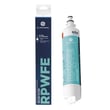
If you are comparing features (ice maker, water filtration, dispenser performance), we recommend reviewing common maintenance items for this model, such as the GE refrigerator water filter RPWFE.
Last updated: February 2026
What is the most common problem with GE PYE22PSKNSS refrigerators?
The most common issues we see on the GE PYE22PSKNSS bottom-mount refrigerator are ice maker problems (no ice, slow ice, clumping or frost) and temperature complaints (fresh food section warming up while the freezer stays cold). These are usually tied to airflow, ice buildup, or a failing sensor, fan, or control.
Most common symptoms (and what they usually point to)
- Ice maker not making ice or slow production: restricted water flow, ice maker failure, or dispenser-side issues
- Fresh food warm, freezer OK: weak or failed fresh food fan, airflow blockage, or temperature sensing problem
- Frost buildup or noisy fan: defrost system trouble or ice contacting the fan blade
- Water dispenser weak or not dispensing: clogged filter or inlet valve problem
- Lights out or flickering: LED light assembly issue
Quick checks we recommend first
- Confirm doors are sealing and closing fully (warm air leaks cause frost and poor cooling).
- Set temperatures to typical targets: 37°F fresh food and 0°F freezer; wait 24 hours for stabilization.
- If ice or water is weak, replace the filter and purge air from the lines.
- Listen for the fresh food fan; if it is not running, cooling in the refrigerator section will suffer.
- If the unit shows an error, use GE refrigerator error codes to narrow the failure area.
Common parts involved on this model
| Problem area | What fails most often | Example part for PYE22PSKNSS |
|---|---|---|
| Temperature sensing | Thermistor reads wrong temp | Refrigerator temperature sensor WR55X10025 |
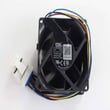
| Air circulation | Fan not moving cold air | Refrigerator fresh food fan motor assembly WR60X35205 |
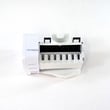
| Ice production | Ice maker stops cycling | Ice maker WR30X28731 |
| Water flow | Filter clogged | GE refrigerator water filter RPWFE |
| Defrost | Ice buildup from defrost failure | Refrigerator defrost heater WR51X10132 and refrigerator defrost bi-metal thermostat WR50X10108 |
Why it matters
Ice maker and cooling complaints often share the same root cause: restricted airflow or incorrect temperature feedback. Fixing the underlying airflow, defrost, or sensing issue prevents repeat failures and helps food stay at safe temperatures.
Related DIY help
- For ice and water dispenser teardown and common failure points, use how to disassemble the ice and water dispenser on a GE refrigerator.
- For filter replacement steps and correct filter type, use how to replace the water filter in a GE refrigerator.
Last updated: February 2026
How do I find the model number on my PYE22PSKNSS?
Your GE bottom-mount refrigerator’s model number is printed on the appliance’s rating label; on model PYE22PSKNSS, it’s typically inside the fresh food compartment on a side wall or near the ceiling. Match that label exactly when ordering parts.
Where to look on a GE bottom-mount refrigerator
Check these common label locations first:
- Inside the refrigerator section on the left or right side wall (often near the crisper area)
- On the ceiling of the fresh food compartment near the lights
- Along the door frame (hinge side) when the refrigerator door is open
- Behind the crisper drawers on the liner wall
- On a removable kickplate area (less common on this style)
What the label should show
The rating label usually includes more than just the model number. Use the model number for diagrams and part fit, and keep the other numbers for reference.
| Label item | What it’s used for |
|---|---|
| Model number (PYE22PSKNSS) | Finding the correct parts list and diagrams |
| Serial number | Identifying production run and date |
| Electrical ratings | Verifying power requirements |
Tips to avoid ordering the wrong part
Model numbers must match character-for-character. Before you buy a water filter, ice maker, or sensor, confirm the exact model number on the label.
- Write it down exactly as shown (letters, numbers, and any suffix)
- Use the full model number when selecting parts like the GE refrigerator water filter RPWFE
- If the label is hard to read, take a clear photo and zoom in
- If you replaced doors, always use the cabinet label (not a sticker on a door)
Why it matters
GE uses similar-looking platforms across multiple refrigerator models; a single character difference can change the correct ice maker, door gasket, control board, or water filter fit.
For more help identifying the right number format, use how to find your appliance model number (and what it means for parts).
Last updated: March 2026