 Owner’s manual


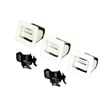
How do I remove the front panel of my Kenmore dryer?
To remove the front panel on your Kenmore dryer model 11064972301, we start by disconnecting power, then releasing the top (clips or screws), removing the front-panel mounting screws (often inside the door opening and along the top edge), and lifting the panel up and off while supporting any attached wiring.
Before you start (safety and prep)
- Unplug the dryer (or switch off the breaker) before opening any panels.
- Let the dryer cool completely if it was recently running.
- Wear cut-resistant gloves; cabinet edges can be sharp.
- Have a small container ready for screws.
- Take a quick photo of wire connections before disconnecting anything.
For model-specific panel fastener locations and any wiring notes, use the 11064972301 owner's manual.
Front panel removal steps (typical for Kenmore 110 series)
- Disconnect power.
- Open the top:
- If your dryer has spring clips, slide a putty knife under the front corners of the top and push in to release.
- If it uses screws, remove the screws at the back of the top panel, then lift the top.
- Remove front-panel screws:
- Look for screws along the top inside edge of the front panel.
- Remove screws in/near the door opening that secure the front panel to the cabinet.
- Disconnect wiring (if present):
- Unplug the door switch harness if it is attached to the front panel.
- Lift the front panel off:
- Tilt the panel slightly forward, then lift up to unhook it from the lower retaining tabs.
What you can access once the front panel is off
| What you’re fixing | Common symptom | Related part for this model |
|---|---|---|
| Door won’t start dryer | No run when door is shut | Dryer door switch WP3406107 |
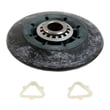
| Squealing or thumping | Loud noise as drum turns | Support WPW10314173 |
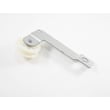
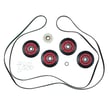
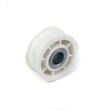
| Belt tension issue | Drum not turning, squeal | Dryer idler pulley 279640 |
Why it matters
Removing the front panel correctly prevents broken plastic tabs, stripped screw holes, and damaged door-switch wiring. It also gives you safe access to high-wear items like the drum support roller, idler pulley, and blower area.
Last updated: February 2026
How do I tell what model my Kenmore dryer is?
Your Kenmore dryer’s model number is printed on the model and serial number label; on model 11064972301, that label is located at the top inside the dryer door well. Write down the full model number and serial number so you can match the correct parts and specifications in the 11064972301 owner's manual.
Where to look on Kenmore model 11064972301
Check these spots in this order:
- Top inside the dryer door well (most common for this model)
- Around the door opening on the cabinet frame
- The rear panel (less common, but possible)
- Near the lint screen housing (on some Kenmore designs)
What the model number tells you
Kenmore model numbers help identify the platform and the correct parts list.
| What you see | What it means | Why it matters |
|---|---|---|
| Full model number (example: 11064972301) | Exact dryer identity | Ensures parts fit and wiring matches |
| Serial number | Production identifier | Helps with service history and correct revisions |
| “110” prefix | Common Kenmore platform identifier | Narrows down compatible components |
Tips to record it correctly
Use these quick checks so you do not miss a digit:
- Copy the model number exactly as printed (no spaces)
- Take a clear photo before ordering parts
- Record the serial number next to the model number
- Keep the info with your purchase paperwork
Why it matters
Using the exact model number prevents ordering the wrong dryer parts (like a heating element, door switch, or timer) and helps you follow the correct troubleshooting and cycle information for your specific Kenmore dryer.
Last updated: February 2026
Where is the filter on a Kenmore dryer?
On Kenmore dryer model 11064972301, the “filter” is the lint screen; you’ll find it at the dryer door opening (right at the front of the drum area). Pull it out before each load, clean off lint, then push it firmly back into place (see the 11064972301 owner's manual).
How to find it fast
- Open the dryer door.
- Look along the front opening where clothes go in.
- Locate the lint screen handle and pull the screen straight out.
- Remove lint with your fingers.
- Reinstall the screen fully seated before starting the dryer.
Cleaning and care (what we recommend)
For normal use, clean the lint screen every load. For residue buildup (often from dryer sheets), wash it occasionally.
- Roll lint off with your fingers.
- If you see a film, wet both sides with hot water.
- Scrub with a nylon brush and a little liquid detergent.
- Rinse with hot water.
- Dry the screen completely, then reinstall.
Quick troubleshooting if the screen won’t sit right
If the lint screen feels loose, won’t slide in smoothly, or pops up, check these common causes:
- Lint packed in the lint screen housing or air duct
- Screen frame bent or warped
- Debris caught at the front lip of the opening
- Screen installed backwards or not fully seated
- Damaged screen that no longer fits the opening (replace the lint screen if needed; for this model, the listed part is screen W10120998)
What “filter location” means on most Kenmore dryers
| What people call it | What it actually is | Where it is |
|---|---|---|
| Filter | Lint screen | At the dryer door opening |
| Vent filter | Exhaust venting path | Behind the dryer and in the home vent run |
| Internal lint | Lint inside cabinet/duct | Inside the dryer cabinet and exhaust ducting |
Why it matters
A clean, properly seated lint screen helps airflow, drying performance, and temperature control. A clogged screen or restricted venting is one of the most common reasons a dryer takes too long to dry.
Last updated: February 2026









