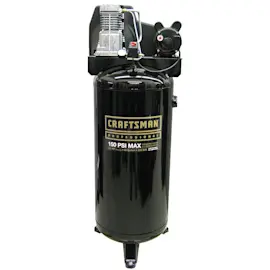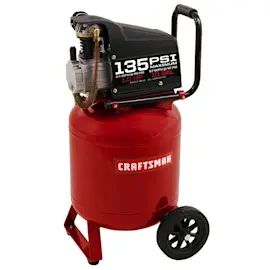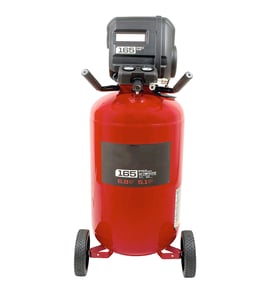

How many PSI is a good air compressor?
A “good” PSI depends on the tool you want to run. For most home and shop air tools, we look for a compressor that can deliver about 90 PSI at the tool (with the tank pressure typically higher), and enough CFM at 90 PSI to keep up. Your Craftsman 106175540 twin-cylinder tank-type air compressor is designed for regulated tool pressure, not maximum tank pressure.
Quick PSI targets by common use
- Brad/finish nailers, staplers: 70 to 100 PSI
- Inflation (tires, balls, blow gun): 30 to 50 PSI (often less)
- Impact wrench, ratchet, die grinder: 90 PSI (tool inlet), with adequate CFM
- HVLP spray (varies by gun): commonly 20 to 50 PSI at the gun, but higher supply pressure may be needed depending on the regulator and gun specs
- Sanders and continuous-use tools: 90 PSI, but CFM is the real limiter
PSI vs CFM (what matters more)
PSI is the pressure; CFM is the airflow that actually powers the tool. If PSI is fine but CFM is low, the tool will slow down, the compressor will run constantly, and pressure will sag.
| What you’re choosing | What it affects most | Rule of thumb |
|---|---|---|
| PSI (regulated) | Whether the tool reaches rated power | Match the tool’s required PSI |
| CFM @ 90 PSI | Whether the tool can run continuously | Meet or exceed the tool’s CFM |
| Tank size (gallons) | How long you can run before pressure drops | Bigger tank = longer bursts |
How we set a “good” PSI on the compressor
- Set the regulator to the tool’s required PSI (many tools are rated at 90 PSI).
- Confirm the tool has a clean, dry air supply (use a filter/regulator if needed).
- Use a hose size that fits the tool demand (small hoses can cause pressure drop).
- For continuous tools, choose based on CFM @ 90 PSI, not tank PSI.
Why it matters
Running too low a PSI reduces performance; running too high can damage tools, waste air, and increase leaks. Correct regulated PSI plus adequate CFM gives steady power and longer compressor life.
For help identifying the exact model number on the unit before ordering parts, use how to find your appliance model number (and what it means for parts).
Last updated: February 2026
How to tell if an air compressor pressure switch is bad?
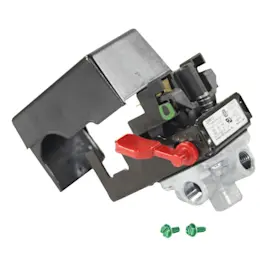
A bad pressure switch on your Craftsman 106175540 twin-cylinder tank-type air compressor shows up as incorrect cut-in or cut-out behavior: the motor will not start, will not stop, or will short-cycle. You may also hear constant air bleeding at the unloader line and see unstable tank pressure.
Quick symptoms checklist
- Motor will not start even though tank pressure is low
- Motor will not shut off and runs past normal cut-out pressure
- Rapid on/off cycling (short cycling)
- Air leaks continuously from the unloader valve or unloader line after the motor stops
- Burnt smell, buzzing, clicking, or visible heat damage at the switch housing
- Breaker trips when the compressor tries to start
Simple tests we use (safe, basic checks)
- Power off and unplug the compressor; let it cool.
- Drain the tank to 0 PSI using the tank drain valve.
- Plug in and turn the unit on.
- If the motor still does not start, the issue is often the pressure switch, power cord, on/off switch, motor, or capacitor.
- If it starts, watch the shutoff behavior.
- A healthy switch reaches cut-out and stops the motor cleanly.
- A bad switch may never open (keeps running) or may open too early (stops at low pressure).
What the unloader leak tells you
After the motor stops, a brief hiss is normal as the unloader releases head pressure. If air keeps leaking steadily, the pressure switch may not be actuating the unloader correctly, or the unloader/check valve system is not sealing.
| What you observe | Most likely direction | What to check next |
|---|---|---|
| Won’t start at low PSI | Switch not closing, electrical supply issue | Outlet, cord, switch contacts, wiring condition |
| Won’t shut off | Switch contacts stuck closed | Switch mechanism, pressure sensing port for blockage |
| Short cycles | Incorrect sensing or failing contacts | Pressure line to switch, vibration-loosened terminals |
| Constant unloader leak | Unloader not resetting or check valve leak | Unloader linkage, tank check valve |
Why it matters
The pressure switch controls motor start/stop based on tank pressure. When it fails, the compressor can overrun, trip breakers, or struggle to restart, which increases wear on the motor, pump, and electrical components.
Helpful DIY reference
For safe electrical troubleshooting steps (like checking continuity and connections), use our guide: how to use a multimeter to test electrical parts video.
Last updated: February 2026
Is a 20 gallon air compressor big enough for air tools?
Yes; a 20-gallon compressor is big enough for many common air tools in a home garage, especially when you use tools in short bursts. For a Craftsman twin-cylinder tank-type air compressor like model 106175540, the real limiter is usually CFM at 90 PSI (airflow), not tank size.
What a 20-gallon tank handles well
A 20-gallon tank gives you a useful air reserve so the pump does not need to run every second. It typically works best for intermittent-demand tools such as:
- Brad and finish nailers
- Staplers and blow guns
- Tire inflators and air chucks
- Small impact wrenches (short bursts)
- Light-duty spray work (small panels, touch-ups)
Tools that can overwhelm a 20-gallon setup
High-demand tools need steady airflow. With these, a 20-gallon tank often means frequent pressure drop and recovery time:
- Die grinders and cutoff tools
- Dual-action (DA) sanders
- HVLP spray guns for continuous painting
- Air hammers used continuously
- Larger impact wrenches used nonstop
Quick sizing rule: match CFM to the tool
Use this as a practical way to decide if your compressor is “big enough” for a specific tool.
| Tool type | Typical demand (CFM @ 90 PSI) | 20-gallon result |
|---|---|---|
| Nailers / inflators | 0.5 to 3 | Works well |
| Impact wrench (light use) | 4 to 6 | Usually OK in bursts |
| DA sander / die grinder | 8 to 12+ | Often struggles |
Why it matters
If the compressor cannot keep up with the tool’s CFM demand, pressure drops, tool performance falls off (weak impacts, slow sanding, uneven spray), and the motor cycles more often, which increases heat and wear.
Best practices to get more usable air
- Set the regulator correctly for the tool; do not run higher PSI than needed.
- Use a larger diameter hose (often 3/8-inch) for higher-flow tools.
- Fix leaks at quick-connects, fittings, and the drain valve.
- Drain tank moisture regularly to protect the tank and air tools.
- For continuous-use tools, plan on work-rest cycles so the pump can recover.
For help confirming you have the correct model and parts list before you buy anything, use how to find your appliance model number (and what it means for parts).
Last updated: February 2026
What is the most common cause of air compressor failure?
The most common cause of failure on a Craftsman 106175540 twin-cylinder tank-type air compressor is poor preventive maintenance, especially dirty intake filtration and lubrication issues that accelerate wear. A close second is overheating, usually caused by restricted airflow, long run times, or cooling problems.
What “maintenance-related failure” usually looks like
These are the patterns we see most often when an air compressor starts failing:
- Clogged or dirty air intake filter: the pump runs hotter and wears faster
- Low, dirty, or wrong oil (oil-lubricated pumps): bearings and cylinder walls wear quickly
- Moisture left in the tank: internal rust, debris, and valve problems
- Air leaks at fittings, hose connections, or the tank check valve: longer run time and heat buildup
- Worn reed valves or valve plate issues: low output, slow recovery, hard starting
- Electrical stress (weak capacitor, failing pressure switch, loose wiring): intermittent starts or tripped breakers
Quick checks that prevent most breakdowns
Use this short routine to catch the common causes early:
- Drain the tank after each use (or at least daily in humid conditions)
- Keep the intake area clear; do not block cooling airflow around the pump and motor
- Inspect the air filter regularly; replace or clean it when it looks dirty
- Listen for leaks after shutoff; hissing usually means a fitting, unloader, or check valve issue
- Verify the power supply is correct; avoid long, undersized extension cords
Troubleshooting guide: symptom to likely cause
| Symptom | Most likely cause | What to do first |
|---|---|---|
| Runs hot, shuts off | Restricted airflow, dirty filter, long duty cycle | Clear vents, check filter, reduce run time |
| Runs but builds pressure slowly | Air leak, worn valves, clogged filter | Leak test fittings, inspect filter |
| Won’t start, hums | Low voltage, bad capacitor, stuck pump | Check outlet/cord, then test electrical parts |
| Cycles frequently | Leak or pressure switch setting issue | Find leaks, verify cut-in/cut-out behavior |
Why it matters
Heat and contamination are what destroy compressors. When the pump runs hot or without clean air and proper lubrication, internal wear accelerates fast, and small issues (like a dirty filter or minor leak) turn into major pump or motor damage.
Helpful DIY reference
For electrical-related no-start issues, we use a meter to confirm power and component health; see how to use a multimeter to test electrical parts video.
Last updated: February 2026