Owner’s manual
 Error Codes

Why is there ice on the bottom of my freezer side by side?
Ice on the freezer floor is almost always caused by a defrost drain problem: meltwater cannot flow down the drain, so it refreezes into a sheet of ice at the bottom. On Kenmore model 79578406800, start by clearing the drain path and confirming airflow is not blocked (blocked vents can worsen moisture and icing). See the owner's manual for vent locations and airflow guidance.
Most common causes
- Defrost drain clogged with ice, food debris, or sludge
- Drain tube restricted or misrouted, causing water to back up and freeze
- Door left slightly open or gasket not sealing, adding excess moisture
- Air vents blocked by packages, reducing proper circulation (Multi-Flow)
What we recommend (safe, practical steps)
- Unplug the refrigerator and remove food from the freezer floor area.
- Melt the ice on the freezer bottom using a hair dryer on low or by placing towels and letting it thaw (do not chip ice with sharp tools).
- Flush the drain with hot water. A common method is 1 teaspoon baking soda dissolved in 2 cups hot water, then slowly pour into the drain opening.
- Confirm airflow: keep packages away from vents so cold air can circulate properly between freezer and fresh food sections.
- If water still returns and refreezes, replace the drain tube: refrigerator drain tube 5251JA3003D.
Quick diagnosis table
| Symptom | What it usually means | What to do next |
|---|---|---|
| Ice sheet on freezer floor | Drain not draining | Thaw and flush drain; check drain tube |
| Water pooling then freezing again | Drain tube still restricted | Replace drain tube; re-check routing |
| Frost buildup plus warm spots | Airflow blocked or door not sealing | Clear vents; inspect door seal |
| Interior moisture buildup | Doors opened often or vents blocked | Improve loading habits; clear vents |
Why it matters
A clear defrost drain prevents recurring ice buildup, protects the freezer drawer area from sticking, and helps the refrigerator maintain stable temperatures by keeping moisture where it belongs.
Last updated: February 2026
How to reset Kenmore bottom freezer ice maker?
On the Kenmore 79578406800 bottom-mount refrigerator, the practical way to “reset” the ice maker is to power-cycle the refrigerator and then restart ice production at the ice maker power switch. After power is restored, the ice maker starts making ice automatically once the freezer reaches 15°F (-9°C) or colder (with the switch set to ON). See the owner's manual for the exact switch location and operating details.
Quick reset steps (power-cycle)
- Turn the ice maker power switch to OFF.
- Unplug the refrigerator (or switch the breaker OFF) for 2 to 5 minutes.
- Restore power.
- Set the ice maker power switch to ON.
- Confirm the freezer is set cold enough; ice production begins after the freezer reaches 15°F (-9°C) or below.
- Wait 24 hours for normal ice production after temperatures stabilize.
If it still will not make ice
These checks solve most “no ice” complaints on bottom-freezer models:
- Ice maker switch: Make sure it is in the ON position.
- Water supply: Confirm the household shutoff valve is fully open and the water line is connected.
- Freezer temperature: If the freezer is too warm, the ice maker will not cycle.
- Ice bucket full or jammed: Level cubes by hand; piled cubes can stop production.
- Airflow: Do not block freezer air vents with food packages.
Helpful troubleshooting table
| Symptom | Most likely cause | What we do first |
|---|---|---|
| No ice at all | Ice maker OFF or freezer too warm | Switch ON; verify freezer temp |
| Slow ice | Freezer not cold enough or frequent door openings | Lower temp; reduce openings |
| Small cubes or hollow cubes | Water supply restriction | Check valve, line, and filter |
| Ice maker stops with bin not full | Cubes piled and tripping shutoff | Level cubes; reseat bin |
Why it matters
A power-cycle clears minor control glitches, but ice makers are temperature-dependent. If the freezer is not consistently cold enough or water flow is restricted, the ice maker cannot restart reliably.
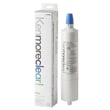
If you suspect restricted water flow, replacing the filter often helps; the correct filter for this model is the Kenmore refrigerator water filter 9990 5231JA2006E. For step-by-step filter guidance, use how to replace the water filter in a Kenmore refrigerator.
Last updated: February 2026
Why is my Kenmore refrigerator leaking underneath?
On Kenmore model 79578406800, a leak underneath is most often caused by defrost water missing the drain path and overflowing into the bottom area, or by a water supply connection issue for the ice maker. We start by checking the defrost drain and the drain pan, then inspect the water line.
Quick checks that fix most leaks
- Unplug the refrigerator before inspecting internal panels or wiring.
- Look for a sheet of ice or standing water on the freezer floor (points to a defrost drain issue).
- Pull the unit forward and check the drain pan for overflow, cracks, or being out of position.
- Inspect the water supply line and fittings for slow drips (especially if you have an ice maker).
- Confirm the refrigerator is level so defrost water flows to the drain correctly.
Most common causes and what to do
| What you see | Most likely cause | What we do next |
|---|---|---|
| Water under the front, freezer floor icy | Clogged or frozen defrost drain | Thaw ice, flush the drain with warm water, clear debris |
| Water only after ice maker runs | Water line or fitting seep | Tighten fittings, inspect tubing, replace damaged line |
| Water in pan but still on floor | Drain pan shifted or cracked | Re-seat pan; replace if damaged |
| Drips near door area | Door not sealing, warm air causing excess frost | Clean/inspect gasket; correct door alignment |
Parts that commonly solve leak symptoms
If you find a split, kink, or brittle water line, replacing the tubing is a reliable fix: refrigerator tubing MJU62070602. If the leak is tied to defrost water not draining correctly, inspect the drain outlet and tube for damage or poor fit: refrigerator drain tube 5251JA3003D.
Why it matters
Leaks under a bottom-mount refrigerator can lead to ice buildup in the freezer, poor cooling, and recurring puddles because defrost water is supposed to run into the drain pan during the defrost cycle. Catching the cause early prevents repeat overflow and protects flooring.
Model-specific notes to follow
Your 79578406800 manual includes guidance on water line hookup and cautions that plumbing issues such as water hammer can contribute to leakage. Use the owner's manual to confirm your water line routing and shutoff practices before making adjustments.
Last updated: February 2026
How to tell if a Kenmore refrigerator compressor is bad?
A bad compressor on your Kenmore 79578406800 usually shows up as poor cooling with the unit running a lot, unusual clicking or repeated start attempts, or the refrigerator not running at all after basic power checks. Use the 79578406800 owner's manual troubleshooting steps first to rule out normal run time and airflow issues.
Quick checks before blaming the compressor
Many “bad compressor” symptoms are caused by power, airflow, or control settings.
- Confirm the refrigerator control is not set to OFF.
- Check the outlet, house fuse, or circuit breaker.
- Allow up to 24 hours after plugging in for full cooling.
- Clean dusty condenser coils (dirty coils make the compressor run longer).
- Make sure doors close fully and gaskets seal; warm air leaks drive long run times.
Symptoms that strongly point to a compressor problem
These signs are more consistent with a compressor that is failing mechanically or electrically.
- Fridge and freezer both warm, but fans run and lights work
- Repeated clicking every few minutes (often a start device trying and failing)
- Compressor is very hot to the touch after repeated start attempts (use caution)
- Compressor is silent and never starts even though the unit has power
- Cooling is weak even though the compressor seems to run almost constantly
Normal sounds vs. problem sounds
Your manual notes that modern, high-efficiency compressors can run longer and may sound pulsating or high-pitched.
| What you notice | Often normal | Often a problem |
|---|---|---|
| Longer run times in warm rooms | Yes | No |
| Pulsating or high-pitched hum | Yes | No |
| Click, then nothing, repeats | No | Yes |
| Warm temps in both sections | No | Yes |
Parts that are commonly involved
If the compressor is not starting, the start components are a common failure point. If the compressor is confirmed failed, replacement is a major sealed-system repair.
- Refrigerator compressor TCA37091209 (compressor itself)
- Refrigerator compressor start relay (often causes clicking and no start)
- Condenser fan motor (poor heat removal can mimic cooling failure)
Why it matters
A true compressor failure affects both the refrigerator and freezer because the compressor drives all refrigerant flow. Ruling out dirty condenser coils, door sealing problems, and normal long run time prevents unnecessary parts replacement.
Last updated: February 2026
What are the common problems with Kenmore Elite refrigerators?
Common problems we see on Kenmore Elite refrigerators, including Kenmore model 79578406800, are warm temperatures (cooling failure), ice maker problems, water leaks or puddles, doors not sealing or closing, and unusual noises. These issues often trace back to dirty condenser coils, airflow restrictions, defrost drainage clogs, or fan and sensor failures.
Most common symptoms and likely causes
- Not cooling well: dirty condenser coils, blocked air vents, evaporator fan not running, frost buildup from defrost issues
- Ice maker slow or not making ice: freezer too warm, restricted water supply, clogged filter, ice bin or ice room door not closing correctly
- Bad-tasting or smelly ice: old ice, food odors, mineral-heavy water, dirty ice bin
- Water under or inside the unit: clogged defrost drain, drain tube issues
- Doors will not close: refrigerator not level, bins/shelves out of position, food packages blocking, gasket problems
Quick checks we recommend first
- Confirm doors close firmly; reseat bins, shelves, and the ice bin
- Clean condenser coils to improve heat transfer and reduce compressor run time
- Verify temperature settings; allow 24 hours after adjustments
- Dump old ice and wash the ice bin; replace the water filter if flow is slow
- Unplug the refrigerator before cleaning or any repair work; use the 79578406800 owner's manual for model-specific procedures
Common fixes and parts that often solve them
| Symptom | First action | Part that may help (if failed) |
|---|---|---|
| Slow water, poor ice quality | Replace filter; flush several gallons | Kenmore refrigerator water filter 9990 5231JA2006E |
| Puddles or leaking | Clear defrost drain; inspect drain path | Refrigerator drain tube 5251JA3003D |
| Warm fridge, weak airflow | Listen for fan; check for frost blockage | Motor,dc 4681JB1027C |
| Light issues, door alarms, intermittent cooling | Test door switch operation | Refrigerator door push-button switch 6600JB1010A |
Why it matters
A small airflow or door-seal problem can cascade into bigger complaints: warmer temps slow ice production, increase frost, and can turn normal defrost water into leaks.
For troubleshooting codes commonly used on this model family, use our Kenmore 795 model bottom freezer refrigerator error codes guide.
Last updated: February 2026