Owner’s manual
 Error Codes


What is the average lifespan of a Kenmore Elite refrigerator?
Most Kenmore Elite refrigerators, including model 79575193401, typically last 12 to 15 years with normal household use. Consistent cleaning, good airflow around the cabinet, and prompt repair of cooling or water issues help you reach (and often exceed) that range.
- Condenser coil cleanliness: dust buildup makes the compressor work harder
- Air circulation: blocked vents reduce cooling efficiency and increase run time
- Door seal condition: warm air leaks cause longer run cycles and frost issues
- Water system health: leaks and restricted flow stress valves and tubing
- Temperature settings: extreme settings can increase wear on the sealed system
Use the care and cleaning guidance in the 79575193401 owner's manual as your baseline.
- Vacuum and brush the condenser area on a regular schedule
- Keep food packages from blocking interior air vents
- Clean and inspect door gaskets; wipe spills so the seal stays flexible
- Replace filters on schedule and flush the dispenser after changes
- Level the refrigerator so doors close fully and consistently
| Item | Typical impact on lifespan | What to do |
|---|---|---|
| Dirty condenser coils | Shortens lifespan | Clean coils and improve ventilation |
| Worn door gasket | Shortens lifespan | Clean, reshape, or replace gasket |
| Stable temperatures | Extends lifespan | Use recommended control settings |
| Water leaks/restrictions | Shortens lifespan | Inspect tubing, fittings, and valve |
A refrigerator that runs longer to maintain temperature uses more energy and puts extra load on the compressor and sealed system. Basic upkeep (especially airflow and cleaning) is the simplest way to protect cooling performance over the full service life.
Last updated: January 2026
What does DH mean on Kenmore Elite refrigerator?
On Kenmore Elite model 79575193401, dH typically indicates a defrost heating issue (the refrigerator is not sensing normal temperature rise during the defrost cycle). This often points to a problem in the defrost heater circuit, wiring, or the main control’s defrost output; use the 79575193401 owner's manual to confirm the display behavior and troubleshooting steps for your exact control panel.
- Power reset: Unplug the refrigerator for 5 minutes, then restore power and watch if dH returns.
- Airflow basics: Make sure food packages are not blocking vents; blocked vents can cause cooling and moisture issues that mimic defrost problems.
- Door sealing: Check that doors close fully and gaskets seal evenly; warm air leaks increase frost load.
- Condenser coil cleaning: Dusty coils can worsen temperature control and run time.
- Listen for fan operation: Unusual fan noise or no airflow can contribute to icing and temperature swings.
In this refrigerator design, defrost performance depends on several components working together. Common failure points include:
- Defrost heater (open circuit or weak heating)
- Defrost sensor/thermistor (misreading temperature)
- Wiring/connectors at the evaporator area (loose or corroded)
- Control board defrost relay/output (not sending power during defrost)
| Symptom you notice | What it often suggests | Example part on this model page |
|---|---|---|
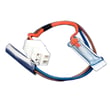
| Heavy frost on freezer back wall, warm fridge | Defrost system not clearing frost | Lg refrigerator defrost heater 5300JK1005D |
| Warm temps, long run time, poor cooling | Airflow restriction or sealed system stress | (Inspect airflow and frost pattern first) |
| Lights act odd when door opens/closes | Door switch issue affecting fans/lights | Refrigerator door push-button switch 6600JB1010A |
When defrost heat is not working correctly, frost can build up on the evaporator and restrict airflow. That reduces cooling to the refrigerator section, can cause temperature swings, and can lead to water leaks when ice melts unevenly.
If your display is showing an error and you want model-family guidance, use Kenmore 795 model bottom freezer refrigerator error codes to interpret common code patterns and next steps.
Last updated: January 2026
What year did the Kenmore Elite come out?
Kenmore Elite launched in 2001 as Kenmore’s premium line. For your Kenmore Elite bottom-mount refrigerator model 79575193401, the owner’s manual for the 795.7519 series is dated 2004, which is a strong indicator of the era for this model family. See the 79575193401 owner's manual.
The Kenmore Elite brand launch year helps with general history, but the manual date is more useful for estimating your refrigerator’s age and choosing compatible parts.
- Kenmore Elite branding began in 2001.
- The 795.7519 series manual is dated 2004.
- The manual covers multiple related 795.7519 and 795.7554 models (same platform family).
- Your refrigerator’s exact manufacture date is on the model and serial tag inside the fresh food section.
| Item | Year | What it tells you |
|---|---|---|
| Kenmore Elite line launch | 2001 | When the Elite name first appeared on premium Kenmore appliances. |
| 795.7519 series manual date | 2004 | The timeframe for the design and documentation used by model 79575193401’s family. |
When ordering parts for Kenmore 79575193401, the model-family timeframe helps you match the correct design version for items like the door switch, water inlet valve, or water tubing.
- Open the fresh food compartment and locate the model and serial label.
- Write down the serial number exactly.
- Use the date code format shown in the 79575193401 owner's manual (or on the label) to translate the serial into a manufacture date.
Last updated: January 2026
What size is Kenmore refrigerator model 79575193401?
Kenmore Elite refrigerator model 79575193401 is a bottom-mount refrigerator; for “size,” we use two measurements: exterior dimensions (height, width, depth) and interior capacity (cubic feet). The exact numbers for your unit are listed in the 79575193401 owner's manual.
When customers ask about size, it is typically one of these:
- Exterior dimensions: to fit a cutout, doorway, or moving path
- Interior capacity (cu ft): to compare storage space
- Clearance needs: space for airflow, door swing, and water line
If you need quick planning numbers before you confirm the exact specs in the manual, most Kenmore bottom-mount units in this style fall in these ranges:
| Measurement | Typical planning range |
|---|---|
| Width | 32 to 36 in |
| Height | 68 to 71 in |
| Depth without handles | 33 to 35 in |
| Depth with handles | 35 to 38 in |
Measure the refrigerator and the path into the kitchen:
- Width at the widest point (often doors or handles)
- Height from floor to top of hinge cover
- Depth from front of doors or handles to the back
- Door swing and drawer clearance for full access
- Service space behind the unit for cords, coils, and water line slack
Correct sizing prevents delivery problems, doors hitting walls or cabinets, restricted airflow that causes warm temperatures, and kinked water lines that can affect the ice maker.
Last updated: January 2026