Installation guide
 Owner’s manual


How many cubic feet is my Kenmore Elite washer?
For Kenmore Elite washer model 11027082604, the exact tub capacity in cubic feet is listed in the product specifications section of the 11027082604 owner's manual. If you need a quick planning number, most Kenmore top-load washers in this style are typically about 3.5 to 4.5 cu. ft.
We recommend using the model-specific documentation because capacity can vary by basket design and wash system.
- Open the 11027082604 owner's manual
- Look for Specifications, Features, or Capacity
- If the manual lists basket dimensions instead of cubic feet, use the method below
- Compare only to Kenmore top-load models with a similar stainless steel basket height
If you measure the inside of the basket, you can estimate cubic feet (use inches).
- Measure inside diameter of the basket (not rim-to-rim outside)
- Measure usable depth to the “do not load above” line
- Convert to cubic inches, then to cubic feet
| What to measure | What to record | Tip |
|---|---|---|
| Basket inside diameter | inches | Measure straight across the center |
| Usable basket depth | inches | Stop at the max-load line |
| Result | cubic feet | Divide cubic inches by 1,728 |
Capacity affects how much laundry you can load without overfilling. Overloading can reduce cleaning performance and contribute to out-of-balance spinning, vibration, and longer cycle times.
Last updated: January 2026
How to force a Kenmore Elite washer to drain?
On Kenmore Elite washer model 11027082604, the fastest way to force a drain is to cancel the cycle and run a Drain/Spin (or Spin Only) cycle; if the tub is still full, manually drain through the pump-out path and then clear the most common blockage points before restarting.
- Press Pause/Cancel (or Stop) to end the current cycle, then select Drain/Spin and start.
- If the washer will not start draining, unplug the washer for 1 minute, plug it back in, then try Drain/Spin again.
- If the tub is very full, manually drain first (steps below) to prevent a spill.
- Unplug the washer.
- Pull the washer forward enough to access the back.
- Lower the drain hose into a shallow pan or bucket (use multiple buckets if needed).
- If water does not flow, the hose is likely blocked or the standpipe setup is causing a restriction; straighten the hose and try again.
- After draining, check for a clog at the pump and hose connections; a blocked pump is a common reason a washer will not drain.
- Kinked or crushed drain hose behind the washer
- Standpipe or laundry tub drain backing up
- Drain hose pushed too far into the standpipe (can contribute to siphoning or poor draining)
- Failed or jammed drain pump
- Lid lock not engaging (some cycles will not proceed without a locked lid)
| Symptom | Most likely area | Example part for this model |
|---|---|---|
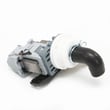
| Hums but will not drain | Drain pump jammed or failed | Pump-water W10536347 |
| Stops mid-cycle, won’t proceed | Lid won’t lock | Washer lid lock WPW10619844 |
| Drains slowly | Hose/standpipe restriction | Drain hose routing and setup |
A washer that cannot drain often cannot spin properly, which leaves clothes soaking wet and can strain the drive system. Draining the tub first also makes troubleshooting safer and cleaner.
For drain hose setup and standpipe depth guidance, follow the installation guide.
Last updated: January 2026
What is the average lifespan of a Kenmore washer?
A Kenmore washer typically lasts 10 to 15 years with normal household use. For your Kenmore Elite washer model 11027082604, consistent maintenance (proper leveling, correct detergent, and routine cleaning cycles) is what most often determines whether you land closer to 10 years or 15.
- Load size and balance: Overloading and frequent out-of-balance loads increase wear on suspension and bearings.
- Detergent choice: Use only HE detergent in this high-efficiency washer to reduce oversudsing and strain.
- Monthly cleaning: Run the Clean Washer cycle about once a month to help prevent odor and residue buildup.
- Leveling and vibration control: A washer that is not level can be noisier and harder on internal components.
- Water quality and hoses: Sediment and restricted flow can stress the fill system and extend cycle times.
- Loud roaring or grinding during spin (often points to bearing or drive system wear)
- Repeated leaking, especially around the tub area
- Frequent no-drain symptoms or slow draining
- Persistent vibration even after leveling
- Cycles that stop because the lid will not lock
| Symptom | Common area involved | Example part for this model |
|---|---|---|
| Won’t drain or drains slowly | Drain pump, hoses | Pump-water W10536347 |
| Lid won’t lock or won’t start | Lid lock system | Washer lid lock WPW10619844 |
| Excessive shaking or banging | Suspension/leveling | Suspension W10820048 |
Knowing the typical 10 to 15 year lifespan helps you decide whether to repair or replace. If your 11027082604 is already in that range and showing multiple symptoms (noise plus leaks plus draining issues), repairs can stack up quickly compared to a single targeted fix.
- Keep loads below the top of the basket
- Use the recommended amount of HE detergent
- Run Clean Washer monthly
- Confirm all four feet are firmly on the floor and the washer is level
- Check inlet and drain connections periodically for leaks
For model-specific operating and care details, follow the 11027082604 owner's manual.
Last updated: January 2026
Is Kenmore Elite high end?
Yes. Kenmore Elite is positioned as Kenmore’s higher-end line; for the Kenmore Elite washer model 11027082604, that typically means upgraded wash performance, more cycle and option choices, and convenience features compared with standard Kenmore models (depending on the exact configuration shown in the 11027082604 owner's manual).
Kenmore Elite washers are generally designed to deliver stronger cleaning and more control over the wash process.
- More cycle options and modifiers (for example, temperature selection and add-on rinse options)
- Convenience features such as Delay Start (commonly up to about 13 hours, depending on model)
- Maintenance features like a dedicated Clean Washer cycle for monthly tub cleaning
- Better handling of tough stains through enhanced wash options on certain cycles
Based on the controls and options described for this model, you can expect these “premium” capabilities.
| Feature/option | What it does | Why it’s considered higher-end |
|---|---|---|
| Clean Washer cycle | Uses higher water volume with liquid chlorine bleach to clean the washer interior | Helps reduce odor and buildup with routine maintenance |
| Delay Start | Delays the start time in 1-hour steps (up to about 13 hours, depending on model) | Adds scheduling flexibility |
| 2nd Rinse | Adds an extra rinse to help remove detergent or bleach residue | Helps with sensitive skin and heavy detergent loads |
| Stain Treat | Boosts cleaning action for tough stains (start on a dry load) | Improves stain removal without heavy pretreating |
A “high-end” washer is not just about appearance; it is about control, cleaning performance, and long-term care features. Using options like 2nd Rinse and running the Clean Washer cycle monthly can also help your Kenmore Elite washer stay fresher and perform more consistently.
- Choose the warmest wash water safe for the fabric for best cleaning.
- Use 2nd Rinse when you see residue or when washing bulky loads.
- Run the Clean Washer cycle monthly (follow the bleach guidance in the manual).
- Keep the lid closed when starting; the washer will not start with the lid open.
Last updated: January 2026