Owner’s manual
 Error Codes


What does the number 23 signify?
On the GE CYE23TSDDSS bottom-mount refrigerator, the “23” is part of the model identifier used to group similar refrigerator platforms and feature sets; it is not a setting, error code, or a special “meaning” you need to interpret for operation. For model-specific details, use the CYE23TSDDSS owner's manual.
What “23” helps identify (and what it does not)
In GE refrigerator model numbers like CYE23TSDDSS, the number is mainly used for product identification. It commonly aligns with the refrigerator’s size class (often around 23 cubic feet), but the exact capacity and configuration are confirmed by the model’s documentation.
It does not indicate:
- A temperature setting for the fresh food or freezer section
- A diagnostic code or alarm
- A manufacturing date
- A part number for filters, sensors, or ice makers
Where you’ll see the model number used
You’ll use the full model number (including the “23”) when you:
- Look up compatible replacement parts (water filter, fan motor, temperature sensor)
- Check installation dimensions and required clearances
- Match service information and wiring/connector layouts
- Confirm which door, handle, or gasket fits your exact unit
Quick reference: “23” in common refrigerator contexts
| If you’re seeing “23” on... | It usually means | What to do |
|---|---|---|
| The model tag / paperwork | Model family identifier (often size class) | Use the full model number for parts and manuals |
| The control panel display | A temperature or menu value (not the model number) | Adjust settings per the manual |
| A service screen / error display | A diagnostic item (varies by model) | Check the error code list and troubleshooting steps |
Why it matters
Using the complete model number (CYE23TSDDSS) prevents ordering the wrong GE parts and helps you follow the correct installation requirements, such as clearance and passageway sizing.
Last updated: February 2026
What are the disadvantages of a bottom freezer refrigerator?
A bottom-freezer refrigerator like the GE CYE23TSDDSS keeps fresh food at eye level, but the tradeoffs are more bending for frozen items, a heavier freezer drawer that can wear door/slide hardware faster, and freezer space that can be harder to organize than a top-freezer design. See the owner's manual for model-specific use and safety details.
Common downsides you may notice day to day
- You bend more often to reach frozen foods, especially items stored in the lower basket.
- The freezer drawer gets heavy when fully loaded; that extra weight increases stress on drawer alignment and mounting screws.
- Freezer organization can be less convenient for small items because they stack in bins and baskets.
- Bottom-freezer models often cost more than basic top-freezer refrigerators with similar capacity.
- If you use ice and water frequently, you may do more maintenance (filter changes, purging air, clearing ice clumps).
What tends to wear faster on bottom-freezer designs
The freezer drawer is a high-use, high-load area. When it is overloaded or slammed, these issues show up sooner:
| Symptom | What it usually points to | What to check first |
|---|---|---|
| Drawer looks uneven or gaps aren’t uniform | Door alignment or mounting screws out of adjustment | Door gap adjustment steps in the manual |
| Warm freezer or inconsistent temps | Airflow or sensing issue | Vents clear; temperature settings; frost buildup |
| Ice maker performance drops | Water supply or ice maker issue | Filter status; dispenser flow; ice bin condition |
Tips to reduce the disadvantages
- Keep heavier frozen items low and centered so the drawer tracks evenly.
- Avoid overpacking the freezer basket; leave room for air circulation.
- Open the freezer drawer fully before lifting items out; it reduces strain on the slides.
- If you see uneven gaps, follow the freezer door gap adjustment procedure in the owner's manual.
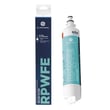
- Stay on schedule with water filter changes; for this model, the refrigerator water filter RPWFE is a common maintenance item.
Why it matters
Most “bottom freezer problems” are really usability and wear issues: frequent bending, heavier drawer loads, and organization challenges. Managing drawer weight and alignment helps the refrigerator seal properly, cool evenly, and avoid unnecessary strain on door hardware.
Last updated: February 2026
What is the most common problem with a GE refrigerator?
On the GE CYE23TSDDSS bottom-mount refrigerator, the most common service complaint is cooling-related: the fresh food section or freezer is too warm because airflow, defrost, or temperature sensing is off. Water dispensing and ice maker issues are also very common and often trace back to the filter or air in the water line (see the CYE23TSDDSS owner's manual).
Most common issues we see (and what usually causes them)
- Not cooling or uneven temps: evaporator fan problem, frost buildup from a defrost failure, or a bad sensor
- Water dispenser slow or not dispensing: clogged filter, filter not seated, air trapped in the line, or supply valve restriction
- Ice maker not working: ice maker turned off, water supply issue, or dispenser/auger problems
- Water leaking or puddles: defrost drain restriction or water line connection seepage
- Door not sealing: gasket not sealing flat, door alignment, or bins preventing closure
- Lights out or dim: failed LED module
Quick checks you can do first
- Confirm temperature settings and give the unit 24 hours to stabilize after changes.
- Listen for the evaporator fan; if the fridge is warm and you do not hear airflow, the fan circuit is a top suspect.
- If water is slow, remove and reinstall the filter so it locks in place; then dispense water for 5 minutes to purge air.
- Check for frost buildup on the freezer back panel (often points to a defrost system issue).
Water and ice troubleshooting (model-relevant)
The manual guidance for this model family points to these high-frequency causes:
- Filter clogged or not installed correctly
- Air trapped in the water system (purge by dispensing for at least 5 minutes)
- Supply line or shutoff valve restriction
| Symptom | Most likely cause | Good next step |
|---|---|---|
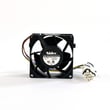
| Fridge warm, freezer ok-ish | Airflow problem | Inspect/replace refrigerator fan motor assembly WR60X26866 |
| Frost buildup, warm temps | Defrost failure | Check refrigerator defrost heater WR51X10132 and refrigerator defrost bi-metal thermostat WR50X10108 |
| Water slow or stops | Filter/air in line | Replace refrigerator water filter RPWFE and purge 5 minutes |
| Temps swing or error-like behavior | Sensor issue | Test/replace refrigerator temperature sensor WR55X10025 |
Why it matters
Cooling and water/ice problems can look “random,” but they usually come from a small set of parts (fan motor, defrost components, temperature sensor, water filter). Fixing the root cause protects food safety, prevents ice buildup, and restores normal dispenser flow.
Last updated: February 2026
Is a top mount or bottom mount fridge better?
A bottom-mount refrigerator like the GE CYE23TSDDSS is better when you want fresh-food items at eye level and more organized refrigerator storage; a top-mount is often the better pick when you want the simplest layout and typically lower energy use and purchase cost.
Quick comparison
| Feature | Top-mount (freezer on top) | Bottom-mount (freezer on bottom) |
|---|---|---|
| Everyday access | Freezer is easiest to reach | Fresh food is easiest to reach |
| Organization | Usually simpler shelving | Often more drawers, bins, and zones |
| Ergonomics | More bending for fresh food | Less bending for fresh food |
| Efficiency (typical) | Often slightly more efficient | Often slightly less efficient |
| Price (typical) | Often lower | Often higher |
How to choose for your kitchen and habits
We recommend deciding based on how you shop and cook, plus how your kitchen is laid out.
- If you use fresh food most often, a bottom-mount keeps it at a comfortable height.
- If you use frozen food most often, a top-mount keeps it easiest to access.
- If you meal prep and like categories (produce, deli, snacks), bottom-mount layouts usually make that easier.
- If you want fewer moving parts and a simpler interior, top-mount designs are often more straightforward.
- If you have a tight install space, measure carefully; clearances and doorway width matter as much as style.
Why installation details matter (especially for bottom-mount)
Bottom-mount and French door designs are often wider and heavier, so planning the move-in path is important. For this model family, the manual calls out minimum clearances for airflow and notes that narrow passageways may require removing doors/handles to prevent damage. Check the exact requirements in the owner's manual.
Typical clearance targets (use your manual for exact)
- Sides: about 1/8 inch
- Top: about 1 inch
- Back: about 2 inches
What this means for repairs and parts
The “better” choice also depends on what you want to maintain. Bottom-mount units commonly rely on components like an evaporator fan and temperature sensors to keep even temperatures.
- If you are troubleshooting warm temperatures, start with airflow and sensor checks.
- Common parts tied to cooling performance include the refrigerator temperature sensor WR55X10025 and the refrigerator fan motor assembly WR60X26866.
Last updated: February 2026