Owner’s manual
 Error Codes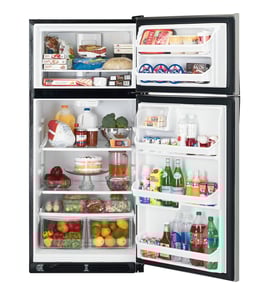




What are the disadvantages of a top mount fridge?
Top-mount refrigerators like the Kenmore 10670214410 are reliable and space-efficient, but the main disadvantages are less convenient fresh-food access (you bend more), fewer premium storage/organization features, and fewer built-in dispenser options compared with many bottom-freezer designs. See the owner's manual for your model’s specific features and adjustments.
Common disadvantages (what most owners notice)
- Fresh-food items sit lower, so you bend more to reach everyday foods.
- Freezer is at eye level, which is convenient for frozen items but shifts the “best access” away from fresh food.
- Less flexible organization in many top-mount layouts (fewer wide deli drawers, fewer full-width pantry-style bins).
- Fewer exterior features on many models (water and ice through the door is less common).
- More temperature swing risk in the freezer if the refrigerator door is opened frequently (warm air rises and can affect the upper compartment).
Quick comparison: top-mount vs bottom-freezer
| Feature | Top-mount (like 10670214410) | Bottom-freezer |
|---|---|---|
| Everyday fresh-food access | Lower, more bending | Higher, easier reach |
| Freezer access | Higher, easier reach | Lower, more bending |
| Storage/organization | Often simpler | Often more “premium” |
| Typical cost to own | Often lower | Often higher |
Ways to reduce the downsides
- Put daily-use items at mid-shelf height to reduce bending.
- Use clear bins to group items and prevent “lost food” in the back.
- Keep door seals clean and sealing well; a worn gasket can worsen temperature stability.
- If you have ice maker issues, check the shutoff arm, fill tube, and water supply basics before replacing parts.
Why it matters
Choosing a refrigerator layout affects daily comfort and food freshness. If bending and organization are priorities, a bottom-freezer style often feels easier to live with; if simplicity and value matter most, a top-mount is a strong fit.
Last updated: February 2026
How to tell cubic feet of Kenmore refrigerator by model number?
For Kenmore model 10670214410, the most reliable way to get cubic feet is to look up the capacity in the product specifications section of the owner's manual. If you only have the model number and no spec sheet, you can still estimate capacity by measuring the usable interior space and converting cubic inches to cubic feet.
How to find capacity using the model number
For many Kenmore refrigerators, the model number itself does not clearly encode cubic feet. With a 106 prefix (commonly Whirlpool-built Kenmore), capacity is typically listed in the specs rather than “hidden” in the digits.
Use these quick checks:
- Find the model/serial label inside the fresh food section (often side wall or near crispers).
- Confirm the full model number is 10670214410 (all digits matter).
- Check the specifications section in the owner's manual for “capacity” or “cubic feet.”
- If you are comparing similar units, note that top-mount refrigerators commonly fall in the 14 to 22 cu. ft. range.
How to estimate cubic feet by measuring (works for any refrigerator)
This gives a close estimate of usable space (shelves and bins reduce it slightly).
- Measure the interior fresh food compartment:
- Width (inches)
- Height (inches)
- Depth (inches)
- Multiply:
W x H x D = cubic inches - Divide by 1728 to convert to cubic feet.
- Repeat for the freezer compartment and add the two results.
Quick conversion table
| What you have | What to do | Result |
|---|---|---|
| Interior inches (W x H x D) | Multiply to get cubic inches | Total cubic inches |
| Cubic inches | Divide by 1728 | Cubic feet |
Why it matters
Knowing cubic feet helps us match the right parts and performance expectations, such as ice maker output, airflow needs, and temperature stability. For example, cooling complaints often involve airflow parts like the refrigerator evaporator fan motor WP2315539 rather than capacity.
Last updated: February 2026
Can I buy extra fridge shelves?
Yes. For Kenmore refrigerator model 10670214410, you can buy additional shelves or replace a cracked shelf as long as the replacement matches your refrigerator’s shelf style and mounting points. Use the parts list for your model and confirm fit details in the owner's manual.
How to make sure you get the right shelf
Refrigerator shelves are not universal; even small differences in width, trim, or rear supports can prevent a proper fit.
- Match the shelf location: fresh food section vs. freezer
- Check the shelf type: glass shelf, wire shelf, or shelf with trim
- Compare mounting style: side rails, rear hooks, or support tabs
- Measure the usable width and depth of your current shelf (front to back)
- Look for any special features: spill guard lip, slide-out design, or deli drawer support
Quick checklist before you order
Use this checklist to avoid ordering the wrong part.
| What to check | What to look for | Why it matters |
|---|---|---|
| Model number | 10670214410 | Ensures the shelf is designed for your Kenmore refrigerator |
| Shelf position | Upper, middle, crisper cover, freezer | Each position can use a different shelf |
| Mounting points | Tabs, hooks, rails | Determines whether the shelf will lock in securely |
| Measurements | Width and depth | Confirms the shelf will physically fit the compartment |
Installation basics (what to expect)
Most shelves install without tools.
- Remove food and bins that block access
- Lift the front edge slightly to disengage stops (if equipped)
- Pull the shelf forward and out
- Slide the new shelf into the same rail or support points
- Confirm it sits level and does not rock or bind
Why it matters
A correctly fitted shelf keeps airflow moving through the refrigerator compartment, helps maintain even temperatures, and prevents stress on liners and shelf supports that can crack over time.
Last updated: February 2026