 Owner’s manual



What is the average lifespan of a Maytag washer?
Most Maytag washers average about 10 to 13 years with normal household use and basic upkeep. For the Maytag PAV2300AWW, real-world lifespan depends on load habits, installation, and how quickly you address leaks or vibration; our PAV2300AWW owner’s manual covers the care steps that help extend service life.
What affects lifespan the most
- Overloading: stresses the drive system, motor, belt, and suspension
- Water quality: hard water can increase detergent buildup and wear
- Hose condition and leaks: small leaks can lead to corrosion or component damage
- Leveling and vibration: repeated out-of-balance spinning accelerates wear
- Routine care: drying the tub area and cleaning residue reduces odors and buildup
Maintenance habits that help a PAV2300AWW last longer
We recommend these practical steps for this Maytag top-load washer:
- Load clothes loosely; do not pack the tub
- Use the correct detergent amount for soil level and water conditions
- Keep the washer level and stable to reduce spin stress
- Leave the lid open after use so the interior can dry
- Inspect fill hoses for bulges, cracks, kinks, or leaks; replace on a schedule
Quick “repair vs replace” guide
| What you’re seeing | Often worth repairing? | Common first checks |
|---|---|---|
| Minor leak at a hose connection | Yes | Tighten fittings, inspect hose and clamp |
| Won’t fill or fills slowly | Often | Clean inlet screens, check hoses, test valve |
| Loud banging in spin | Often | Leveling, load redistribution, suspension wear |
| Repeated major failures | Depends | Compare repair cost vs. age and condition |
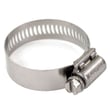
If you’re addressing a leak or loose connection, a compatible clamp such as the hose clamp WP285655 is a common wear item used on many washer hose connections.
Why it matters
Knowing the typical lifespan helps you plan maintenance and decide when a repair is a smart investment. Catching small issues early (leaks, vibration, slow fill) often prevents bigger, more expensive failures.
Last updated: January 2026
What is the capacity of the Maytag PAV2300?
The exact tub capacity in cubic feet for the Maytag PAV2300AWW is not specified in the model-specific documentation we have; the washer is labeled “Oversize Capacity Plus.” For a practical estimate, measure the wash basket and calculate volume; use the PAV2300AWW owner’s manual for correct loading limits and water-level selection.
How to estimate capacity on the PAV2300AWW (quick method)
You can estimate cubic feet by measuring the inside of the wash basket and using a simple cylinder-volume calculation.
- Unplug the washer before measuring.
- Measure the inside basket diameter (in inches).
- Measure usable depth (bottom to the top row of holes you load to).
- Use the formula below to estimate cubic feet.
- Treat the result as an estimate; the agitator and basket shape reduce usable volume.
| Measurement | What to do | Notes |
|---|---|---|
| Diameter (D) | Radius R = D ÷ 2 | Inches |
| Depth (H) | Use usable depth | Load height matters |
| Volume | Cubic feet ≈ (3.1416 × R² × H) ÷ 1728 | 1728 in³ = 1 ft³ |
What “Oversize Capacity Plus” means in everyday use
Even without a published cubic-feet number, Maytag’s guidance for this design focuses on circulation and correct water level.
- Load dry items loosely, do not pack them down.
- Keep the load at or below the top row of holes.
- Mix large and small items to reduce out-of-balance spinning.
- Select the water level (Mini, Medium, Large, Oversize) based on load size.
Why it matters
Overloading can cause poor cleaning, excessive vibration, and extra wear on drive components. If you’re seeing slipping or weak spin after repeated heavy loads, a worn belt is a common check.
- Burning rubber smell during spin
- Slow or no spin with a full load
- Squealing or slipping noises
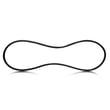
If belt wear is suspected, the compatible replacement is the washer drive belt WP21352320.
Last updated: January 2026
What is the most common problem with a Maytag washer?
For the Maytag PAV2300AWW washer, the most common customer-reported issues are the washer not draining or not spinning, often tied to a simple setup problem (lid not closed, kinked hose) or a worn drive component. Our PAV2300AWW user manual also highlights basic “Before You Call” checks for no-drain and no-spin symptoms.
Quick checks first (fast, no parts)
- Confirm the lid is fully closed; this model is designed not to spin with the lid open.
- Make sure the drain hose is not kinked or pinched.
- Check that the drain outlet (standpipe or laundry tub) is not clogged.
- Verify the power cord is firmly plugged in and the breaker is not tripped.
- If the motor stopped mid-cycle, wait about 30 minutes and restart; the motor overload protector may need time to cool.
When it is likely a part issue
If the basics look good and the washer still will not drain or spin, these are common part-related suspects on top-load Maytag designs like PAV2300AWW:
- Drive system wear (belt or pulley issues)
- Drain path restrictions (hose or tub-to-pump hose)
- Fill problems that stop the cycle from progressing (water valve or water-level sensing)
Common symptom-to-part mapping
| Symptom | What it often points to | Example compatible part for this model |
|---|---|---|
| Won’t spin or weak spin | Worn/slipping belt or drive components | Washer drive belt WP21352320 |
| Won’t drain or drains slowly | Kinked/blocked drain hose or internal hose restriction | Drain hose WP21001872 or washer tub-to-pump hose WP21001915 |
| Won’t fill (or fills very slowly) | Inlet valve or supply restriction | Water valve WP21001932 |
| Overfills or wrong water level | Water-level sensing issue | Washer water-level switch WP21001554 |
Why it matters
Drain and spin problems can leave clothes soaking wet, strain the motor, and cause repeated cycle interruptions. Catching a kinked hose or a slipping belt early can prevent bigger repairs later.
Last updated: January 2026


