Owner’s manual
 Error Codes



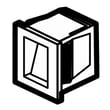
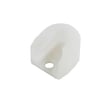
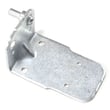
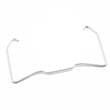

How do I know if my compressor is bad in my Kenmore freezer?
If your Kenmore upright freezer model 25328042807 is warm and you hear repeated clicking, a steady hum with no cooling, or the compressor will not start, the most common causes are a failed start device (relay/overload) or a failed compressor. Use the checks below and confirm normal operating sounds in the 25328042807 owner's manual.
- Verify the freezer is plugged in and the outlet has power.
- Set the temperature control colder; then wait several hours for temperatures to stabilize.
- Listen: gurgling or bubbling can be normal refrigerant flow; popping at startup can be normal metal expansion.
- Check for excessive frost buildup or a door not sealing (warm air leaks can mimic a “bad compressor”).
- Make sure the freezer is level and not vibrating against a wall.
| What you notice | Most likely cause | What to do next |
|---|---|---|
| Click every 1 to 5 minutes, compressor never runs | Start relay/overload issue | Test/replace the start device; see how to replace a freezer compressor start relay |
| Compressor runs but freezer stays warm | Sealed system issue (refrigerant leak, restriction, weak compressor) | Schedule sealed-system service; check for dirty condenser area and airflow issues |
| Loud running sound but temps are normal | Normal operation on modern freezers | No repair needed; sound often levels off |
| No sound at all and no cooling | Power/control problem | Check temperature control setting and wiring connections |
- Unplug the freezer.
- Access the compressor area at the back/bottom.
- Inspect the start device for burn marks or rattling pieces.
- Test the start device for continuity; replace if open/failed.
- If the start device tests good but the compressor will not start (or trips quickly), the compressor is the next suspect.
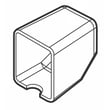
Model-matched part to consider: the freezer compressor overload and relay clamp 216954300 is the start/overload hardware commonly involved when you hear clicking and the compressor will not stay running.
A weak start relay can stop a good compressor from starting, so checking the start device first prevents unnecessary sealed-system repairs. When the compressor is truly failing, it typically draws high current, overheats, and trips the overload repeatedly.
Last updated: February 2026
How long should a Kenmore upright freezer last?
A Kenmore upright freezer like model 25328042807 typically lasts 10 to 15 years. With steady temperatures, good airflow, and a tight door seal, many units reach the high end of that range before major sealed-system repairs become likely.
Most upright freezers follow a similar ownership curve:
| Freezer age | What’s common | What to do |
|---|---|---|
| 0 to 5 years | Normal cycling, stable temps | Keep it level, avoid overloading warm food |
| 6 to 10 years | More frost issues, noisier starts | Clean, check door seal, monitor temps |
| 11 to 15 years | Higher risk of compressor or control failures | Decide repair vs. replace based on cost |
We see the best longevity when you focus on the basics:
- Keep the door openings short and organized to reduce run time.
- Allow proper cool-down time after plugging in; the manual notes about 4 hours before loading unfrozen food.
- Avoid blocking air circulation with liners (they reduce efficiency).
- Keep the door sealing tightly; replace a worn gasket if you feel air leaks.
- Let temperatures stabilize between control adjustments (several hours is typical).
For model-specific operating and temperature-control details, use the 25328042807 owner's manual.
A simple maintenance or door-seal fix often pays off; sealed-system or compressor work is usually the tipping point.
- Good repair candidates: door seal leaks, control knob issues, minor electrical parts.
- Consider replacement when: cooling is weak even after basic checks, or the compressor is failing.
If you’re chasing frost buildup or warm temps caused by air leaks, the freezer door gasket 5304507199 is the correct gasket listed for this model.
A freezer that runs longer to hold temperature uses more energy and stresses the compressor. Keeping airflow clear and the door sealed helps your Kenmore 25328042807 maintain safe food storage temperatures with less wear.
Last updated: February 2026
How to remove door from upright freezer?
To remove the door on your Kenmore upright freezer model 25328042807, we follow the manual’s door-removal procedure: lay the freezer on its back on a rug or blanket, disconnect any door wiring connector (if equipped), then remove the hinge screws and lift the door off.
- Unplug the freezer to prevent electrical shock.
- Empty door bins and remove loose shelves so nothing shifts.
- Protect the floor and cabinet with a rug, blanket, or cardboard.
- Have a helper support the door; it is heavier than it looks.
- Keep hinge screws organized so they go back into the same locations.
We recommend following the step-by-step instructions in the 25328042807 owner’s manual.
- Gently lay the freezer on its back on a rug or blanket.
- Remove the two base screws and the base panel.
- If your door has wiring, remove the wire from the cabinet clips and unplug the connector by holding the cabinet connector steady while pulling the door connector out.
- Remove the bottom hinge screws.
- Remove the plastic top hinge cover.
- Remove the screws from the top hinge.
- Lift the top hinge off the cabinet.
- Lift the door (and bottom hinge) away from the cabinet.
- To reinstall, reverse the steps and tighten all screws securely to prevent hinge slippage.
| Item | Why it helps |
|---|---|
| Nut driver or screwdriver | Removes hinge and base panel screws |
| Blanket or rug | Prevents cabinet and floor damage |
| Small container | Holds screws and hinge cover |
| Helper | Supports door during hinge removal |
Removing the door correctly prevents hinge slippage, protects the door seal, and avoids damaging any door wiring. A misaligned door can lead to warm air leaks, frost buildup, and poor temperature control.
Last updated: February 2026
What size is Kenmore freezer model 25328042807?
Kenmore upright freezer model 25328042807 is a full-size freestanding upright freezer; the exact storage capacity (cubic feet) and the exact exterior dimensions are provided in the specifications section of the 25328042807 owner's manual and on the model’s serial/rating plate inside the cabinet.
Use these checks so you get the correct numbers for your specific unit:
- Open the door and locate the serial/rating plate (upright models are typically on the upper left interior wall).
- Record the model number and serial number exactly as shown.
- Look for capacity (cu. ft.) and any listed overall dimensions.
- If the plate doesn’t list dimensions, use the specifications pages in the manual.
- Measure the freezer yourself for fit: width, height, depth, plus door swing clearance.
These ranges help with space planning while you confirm the exact specs for model 25328042807.
| Measurement | Typical range (upright freezer) | What to measure |
|---|---|---|
| Capacity | 14 to 21 cu. ft. | Listed in specs or on rating plate |
| Width | 28 to 33 in. | Cabinet width (not including door handle) |
| Height | 60 to 72 in. | Floor to top of cabinet |
| Depth | 28 to 34 in. | Cabinet depth; add handle if needed |
Exact size affects real-world fit and parts fitment. For example, a door seal must match the door perimeter; if you’re addressing frost buildup or warm temperatures, replacing a worn gasket can restore a tight seal.
If you’re replacing the door seal for this model, match by model number before ordering: freezer door gasket 5304507199.
Last updated: February 2026
Where is the model number on a Kenmore upright freezer?
On the Kenmore upright freezer model 25328042807, the model and serial number label is typically on the upper left wall inside the freezer compartment. This is the primary location called out for upright models in the 25328042807 owner's manual.
- Upper left interior wall inside the freezer (most common for upright models)
- Along the inside side wall near the front opening
- Behind the lower kick plate or toe grille area
- On the back exterior panel (less common, but possible)
- Open the freezer door and look at eye level on the upper left interior wall.
- Use a flashlight and look for a silver or white rating plate.
- Write down both the model number and serial number; you will need both for parts lookup and service.
| Item on the label | What it’s used for | Example format |
|---|---|---|
| Model number | Matching parts and diagrams | 253.XXXXXXX |
| Serial number | Identifying production run | Letters and numbers |
| Electrical info | Confirming power requirements | Volts/amps |
We use the model number to match the correct Kenmore freezer parts (like a door gasket, temperature control knob, or wire harness) because similar-looking upright freezers can use different components.
Last updated: February 2026
Why is my Kenmore upright freezer not freezing?
If your Kenmore upright freezer model 25328042807 is running but not freezing, the most common causes are warm-air leaks at the door, poor airflow around the cabinet, incorrect temperature control settings, or heavy frost buildup restricting cold-air circulation. Use the checks below, then confirm operating details in the 25328042807 owner's manual.
- Make sure the temperature control is not set to OFF; set colder and allow several hours to stabilize between adjustments.
- Verify the door closes and seals fully; a slightly open door quickly causes cooling and frost problems.
- Confirm the freezer is level so the door aligns and seals properly.
- Leave clearance for airflow around the cabinet; the exterior can feel warm during normal heat transfer.
- Do not line shelves with foil, wax paper, or towels; liners block cold-air circulation.
- Reduce door openings and let hot foods cool to room temperature before loading.
A leaking gasket lets warm, moist air in, which leads to frost buildup and weak freezing.
What to look for
- Gaps, tears, or hardened sections on the gasket
- Frost near the door opening
- Door that does not “pull in” for a final seal
| Symptom | Likely cause | What to do |
|---|---|---|
| Frost near door, temps rising | Door not sealing | Clean gasket and mating surface; re-level cabinet |
| Door looks aligned but still leaks | Worn gasket | Replace the freezer door gasket 5304507199 |
If frost accumulates (about 1/4 to 1/2 inch), it can reduce cooling performance. We recommend defrosting safely and removing frost with a plastic scraper only.
- Unplug the freezer before defrosting.
- Remove food and leave the door open.
- Never use a metal tool to chip ice.
A freezer that is not level, not sealing, or not getting airflow will run longer, build frost faster, and still fail to reach safe food-storage temperatures.
Last updated: February 2026