Installation guide
 Owner’s manual


How to hard reset a Kenmore 11027086601 Elite washer?
To hard reset your Kenmore Elite washer model 11027086601, stop the cycle, then power-cycle the washer. Press STOP (once to pause, twice to stop and power off), unplug for 60 seconds, plug back in, then press POWER and START. See the manual for control behavior.
Quick hard reset steps
- Press STOP once to pause the cycle.
- Wait for the Lid Lock light to turn off before opening the lid.
- Press STOP a second time to stop the cycle and turn the washer off.
- Unplug the washer from the outlet.
- Wait 60 seconds.
- Plug the washer back in, press POWER, select a cycle, then press START.
If the controls still seem frozen
- Confirm the lid is fully closed; the washer will not start with the lid open.
- If Lid Lock is on, wait for it to turn off before trying to open the lid.
- Reselect the cycle and options before pressing START.
- Avoid overloading; do not load above the top of the stainless steel basket.
- Use only HE detergent to reduce oversudsing and cycle interruptions.
What the main buttons do on this model
| Button | What it does | Helpful tip |
|---|---|---|
| POWER | Turns the washer on or off | Use after plugging back in |
| START | Starts the selected cycle or restarts after STOP | Lid must be closed |
| STOP | 1 press pauses; 2 presses stops and powers off | Use before unplugging |
Why it matters
A hard reset clears a temporary control hang and forces the washer to reinitialize the lid lock and cycle logic, which helps after a power flicker or an interrupted cycle.
Last updated: February 2026
How to open front panel of Kenmore front load washer for an F21 error?
On the Kenmore Elite washer model 11027086601, you typically access the drain pump cleanout and related wiring for an F21 (long drain) issue by removing the lower front access panel (toe panel). Unplug the washer first, then remove the bottom screws and pull the panel down and out; follow the safety and access notes in the owner's manual.
Before you remove the front access panel
- Unplug the washer to prevent electrical shock.
- Turn off both water faucets (hot and cold).
- Have towels and a shallow pan ready; an F21 condition often means water is still in the tub.
- If the washer is full of water, plan to drain carefully once you reach the pump area.
- Work with the washer pulled forward enough to reach the lower screws without tipping it.
How to remove the lower front panel (toe panel)
- Unplug the power cord.
- Locate the fasteners along the very bottom edge of the front access panel.
- Remove the screws (many Kenmore designs use three along the bottom).
- Pull the bottom of the panel slightly toward you, then drop the panel down to disengage the top tabs/clips.
- Set the panel aside and look for the drain pump area and hoses.
What to check once the panel is off (common F21 causes)
- Coins, lint, socks, or debris in the pump cleanout or pump inlet
- Kinked, crushed, or partially blocked drain hose
- Loose hose clamp or air leak at the pump connections
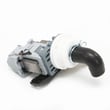
- A failing drain pump motor or jammed impeller (replacement is the water pump W10536347)
Quick diagnosis guide
| Symptom | Most likely cause | What we do next |
|---|---|---|
| Hums but won’t drain | Pump jam or failed pump | Check for blockage; replace pump if needed |
| Drains slowly | Partial clog in pump or hose | Clear debris; verify hose routing |
| Leaks after service | Hose not seated or clamp loose | Re-seat hose; tighten clamp |
Why it matters
An F21 long-drain condition can leave water in the tub and stop the cycle. Getting the toe panel off safely lets us clear a blockage quickly and prevents repeat drain errors, odors, and pump damage.
Last updated: February 2026
Is it worth repairing a Kenmore washing machine?
Yes. Repairing your Kenmore Elite washer model 11027086601 is worth it when the failure is a common service part (drain pump, lid latch, suspension) and the washer is otherwise in good shape. Replace the washer when the repair is major tub or drive work and the cost reaches about half the price of a comparable new washer.
Quick way to decide
Use these checkpoints to make a clear repair vs. replace call:
- Repair cost: Repair when the estimate is under about 50% of replacement cost.
- Failure type: One clear symptom (no drain, no start, vibration) is a strong repair candidate.
- Condition: Repair when the cabinet is solid and there is no chronic leaking.
- Performance: Repair when it still washes well and problems are recent, not ongoing.
Repairs that are usually worth it on model 11027086601
These fixes are common and typically restore normal operation:
- Not draining or stopping mid-cycle: check the drain path; replace the water pump W10536347 if the pump is seized or noisy.
- Lid will not lock or cycle will not start: inspect the lid strike area; replace the latch WPW10619844 if it will not engage.
- Excessive shaking or banging: level the washer first; replace the suspension W10820048 if the tub bounces excessively.
| Symptom | Likely system | Repair value |
|---|---|---|
| Won’t drain | Pump, hose, clamp | Usually worth it |
| Won’t start/lock | Lid latch/lock | Usually worth it |
| Heavy vibration | Leveling, suspension | Often worth it |
| Grinding at tub area | Bearing/drive/tub | Replace often makes more sense |
Why it matters
A targeted repair keeps a durable washer running for years; major tub or drive repairs can snowball into higher cost and longer downtime.
No-cost checks before buying parts
- Level the washer and confirm all feet contact the floor (see the installation guide).
- Use only HE detergent and do not load above the top of the basket.
- Use the monthly Clean Washer cycle to reduce residue and odor (see the owner's manual).
Last updated: February 2026
What is the capacity of the Kenmore 11027086601 Elite washer?
The Kenmore Elite washer model 11027086601 is a high-efficiency top-load washer; its exact tub capacity (in cubic feet) is listed in the product specifications section of the owner's manual.
How to find the capacity quickly
We recommend checking the specs page in the manual because it lists capacity alongside key dimensions and electrical requirements.
- Open the owner's manual
- Look for “Specifications” or “Product dimensions”
- Find “Capacity” (often shown as cu. ft.) or “Washer capacity”
- If the manual lists basket size instead, use the stated basket volume as the capacity reference
Typical capacity range for this washer type
Most Kenmore Elite high-efficiency top-load washers in this design class run in a mid-to-large capacity range.
| Washer type | Typical capacity range | What that means for loads |
|---|---|---|
| HE top-load (similar to 11027086601) | 3.5 to 4.8 cu. ft. | Comforters, towels, mixed loads |
| Compact top-load | 1.5 to 3.4 cu. ft. | Smaller loads, limited bedding |
Why it matters
Capacity affects how much you can load without washing above the basket’s recommended fill line. Overloading reduces cleaning performance, increases out-of-balance spinning, and can add stress to suspension and drive components.
Related usage tip (helps performance)
The manual guidance for this model is to avoid loading clothes above the top of the stainless steel basket and to use HE detergent in the dispenser. Those two habits help prevent oversudsing and improve rinse and spin results.
Last updated: February 2026