Error Codes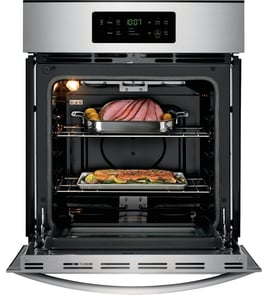



How do I know what model Kenmore oven I have?
To know which Kenmore oven you have, find the model number on the appliance’s rating label. For a Kenmore electric built-in oven, it’s most often on the oven frame behind the door, along the side trim, or on the frame area near the lower opening.
Check these common spots in this order:
- Open the oven door and look along the door jamb (left or right side)
- Look along the front frame behind the door, near the hinge area
- Check the side trim area just inside the oven opening
- If your unit has a lower access panel, check behind or near that panel
- If the oven was recently installed, check paperwork from the install for the model number
Most labels include:
- Model number (for example, 9114018813)
- Serial number
- Electrical rating information (volts/amps)
| Item | What it’s used for | Example format |
|---|---|---|
| Model number | Identifies the exact oven design for parts lookup | 9114018813 |
| Serial number | Identifies your specific unit’s production run | Letters and numbers |
Using the exact model number helps us match the correct Kenmore wall oven parts, diagrams, and compatible replacements. Even small model changes can affect items like the temperature sensor, oven rack, or door glass.
Use these practical options:
- Look for a faint “imprint” on the label and take a photo with flash at an angle
- Check inside the cabinet cutout area if the oven was pulled out previously
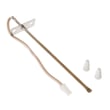
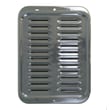
- Compare your oven’s parts to common replacements listed for this model, such as the sensor WB21X5301 or oven rack WB48T10094
- Use our guide: how to find your appliance model number (and what it means for parts)
Last updated: February 2026
Is it worth replacing an oven control board?
Replacing the oven control board in your Kenmore 9114018813 is worth it when the oven is otherwise in good shape and the total repair cost stays well below the cost of a comparable replacement wall oven. If the oven is older and showing multiple issues (heating, door, wiring), replacement usually makes more sense.
- Age: Under 10 years old usually favors repair; over 15 years old usually favors replacement.
- Symptoms: Random beeping, dead display, wrong temperatures, or buttons not responding often point to a control issue.
- Total cost: Add the board price, service labor, and any related parts.
- Overall condition: If the door, insulation, and wiring are in good condition, repair is more likely to pay off.
- Safety: If you see burning smells, melted wiring, or tripped breakers, stop using the oven and address the electrical issue first.
| Scenario | Typical outcome | Why |
|---|---|---|
| Board cost is reasonable and oven has no other problems | Replace the board | Restores normal bake/broil control without buying a new unit |
| Board plus labor approaches a large share of a new oven | Consider replacement | You avoid stacking repairs on an aging appliance |
| Temperature is off but controls seem normal | Test sensor first | A bad sensor can mimic control problems |
Even when the control board is suspected, we often see these parts involved in the same complaint:
- Sensor WB21X5301 (temperature sensing; can cause overheating or underheating)
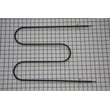
- Oven broiler element WB44M5 (if broil is weak or uneven)
- Lamp bulb 40A15 (not a control fix, but a common add-on while servicing)
A control board is the “brain” of the oven. If it is failing, you can get inaccurate temperatures, intermittent heating, or a non-responsive keypad. Making the right call prevents repeat service visits and helps you avoid replacing parts that are not actually causing the problem.
Last updated: February 2026
What are the parts of an electric oven?
An electric oven like the Kenmore 9114018813 is built around a heating system (bake and broil), temperature sensing and control, and door and rack hardware that safely contains heat. Common service parts include the broiler element, temperature sensor, oven rack, door glass, and oven light.
- Heating parts: bake element (often hidden under the oven floor) and broil element (top of cavity)
- Temperature control: oven temperature sensor, control board or thermostat (varies by design)
- Cooking hardware: oven racks and rack supports
- Door assembly: door glass, hinges, handle, and insulation/retainers
- Lighting: oven light bulb and lens/cover
- Cabinet and trim: outer cabinet, trim pieces, insulation, wire covers
These are common parts we see customers replace on this model:
| Oven area | What it does | Example part on this model |
|---|---|---|
| Broil heat | Provides high top heat for broiling and browning | Oven broiler element WB44M5 |
| Temperature sensing | Tells the control how hot the oven is | Sensor WB21X5301 |
| Interior lighting | Lights the oven cavity | Lamp bulb 40A15 |
| Cooking support | Holds cookware at different heights | Oven rack WB48T10094 |
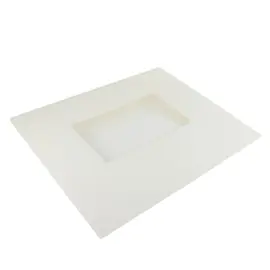
| Door viewing/safety | Helps retain heat while letting you see inside | Door glass WB36X779 |
Knowing the major oven parts helps you troubleshoot faster. For example, uneven browning often points to a heating issue, while temperature swings often point to a sensor or control problem. Ordering the correct replacement part for Kenmore 9114018813 also helps avoid fitment and wiring mismatches.
- Turn off power at the breaker (wall ovens are typically 240V)
- Let the oven cool completely
- Use gloves when handling door glass and metal panels
- Label wires before disconnecting any electrical part
- Use the correct test tool when checking continuity (see how to use a multimeter to test electrical parts video)
Last updated: February 2026
What kind of outlet does a wall oven need?
Most Kenmore wall ovens like model 9114018813 use a 240-volt (208/240V) dedicated circuit and are typically hardwired to a junction box instead of plugging into a standard wall outlet. The exact wiring method and breaker size depend on the oven’s rating label and your home’s electrical setup.
Most electric built-in wall ovens in this class use:
- 208/240V power (not 120V)
- A dedicated circuit (no other appliances on the same breaker)
- Copper wiring sized for the circuit
- A junction box connection (common) or a range-style receptacle (less common)
- A 2-hot plus ground setup; some installations also use a neutral depending on the oven’s design
Wall ovens are usually connected with one of these setups:
| Setup | Conductors you’ll see | Where it connects | Notes |
|---|---|---|---|
| 3-wire (older installs) | Hot, hot, neutral/ground combined | Junction box | Common in older homes; may not meet current code in some areas |
| 4-wire (current standard) | Hot, hot, neutral, ground | Junction box or receptacle | Most common for newer installs |
We recommend these checks first because they prevent nuisance tripping, weak heating, or unsafe wiring:
- Read the rating label (usually on the oven frame behind the door) for amps and volts
- Confirm you have a 2-pole breaker sized to the oven’s requirements (often 30A to 50A for many wall ovens)
- Verify the home wiring is in good condition and the junction box is accessible
- If you are converting from hardwire to plug-in, match the cord/receptacle type to the circuit and code
- If you are troubleshooting power issues, use a meter to confirm voltage at the junction box (see how to use a multimeter to test electrical parts video)
A wall oven draws high current. Using the wrong voltage, breaker size, or wiring method can cause slow preheat, error codes, repeated breaker trips, or damaged components like the temperature sensor WB21X5301.
Last updated: February 2026