
Can I add sawstop to any table saw?
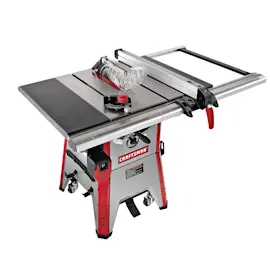
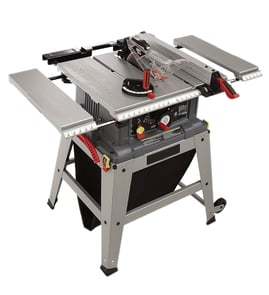
No. You generally cannot add SawStop-style flesh-sensing braking to just any table saw, including the Craftsman 113299120 10" table saw; that safety system is built into specific saw designs and requires a matched blade brake, arbor, and control electronics.
What you can do instead (safer upgrades that fit most saws)
- Use a riving knife or splitter (when your saw supports it) to reduce kickback.
- Install a quality blade guard and anti-kickback pawls if compatible with your fence and throat plate.
- Use a push stick or push block for narrow rips.
- Add a zero-clearance insert to reduce tear-out and help support small offcuts.
- Improve dust collection and lighting so you can see the cut line clearly.
- Keep the blade sharp and appropriate for the material (dull blades increase binding and kickback).
Compatibility checklist before buying any “safety kit”
Because the Craftsman 113299120 is an older-style 10-inch table saw platform, verify these items before you purchase accessories:
| What to check | Why it matters | Typical outcome |
|---|---|---|
| Arbor size and blade diameter | Determines what blades and some guards can fit | Most are 10-inch blades; arbor varies by design |
| Throat plate opening | Affects guard/splitter and insert options | Many upgrades require a matching insert |
| Fence type and alignment | Poor fence alignment increases kickback risk | May need fence tune-up before accessories |
| Mounting points on trunnion/table | Determines whether a splitter/guard can be secured | Some saws need model-specific hardware |
Why it matters
SawStop technology is not just an add-on switch; it is an integrated system that must stop the blade in milliseconds without damaging the saw structure. For most table saws, the practical path is improving kickback prevention, guarding, and safe cutting technique.
Helpful next step
If you are shopping for parts or accessories by model number, use how to find your appliance model number (and what it means for parts) to confirm you are matching items to Craftsman model 113299120.
Last updated: February 2026
Can you use an 8 inch blade on a 10 inch table saw?
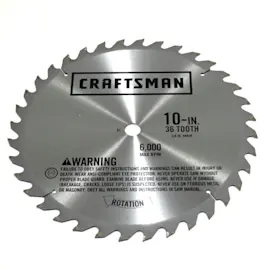
Yes. On a Craftsman 113299120 10-inch table saw, you can use an 8-inch blade as long as the blade’s arbor hole matches your saw’s arbor size and the blade is rated for the saw’s RPM. Expect reduced maximum cut depth compared with a 10-inch blade.
What changes when you drop from 10-inch to 8-inch
An 8-inch blade works fine for many cuts, but it changes how the saw performs.
- Less cutting depth: you lose roughly 1 inch of max depth versus a 10-inch blade.
- Same accuracy potential: fence alignment and blade quality matter more than diameter.
- Different guard fit: the blade guard and splitter/riving knife alignment may not match the smaller diameter.
- Dado note: many stacked dado sets are 8-inch diameter and are commonly used on 10-inch saws (when the saw is designed to accept dado sets).
Quick compatibility checklist (before you install)
Use this list to avoid unsafe fitment issues.
- Confirm the arbor hole size on the blade matches the saw arbor (common sizes are 5/8 inch or 1 inch).
- Verify the blade’s max RPM rating meets or exceeds the saw’s no-load RPM.
- Make sure the blade’s kerf works with your splitter/riving knife (if equipped).
- Check that the flanges and arbor nut fully clamp the blade.
- Spin the blade by hand (unplugged) to confirm no contact with throat plate or guards.
Typical cut-depth comparison
Exact depth varies by saw design and blade geometry, but these are typical ranges.
| Blade diameter | Typical max cut depth at 90° | Typical max cut depth at 45° |
|---|---|---|
| 10-inch | ~3-1/8 in. | ~2-1/4 in. |
| 8-inch | ~2-1/8 in. | ~1-1/2 in. |
Why it matters
Blade diameter affects cut capacity and how well your safety components (guard, splitter/riving knife, throat plate) line up. A correctly sized arbor fit and proper guarding reduce kickback risk and help you get cleaner, more controlled cuts.
For help identifying the exact model number format and what it means when ordering parts, use how to find your appliance model number (and what it means for parts).
Last updated: February 2026
How to get rid of an old table saw?
If you are getting rid of an old Craftsman 113299120 10" table saw, the safest approach is to remove the blade, secure the cord, and choose a disposal option that keeps sharp parts and heavy metal out of regular household trash whenever possible.
Safe prep steps before disposal
- Unplug the saw and remove the blade, throat plate, and any loose guards
- Lower the arbor fully and lock the bevel and height adjustments
- Coil and tape the power cord to the frame so it cannot snag during transport
- Bag or box sharp parts (blade, splitter/riving knife, anti-kickback pawls) separately
- Wipe off heavy sawdust buildup to reduce mess and fire risk during hauling
Best ways to dispose of or rehome a table saw
1) Reuse or donate (best if it still runs)
If the motor runs and the arbor spins smoothly, rehoming is usually the quickest and most responsible option.
2) Scrap metal recycling (best if it is worn out)
Most table saws are largely steel and aluminum. A scrap yard or metal recycler can take the main saw body, stand, and cast-iron top (if equipped). Remove non-metal accessories first.
3) E-waste drop-off (for the motor and switch components)
If your local program separates “corded power tools” as e-waste, that is a good fit for the motor, switch, and wiring.
4) Bulk pickup or transfer station
If recycling is not available, use a bulk pickup day or take it to a transfer station. Keep the blade removed and packaged.
What to remove and keep (quick checklist)
| Item | Remove first? | Why |
|---|---|---|
| Saw blade | Yes | Sharp edge hazard during handling |
| Fence and miter gauge | Yes | Prevents bending and makes transport easier |
| Switch key (if equipped) | Yes | Prevents accidental start if plugged in |
| Extension wings/stand | Optional | Helps fit in a vehicle and reduces weight per piece |
Why it matters
A 10" table saw is heavy and has exposed sharp and pinch-point areas. Prepping it correctly reduces injury risk during lifting and helps recyclers handle the tool safely.
For help confirming you have the correct model number before listing it for donation or recycling paperwork, use how to find your appliance model number (and what it means for parts).
Last updated: February 2026