Owner’s manual
 Error Codes



What is the cubic foot of my Kenmore refrigerator model 10651762510?
The Kenmore side-by-side refrigerator model 10651762510 has a total capacity of about 21.9 cubic feet. For the exact capacity listing and how Kenmore defines usable space for your specific configuration, check the 10651762510 owner's manual.
How to confirm the capacity on your refrigerator
We recommend verifying capacity using the model-specific literature because capacity can be listed as total volume and may vary slightly by configuration.
- Look for a specifications or product data section in the manual
- Confirm you are using the exact model number: 10651762510
- If your unit has an ice maker and in-door ice bin, remember those components reduce usable storage space
- Compare your shelf and bin layout to the diagrams in the manual
Total capacity vs. usable space (what you should expect)
“Cubic feet” is the cabinet’s rated internal volume; usable space is what you can actually load after shelves, bins, and the ice system take up room.
| Measurement type | What it means | What you notice day to day |
|---|---|---|
| Total capacity (cu. ft.) | Rated interior volume | Used for comparing models |
| Usable storage | Space after shelves, bins, ice bucket | Determines how much food fits |
Why it matters
Knowing the capacity helps when you are comparing replacement refrigerators, planning kitchen space, or deciding whether storage issues are caused by organization versus a cooling or airflow problem (for example, blocked vents in a side-by-side).
Last updated: February 2026
What's the average lifespan of a Kenmore refrigerator?
Most Kenmore refrigerators last 10 to 15 years. For a Kenmore 10651762510 side-by-side refrigerator, reaching the high end of that range is common when airflow stays strong, doors seal tightly, and routine maintenance is followed in the 10651762510 owner's manual.
Typical lifespan ranges (what we see most often)
| Appliance type | Typical lifespan | What usually ends it first |
|---|---|---|
| Side-by-side refrigerator | 10 to 15 years | Sealed system wear, cooling airflow issues |
| Top-freezer refrigerator | 12 to 18 years | Thermostat/control issues, door seal leaks |
| Bottom-freezer refrigerator | 10 to 15 years | Fan/defrost problems, control issues |
Maintenance that extends life the most
- Clean condenser coils regularly so the compressor runs cooler and less often.
- Keep door gaskets clean and confirm the doors close easily and fully.
- Replace filters on schedule to protect the water system and keep flow strong.
- Avoid overpacking; blocked vents cause warm spots and longer run times.
- Level the refrigerator so doors self-close and seals stay even.
Parts that commonly affect longevity
These parts do not set the lifespan by themselves, but when they fail, the refrigerator works harder and wears faster:
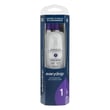
- Refrigerator water filter 9081 (helps protect the dispenser and ice maker water path)
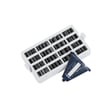
- Refrigerator air filter W10311524 (helps reduce odors and keeps airflow areas cleaner)
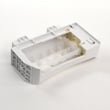
- Refrigerator ice maker W10873791 (a frequent wear item on ice and water models)
- Refrigerator electronic control board WPW10226427 (controls key cooling functions)
Why it matters
A refrigerator that runs longer than normal to hold temperature uses more energy and puts extra load on the compressor and fans. Simple upkeep, especially coil cleaning and good door sealing, is the difference between a typical 10 to 15 year life and an early failure.
Last updated: February 2026
Why is my Kenmore side by side ice maker not working?
On Kenmore side-by-side refrigerator model 10651762510, an ice maker usually stops working because water flow is restricted (shutoff closed, kinked line, clogged filter), the ice maker is switched OFF, or the unit needs 24 to 72 hours after a new install or water-system flush.
Quick checks that fix most no-ice problems
- Make sure the household water shutoff valve is fully open.
- Straighten any kinked water supply line; kinks reduce flow and cause small or hollow cubes.
- Confirm the ice maker is turned ON (wire shutoff arm down or switch ON, depending on design).
- Verify the freezer door closes completely; some dispensers will not run unless the door is fully shut.
- If you recently changed the filter, flush the water system and discard early ice.
Normal timing after setup or filter changes
| Situation | What to expect |
|---|---|
| After connecting water or flushing | Ice can start in about 24 hours |
| Full ice production | Up to 72 hours |
| First ice made | Discard the first 3 batches |
For model-specific steps, use the 10651762510 owner's manual.
Clear ice jams and dispenser clogs
- Check for ice jammed in the ejector area (on some models).
- Break up clumped ice in the bin with a plastic utensil.
- Clean and dry the ice chute and bin bottom; empty and clean about every 2 weeks.
When to suspect a failed inlet valve
If the ice maker never fills with water and the supply is on and unkinked, the inlet valve is the next common cause. For this model, a matching replacement is the refrigerator water inlet valve WPW10341320.
Why it matters
Restoring proper water flow prevents hollow cubes, dispenser jams, and repeated thaw-refreeze clumping that keeps the ice maker from producing consistently.
Last updated: February 2026