Owner’s manual
 Error Codes



How to remove bottom grille on GE refrigerator?
On the GE CFE28TSHBSS bottom-mount refrigerator, the bottom grille (base grille) is typically held in place with screws and/or locking tabs. We remove it by taking out the fasteners first, then pulling the grille straight out so the clips release without cracking the plastic. For model-specific access points, use the owner's manual.
Steps to remove the bottom grille
- Unplug the refrigerator or switch off power at the breaker (recommended when working near wiring).
- If the unit is tight to the wall, raise the front leveling legs slightly and pull the refrigerator straight out (avoid sliding sideways to protect the floor).
- Look along the top edge and corners of the grille for screws; remove them with a Phillips screwdriver.
- Grip the grille near both ends and pull straight outward to release the retaining clips.
- If it feels stuck, press in on any visible tabs while pulling; do not pry hard with a metal tool.
Reinstalling the grille
Line the grille up with the mounting slots, push it in until it seats, then reinstall the screws.
| Task | What to do | What to avoid |
|---|---|---|
| Remove fasteners | Take out Phillips screws first | Forcing the grille while screws are still installed |
| Release clips | Pull straight out with two hands | Twisting the grille (can snap clips) |
| Move refrigerator | Pull straight out, then push straight back | Rolling over the power cord or water line |
Why it matters
The bottom grille helps protect components and supports airflow around the machine compartment. Removing it the right way prevents broken tabs, rattles, and poor fit after reassembly.
Last updated: February 2026
Is GE Café considered high end?
Yes. GE Café is widely considered a high-end line within GE’s mainstream lineup; it’s positioned above standard GE models and typically offers more premium styling, finishes, and feature sets. For your GE CFE28TSHBSS refrigerator, the “high-end” experience is mainly about design and convenience features, not different basic cooling fundamentals.
What “high end” means for GE Café refrigerators
GE Café is generally viewed as “premium” because it emphasizes upgraded aesthetics and user-facing features.
- More design-forward look (handles, finishes, coordinated styling)
- Feature-rich controls and dispenser options (varies by model)
- Higher typical price point than standard GE lines
- More emphasis on fit-and-finish details (doors, trim, lighting)
- Similar core refrigeration system concepts (compressor, fans, defrost) as other quality refrigerators
Practical ownership notes (filters and maintenance)
For the CFE28TSHBSS, using the correct water filter and replacing it on schedule helps protect water flow and reduces leak risk from a stressed filter housing. The manual also notes that damage caused by a non-GE brand water filter can affect warranty coverage; we recommend sticking with the specified filter type and intervals in the owner's manual.
Here are common, model-relevant maintenance items that support “premium” performance:
- Replace the water filter on schedule; don’t run it past its service life
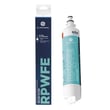
- If you need a replacement, use the correct refrigerator water filter RPWFE
- Purge air after filter changes to reduce sputtering at the dispenser
- Keep door gaskets sealing evenly to prevent moisture and temperature swings
- Address error codes promptly using the display guidance and troubleshooting steps
Quick comparison: where Café typically sits
| Tier | Example positioning | What you usually get |
|---|---|---|
| Mainstream | Standard GE | Core features, value-focused |
| Premium | GE Café | Upgraded styling, more convenience features |
| Luxury | Built-in luxury brands | Pro-level build, integrated designs, highest cost |
Why it matters
If you’re choosing parts or planning repairs, “high end” mostly affects cosmetics and feature components (like dispenser controls, lighting, and door hardware). The essentials, like temperature sensing and airflow, still rely on standard serviceable parts and good maintenance practices.
Last updated: February 2026
What is the most common problem with a GE refrigerator?
The most common issue we see with GE refrigerators like model CFE28TSHBSS is a cooling problem (fresh food or freezer not staying at the set temperature). It is usually caused by airflow restrictions, a defrost system issue, or a failed cooling component such as a sensor or evaporator fan.
Quick checks before replacing parts
- Confirm the temperature settings for the freezer and fresh food sections in the owner's manual.
- Make sure the doors fully close and seal; a small gap can cause warm temps and frost.
- Avoid overpacking; blocked vents reduce airflow and cause uneven cooling.
- Listen for the evaporator fan; if it is silent or noisy, airflow can stop.
- Check for heavy frost on the freezer back wall; that points to a defrost problem.
- Clean dust from the condenser area (where accessible); poor heat release hurts cooling.
Parts that commonly relate to “not cooling” symptoms
If the basic checks above do not help, these model-matched parts are common suspects:
| Symptom you notice | Likely area | Example model-matched part |
|---|---|---|
| Temps drift up and down | Temperature sensing | Refrigerator temperature sensor WR55X10025 |
| Warm fridge, freezer OK or weak airflow | Evaporator fan/air movement | Refrigerator evaporator fan motor assembly WR60X35205 |
| Frost buildup, warm temps over time | Defrost system | Refrigerator defrost heater WR51X10132 or refrigerator defrost bi-metal thermostat WR50X10108 |
| Interior lights out (less common) | Lighting circuit | Refrigerator led light assembly WR55X11132 |
Why it matters
Cooling issues can snowball quickly: warmer temperatures increase run time, create frost and airflow blockages, and can lead to food spoilage. Catching the cause early (airflow, defrost, sensor, or fan) helps restore stable temperatures and reduces strain on the compressor.
Related control and alarm features (helpful for diagnosis)
Your CFE28TSHBSS has control features that can affect what you observe during troubleshooting:
- Door alarm alerts when doors are left open.
- Control lock can disable dispenser and buttons.
- Sabbath mode turns off interior lights and some advanced features; the compressor runs on a timed defrost in this mode.
For door-alarm behavior and reset steps, use how to reset the door alarm on a GE refrigerator.
Last updated: February 2026
Is a top mount or bottom mount fridge better?
A bottom-mount refrigerator like the GE CFE28TSHBSS is better for everyday convenience because the fresh-food section sits at eye level, so you bend less for the items you use most. A top-mount is often the better pick if you want a simpler layout and typically lower purchase cost.
Quick comparison
| Feature | Top-mount (freezer on top) | Bottom-mount (freezer on bottom) |
|---|---|---|
| Most-used items | Lower, more bending | Higher, easier access |
| Freezer access | Easy, at chest level | More bending, often a pull-out drawer |
| Organization | Usually simpler | Often more bins, drawers, and zones |
| Efficiency | Often slightly better | Often slightly lower (varies by model) |
| Best for | Budget, simplicity | Convenience, fresh-food access |
What we recommend choosing based on
- How you cook: If you use fresh ingredients daily, bottom-mount wins for access.
- Freezer habits: If you’re in the freezer constantly, a top-mount can feel easier.
- Kitchen fit: Measure height, width, and depth (including handles) before deciding.
- Storage style: Bottom-mount designs commonly support more “grab-and-go” organization.
- Maintenance comfort: Both styles need routine cleaning and good door sealing.
For model-specific dimensions and clearance guidance for your GE CFE28TSHBSS, use the owner's manual.
Why it matters
The “better” style is the one that matches how you reach, load, and organize food. Layout affects daily comfort, door-swing clearance, and how evenly temperatures stay when the doors are opened frequently.
Related parts that support performance
Even the best layout will feel “worse” if cooling or water flow is off. These common maintenance and performance parts for the CFE28TSHBSS can help:
- Refrigerator water filter RPWFE
- Refrigerator temperature sensor WR55X10025
- Refrigerator evaporator fan motor assembly WR60X35205
Last updated: February 2026