Error Codes


How many cubic feet is my Kenmore refrigerator by model number?
Your Kenmore top-mount refrigerator model 1069610680 has a specific cubic-foot capacity, but the most reliable way to get the exact number is to read the refrigerator’s rating plate (model and serial tag) inside the fresh-food section. That tag lists the official capacity for your exact build.
Use these methods in order; the first one is the most accurate.
- Check the rating plate inside the refrigerator compartment (often on a side wall, ceiling, or near the crisper area). Look for “Capacity” or “Total volume.”
- Look for a tech sheet stored on many Kenmore 106-style units (commonly behind the toe grille or taped to the back). It often lists capacity and specs.
- Use model-based lookup by searching the model number 1069610680 in our parts system; model families sometimes share similar cabinet sizes, but the tag is still the final word.
- Estimate by measuring interior volume only if the tag is missing (see the quick estimate below).
If you need a working estimate, measure the usable interior space and convert to cubic feet.
- Measure width x depth x height of the fresh-food compartment (in inches)
- Do the same for the freezer compartment
- Add them together, then divide by 1,728
| What you have | What it gives you | Best for |
|---|---|---|
| Rating plate capacity | Exact factory cubic feet | Accurate listing and comparisons |
| Interior measurement estimate | Approximate usable cubic feet | Planning shelf/bin space |
Cubic-foot capacity helps you compare refrigerators, choose correctly sized storage bins, and understand whether cooling issues are related to overloading or airflow restrictions.
If you are checking capacity because the refrigerator is not cooling right, we recommend reviewing common Kenmore diagnostics in Kenmore 106 model refrigerator error codes.
Last updated: February 2026
How to find Kenmore refrigerator model number?
For your Kenmore top-mount refrigerator, the model number is printed on a rating label inside the fresh food section or freezer. On model 1069610680, the label is most often on an inside wall, along the door frame, or behind the lower crisper drawer.
- Inside the refrigerator compartment on a side wall (upper area)
- Inside the freezer on a side wall or back wall
- On the door frame (open the door and look around the perimeter)
- Behind or just above the lower crisper drawer area
- Behind the toe grille or kick plate at the bottom front
The rating label typically includes:
- Model (this is the model number you need)
- Serial (unique to your unit)
- Electrical ratings (volts/amps)
- Sometimes a type code or manufacturing date
| You need this for | What to write down |
|---|---|
| Ordering parts | Full model number (example: 1069610680) |
| Matching the right diagram | Model number plus any suffix letters/numbers (if shown) |
| Service history | Model and serial number |
Kenmore model numbers can look similar across different refrigerator designs. Using the exact model number from the rating label helps us match the correct parts list and diagrams, so you get the right items the first time.
If you are troubleshooting cooling or frost issues after you find the model number, our Kenmore 106 model refrigerator error codes guide can help you narrow down the problem.
Last updated: February 2026
What's the average lifespan of a Kenmore refrigerator?
Most Kenmore refrigerators average 10 to 15 years of service life. For a Kenmore 1069610680 top-mount refrigerator, consistent maintenance (clean airflow, good door sealing, and stable temperatures) is what most often determines whether it lands closer to 10 years or pushes beyond 15.
- 10 to 15 years: common for many household refrigerators
- 15 to 20 years: achievable when the sealed system stays healthy and maintenance is consistent
- Under 10 years: most often tied to poor airflow (dirty condenser area), door seal leaks, or repeated cooling-system stress
- Condenser airflow: keep the condenser area clear of dust and pet hair
- Door gasket condition: a leaking gasket forces longer run times and shortens component life
- Defrost performance: heavy frost buildup can reduce cooling and overwork the compressor
- Fan operation: evaporator and condenser fans must run smoothly to move heat properly
- Temperature habits: avoid frequent warm-load dumping and keep settings steady
- Vacuum the condenser area regularly (more often with pets).
- Confirm doors close fully and don’t pop open.
- Keep vents inside the refrigerator and freezer unblocked.
- If you see recurring frost on the freezer back wall, address defrost issues early.
- If the unit struggles to start or clicks repeatedly, check start components promptly.
| Symptom | What it can point to | Example part on this model page |
|---|---|---|
| Clicking, hard starting, intermittent cooling | Start circuit issues | Run capacitor WPW10662129 |
| Frost buildup, warm fridge section | Defrost control problem | Refrigerator defrost bi-metal WP4387503 |
| Water under fridge or in drain area | Drain system issue | Refrigerator drain pan WPW10614158 |
A refrigerator that runs longer than it should (from dirty coils, air leaks, or frost restriction) puts extra wear on the compressor, fans, and defrost system. Fixing small airflow or sealing problems early is the simplest way to extend the life of your Kenmore top-mount refrigerator.
Last updated: February 2026
Why is the top part of my refrigerator not cooling?
If the fresh food (top) section of your Kenmore 1069610680 top-mount refrigerator is warm, the most common causes are blocked airflow from the freezer, frost buildup on the evaporator, or a failed fan that is not moving cold air into the refrigerator compartment.
- Make sure packages are not blocking the air vents between the freezer and refrigerator sections.
- Set the refrigerator control to a colder setting and wait 24 hours to see if temperatures stabilize.
- Confirm the freezer is actually cold (around 0°F to 5°F); the refrigerator section depends on freezer cooling.
- Listen for the evaporator fan running (usually a steady fan sound when the compressor is on).
- Check door closing and sealing; warm air leaks can overwhelm cooling.
Cold air is made in the freezer and pushed into the refrigerator by the evaporator fan. If airflow is restricted or the fan is not running, the top section warms up even though the freezer may still feel cold.
| Symptom | Likely cause | What you can do next |
|---|---|---|
| Freezer cold, fridge warm | Air vent blocked | Clear items away from vents and return vents |
| Frost/ice on freezer back wall | Defrost problem | Inspect defrost components; consider refrigerator defrost bi-metal WP4387503 |
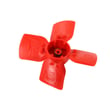
| No fan sound from freezer | Evaporator fan issue | Check wiring/ice obstruction; consider evaporator motor 482731 |
| Warm temps and compressor struggles to start | Start/run components | Consider run capacitor WPW10662129 if symptoms match |
When airflow or defrost fails, temperatures in the fresh food section rise quickly, food spoils faster, and the compressor can run longer than normal. Fixing the root cause restores proper air circulation and stable temperatures.
For step-by-step troubleshooting of airflow and fan issues, use our DIY article how to fix your evaporator cooling fan.
Last updated: February 2026