Installation guide
 Owner’s manual
 Error Codes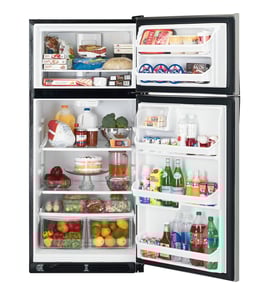




What are the disadvantages of a top mount fridge?
A top-mount refrigerator like the Frigidaire LFHT1817LB4 puts the freezer at eye level and the fresh-food section below; the main disadvantages are more bending to reach everyday items, fewer convenience features on many models, and less flexible organization than many bottom-freezer designs. See the LFHT1817LB4 owner’s manual for your model’s specific features and storage layout.
- More bending and squatting to reach produce drawers, deli drawers, and lower shelves.
- Less “fresh-food first” ergonomics since the refrigerator compartment is lower.
- Fewer built-in convenience options on many top-mounts (for example, limited in-door water or ice features on some configurations).
- Tighter organization in the freezer compared with many drawer-style bottom freezers.
- Door swing and clearance needs can be more noticeable in smaller kitchens; proper clearances help airflow and usability.
We recommend these setup habits to make a top-mount easier to live with:
- Keep the most-used items at mid-shelf height in the fresh-food section.
- Use bins to group items so you are not searching on lower shelves.
- Set controls and then wait a full day before changing again (temperature changes take time to stabilize).
- Confirm the cabinet is level and slightly tilted back so doors close reliably.
- Maintain installation clearances for airflow (typical guidance is small side/top clearance and about 1 inch behind).
| Feature | Top-mount (like LFHT1817LB4) | Bottom-freezer |
|---|---|---|
| Fresh-food access | Lower, more bending | Higher, easier reach |
| Freezer access | Higher, easier reach | Lower, drawer-style on many models |
| Organization | Often simpler shelving | Often more flexible layouts |
| Typical cost | Often lower | Often higher |
Ergonomics and organization affect how well food stays visible and accessible; when items are easier to reach and group, you waste less time with the door open and the refrigerator holds temperature more consistently.
Last updated: February 2026
How to reset a Frigidaire freezer control panel?
For a Frigidaire LFHT1817LB4 top-mount refrigerator, the most reliable “reset” for the freezer control panel is a power cycle: unplug the refrigerator (or switch off the breaker) for 5 minutes, then restore power and allow the controls time to stabilize. Use the temperature control guidance in the LFHT1817LB4 owner’s manual.
- Unplug the refrigerator or turn off the circuit breaker.
- Wait 5 minutes (this clears minor control glitches).
- Restore power.
- Confirm the interior lights and fans come back on.
- Set Fresh Food and Freezer controls back to your preferred settings.
- Wait 24 hours before making additional temperature adjustments (this is normal for this style of control system).
If the display or temperature response still seems off after a power cycle, focus on the basics that affect control behavior:
- Make sure the doors seal completely on all sides.
- Verify the refrigerator is level and slightly tilted 1/4 inch (6 mm) front to back.
- Confirm the toe grille is properly attached.
- Avoid rapid setting changes; give the unit time to respond.
| Situation | What you’ll see | What to do |
|---|---|---|
| You change a temperature setting | Cooling changes slowly | Wait up to 24 hours before changing again |
| LED-style temperature range | Mid-range is typical | Many models run normally around 3 to 5 |
| After a power outage | Display may act odd briefly | Power cycle, then reset temps |
A power cycle clears minor electronic glitches, but stable temperatures depend on airflow, leveling, and tight door seals. If the refrigerator is not level or the gasket leaks, the freezer can warm up and make the controls seem unresponsive.
Last updated: February 2026
What is the upper part of a fridge called?
In a top-mount refrigerator like the Frigidaire LFHT1817LB4, the upper compartment is the freezer. It is designed to keep foods frozen and typically houses freezer shelving, the ice maker area (if equipped), and cold-air circulation components.
- Freezer shelves or bins for frozen food storage
- A freezer temperature control or shared control system (varies by model)
- An ice maker area (if your refrigerator is equipped with one)
- Air vents that circulate cold air between the freezer and fresh food section
- The freezer door and door seal (gasket)
| Compartment | Typical location on LFHT1817LB4 | Main purpose | Typical temperature |
|---|---|---|---|
| Freezer | Top | Long-term frozen storage | About 0°F |
| Fresh food (refrigerator) | Bottom | Chilled storage for everyday foods | About 37°F |
Knowing the correct compartment name helps when you are troubleshooting cooling issues, checking airflow, or ordering the right Frigidaire refrigerator parts (for example, freezer door components versus fresh food door bins).
- For control settings and normal operation guidance, use the LFHT1817LB4 owner’s manual.
- For setup details like leveling and door seal checks, use the LFHT1817LB4 installation guide.
Last updated: February 2026
Are top mount or bottom mount fridges better?
Top-mount and bottom-mount refrigerators are both good choices; the better option depends on how you use your kitchen. For a Frigidaire top-mount like model LFHT1817LB4, you typically get a simpler layout and often lower operating cost, while bottom-mount designs usually make fresh-food access easier at eye level.
| Feature | Top mount (freezer on top) | Bottom mount (freezer on bottom) |
|---|---|---|
| Fresh-food access | Lower; more bending | Higher; less bending |
| Freezer access | Easier; at chest/eye level | Lower; more bending |
| Efficiency and complexity | Often simpler; commonly efficient | Often more features; can use more energy |
| Cost to buy/repair | Often lower | Often higher |
Top-mount refrigerators are a strong fit when you want straightforward cooling, fewer “extras” to maintain, and a layout that works well for frozen-food-heavy households.
- You use the freezer often (frozen meals, bulk storage)
- You want a simpler design with fewer components to service
- You prefer a typically lower purchase price
- You have limited kitchen space and want a classic, compact footprint
- You are comfortable bending to reach crisper drawers and lower shelves
Bottom-mount models are usually chosen for convenience in the fresh-food section, since the refrigerator compartment is where most people spend the most time.
- You cook frequently and want fresh food at eye level
- You have back or knee discomfort and want less bending for daily items
- You store lots of produce and use crispers often
- You want wider refrigerator shelves and easier access to drinks and leftovers
The “best” style is the one that matches your habits. If you open the freezer more than the refrigerator, a top mount can feel more ergonomic. If you live in the fresh-food section, a bottom mount can reduce daily bending and make organization easier.
A properly installed and leveled refrigerator cools more consistently and seals better. We recommend following the clearances, leveling steps, and door-seal checks in the LFHT1817LB4 installation guide.
Last updated: February 2026
What number should my Frigidaire freezer be set at?
For the Frigidaire LFHT1817LB4 top-mount refrigerator, set the freezer to keep food at 0°F; if your control is a numbered dial, start in the middle range and make small changes, then wait 24 hours for temperatures to stabilize (as noted in the LFHT1817LB4 installation guide).
Most Frigidaire top-mount models use either a numbered dial (relative coldness) or an LED range setting.
- Target freezer temperature: 0°F (-18°C)
- If you have an LED-style range control, 3 to 5 is the normal operating range
- If you have a numbered dial, start at mid-setting (commonly around 4 to 6)
- Adjust only one step at a time
- Wait 24 hours before adjusting again
- Put an appliance thermometer between frozen packages in the center of the freezer.
- Check the temperature after the unit runs normally for a full day.
- If the freezer is warmer than 0°F, turn the control colder one step.
- If the freezer is colder than needed (for example, consistently below -5°F), turn the control warmer one step.
Numbered controls are not degrees; they are a relative scale.
| Control type | What you set | What it means |
|---|---|---|
| Numbered dial | 1 to 9 (varies) | Higher number = colder |
| LED range | 1 to 9 (varies) | 3 to 5 = normal range |
| Digital temp display | Degrees | Shows actual temperature |
Keeping the freezer near 0°F helps prevent thawing and refreezing (freezer burn), protects food quality, and reduces compressor run time. If temperatures swing a lot, also check that the doors seal fully and the refrigerator is properly leveled, which are part of the setup checks in the LFHT1817LB4 installation guide.
Last updated: February 2026
Why is my Frigidaire Professional freezer not making ice?
If your Frigidaire LFHT1817LB4 freezer is not making ice, the most common causes are the ice maker being turned OFF, the water supply not connected or leaking, or temperature and airflow issues that prevent the ice maker from cycling. Start with the ice maker ON check and water connection checks in the LFHT1817LB4 installation guide.
- Confirm the ice maker is turned ON (some models use a signal arm; others use a switch).
- Verify the house water supply is connected and the shutoff valve is fully open.
- Look for drips at the water line connections; recheck for leaks after 24 hours.
- Make sure the freezer is cold enough; allow 24 hours after any control change.
- Check that the refrigerator is level and tilted slightly back (about 1/4 inch front to back) so doors seal well.
- Ice maker ON: Ensure the ice maker is ON before troubleshooting anything else.
- Water supply: If the water line is not connected yet, keep the ice maker OFF until it is connected.
- Temperature: After adjusting controls, wait 24 hours before making more changes.
- Airflow: Avoid blocking freezer vents with food packages; poor airflow can slow or stop ice production.
- Door seal: If the freezer door is not sealing, warm air and frost can interfere with ice maker operation.
| Symptom | Most likely cause | What to do next |
|---|---|---|
| No ice at all | Ice maker OFF or no water supply | Turn ice maker ON; confirm water valve is open |
| Small or hollow cubes | Low water flow | Check for kinked line; confirm strong household water pressure |
| Frost buildup, slow ice | Door not sealing or airflow blocked | Check gasket contact; clear vents |
| Water leaking at back | Loose connection | Tighten fittings; recheck in 24 hours |
An ice maker depends on steady water flow, a tight door seal, and stable freezer temperatures. Fixing a simple ON setting, leak, or airflow problem prevents repeat freeze-ups and helps the refrigerator maintain consistent cooling.
- Use common refrigerator ice maker problems and solutions to match your exact symptom to the right next check.
Last updated: February 2026
What is the most common problem with Frigidaire refrigerators?
Cooling problems are the most common issue we see with Frigidaire refrigerators, including model LFHT1817LB4. The usual pattern is the freezer stays cold while the fresh-food section warms up; that points to restricted airflow, dirty condenser coils, or a defrost problem causing ice buildup.
- Freezer cold but refrigerator warm
- Frost or ice on the freezer back wall
- Temperatures swing or food freezes in the refrigerator section
- Fan noise changes (louder, intermittent, or silent)
- Water dripping inside after heavy frost
The installation instructions for LFHT1817LB4 note to wait 24 hours after control changes; use the LFHT1817LB4 installation guide as your baseline.
- Set controls to a normal setting; wait 24 hours before adjusting again
- Confirm doors seal fully and the cabinet is level (poor sealing causes warm temps and frost)
- Clean condenser coils to restore heat transfer
- Keep interior vents clear of food packages
- If equipped with an ice maker, verify the water connection is dry; recheck for leaks after 24 hours
| Symptom | Most likely area | Next step |
|---|---|---|
| Freezer cold, fridge warm | Airflow (fan, vents, ice on coils) | Listen for fan, check for frost, clear vents |
| Heavy frost on freezer wall | Defrost system | Inspect for ice buildup; test defrost parts |
| Warm everywhere | Coils or sealed system | Clean coils; if unchanged, schedule service |
- Refrigerator evaporator fan motor 241854301 (circulates cold air)
- Refrigerator defrost heater 242044008 (melts frost during defrost)
- Refrigerator defrost bi-metal thermostat 5303918202 (helps control defrost operation)
When airflow is blocked by ice or the fan cannot move air, the refrigerator section warms first even if the freezer still feels cold; that can affect food safety and increase run time.
Last updated: February 2026