Owner’s manual
 Error Codes





How to tell if a Samsung dryer heating element is bad?
On a Samsung dryer like model DV511AGW, a bad heating element usually shows up as no heat or weak heat even though the drum tumbles. The most reliable check is a continuity/resistance test with a multimeter after unplugging the dryer and accessing the heater terminals (see the DV511AGW owner's manual).
Quick signs the heating element is failing
- Clothes stay damp after a full cycle, especially on timed dry
- Dryer runs normally but produces little or no heat
- Burning smell or scorching (stop using the dryer until inspected)
- Breaks or damage visible on the heater coil (if you can see it)
- Heat is intermittent (heats sometimes, then stops)
How we test the heating element (multimeter method)
- Disconnect power (unplug; for electric dryers, confirm power is off).
- Access the heater housing and remove at least one wire from the element terminal so you are not reading through the circuit.
- Set the meter to ohms (Ω) or continuity.
- Test terminal-to-terminal on the element.
- Test each terminal to the metal heater housing (ground test).
What the readings mean
| Test | Normal result | What “bad” looks like |
|---|---|---|
| Terminal to terminal | Continuity and a steady resistance reading | No continuity or “OL/infinite” (open element) |
| Terminal to metal housing | No continuity | Continuity (short to ground) |
Don’t overlook these common “no heat” causes
A good element can still mean no heat if a safety or airflow part has failed.
- Restricted venting or lint buildup (most common)
- Failed high-limit thermostat: dryer high-limit thermostat DC47-00017A
- Failed thermal cut-off: dryer thermal cut-off thermostat DC47-00016A
- Temperature sensing issue: dryer thermistor DC32-00007A
Why it matters
A grounded or open heating element can stop drying performance and can also overheat wiring or trip safety devices. Confirming the element with a meter helps you replace the right part and restore safe, normal heat.
Last updated: February 2026
How do I reset my Samsung dryer?
For the Samsung DV511AGW dryer, the most reliable reset is a power cycle: turn the dryer off, disconnect power at the plug or breaker for 5 minutes, then restore power and start a cycle. This clears many temporary control glitches and some error conditions.
Reset steps (recommended)
- Press Power to turn the dryer off.
- Unplug the dryer, or switch the dryer circuit breaker OFF.
- Wait 5 minutes (10 minutes if the control panel was frozen).
- Restore power (plug back in, or switch breaker ON).
- Press Power, select a cycle, and press Start/Pause.
- If an error returns immediately, stop and troubleshoot the cause instead of repeating resets.
If the dryer still will not run after a reset
A reset will not fix an open door circuit, overheating safety trip, or a failed component. Check these common causes:
- Door not fully closed or a failed door switch
- Restricted venting or lint buildup causing overheating
- No heat or cycling heat due to a temperature-sensing issue
- Drum not turning due to a belt or roller problem
Quick symptom-to-next-step table
| What you see | What to check next | Common related part |
|---|---|---|
| Panel responds, but dryer will not start | Door latch and switch operation | Dryer door switch DC64-00828B |
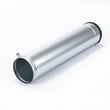
| Dryer stops mid-cycle, clothes still damp | Airflow and vent restriction | Dryer exhaust duct connector DC97-07895A |
| Dryer overheats or shuts down on heat | Lint blockage, then safety thermostats | Dryer thermal cut-off thermostat DC47-00016A |
Why it matters
Resetting is a fast first step, but repeated overheating or no-start symptoms usually point to airflow problems or a failed switch, thermostat, or sensor. Fixing the root cause prevents repeat shutdowns and helps the dryer dry faster and more evenly.
For model-specific operating details and any display messages, follow the DV511AGW user manual. You can also match any code to the Samsung dryer error codes guide to narrow the next check.
Last updated: February 2026
What is the average lifespan of a Samsung dryer?
A Samsung dryer typically lasts 10 to 15 years with normal household use. For your Samsung DV511AGW dryer, consistent airflow maintenance (lint and venting) and avoiding overloads are the biggest factors that push life toward the high end; see the DV511AGW owner’s manual for model-specific care guidance.
What affects dryer lifespan the most
- Vent restriction (crushed duct, long runs, clogged vent hood) that overheats the dryer
- Lint buildup in the lint screen housing and blower area
- Overloading that strains the drum belt, rollers, and motor
- Heat stress from repeated high-heat cycles and poor airflow
- Wear parts aging out (belt, rollers, thermostats, sensors)
Maintenance that helps you reach 15 years
- Clean the lint screen every load
- Inspect and clean the entire vent path regularly (dryer outlet to exterior hood)
- Keep loads medium-sized so the drum tumbles freely
- Use lower heat when appropriate and avoid back-to-back heavy loads
- Listen for early warning noises and address them before they damage other parts
Common wear items and what they usually mean
| Symptom | Common cause | Example part for DV511AGW |
|---|---|---|
| Squealing, thumping, rumbling | Worn drum support rollers | Samsung dryer drum support roller DC97-16782A |
| Drum not turning, burning rubber smell | Worn or broken belt | Samsung dryer drum belt 6602-001655 |
| Overheating, shuts off mid-cycle | Airflow issue or safety thermostat opening | Dryer thermal cut-off thermostat DC47-00016A |
Why it matters
A dryer can run for years past the “average” if it stays cool and ventilated. Most early failures we see are airflow-related; restricted venting raises temperatures, which shortens the life of thermostats, sensors, the motor, and even the drum support system.
Last updated: February 2026
How to tell if Samsung dryer thermal fuse is bad?
On a Samsung DV511AGW dryer, a bad thermal fuse typically shows up as a dryer that will not start (most common) or a dryer that runs but won’t heat. The sure way to tell is a continuity test with a multimeter; a good fuse reads closed/near 0 ohms, a blown fuse reads open (no continuity). For model-specific access and test points, use the DV511AGW owner's manual.
Quick symptoms checklist
- Dryer won’t start even though the display and controls seem normal
- Drum light may work but motor will not run
- Dryer runs but produces no heat (on some configurations)
- Cycle stops early after a short run time
- You recently had poor airflow (long dry times, very hot cabinet)
How we test the thermal fuse (basic method)
- Unplug the dryer (and shut off gas if you have a gas model).
- Access the fuse area (commonly on the blower housing or heater duct).
- Pull at least one wire off the fuse terminal.
- Set the meter to continuity or ohms.
- Touch probes to the fuse terminals.
What the meter reading means
| Meter result | What it means | What to do next |
|---|---|---|
| Beep / ~0 to 1 ohm | Fuse is good | Keep troubleshooting airflow, heat circuit, or controls |
| No beep / OL / very high ohms | Fuse is blown | Replace the fuse and correct the overheating cause |
Fix the cause first (or it can blow again)
A thermal fuse usually opens because the dryer overheated. Before or right after replacing it, we recommend:
- Clean the lint screen and housing
- Inspect and clear the vent duct to the outside
- Confirm the outside vent hood opens freely
- Check for crushed, kinked, or overly long venting
- If heat is erratic, test heat sensors such as the dryer high-limit thermostat DC47-00017A and the dryer thermal cut-off thermostat DC47-00016A
Why it matters
The thermal fuse is a safety device; when it opens, it prevents unsafe overheating. Restoring proper airflow and verifying thermostats helps your DV511AGW dry faster, run cooler, and avoid repeat failures.
Last updated: February 2026