 Owner’s manual
 Error Codes


Is 7.4 cubic feet a large dryer?
Yes. A 7.4 cubic foot drum is considered a large-capacity dryer; it typically handles bigger mixed loads and bulky items (like comforters) with fewer cycles. For your Hotpoint NBXR453EV0WW settings and load guidance, use the NBXR453EV0WW owner's manual.
What “large capacity” means in real use
A 7.4 cu. ft. electric dryer is generally a step up from standard capacity. It helps when you want to dry more at once without overpacking the drum.
Common benefits:
- Fewer loads per week for families
- More room for bulky items (blankets, comforters)
- Better tumbling action when loads are sized correctly
- Less chance of wrinkles from crowding (when you avoid overfilling)
Capacity comparison (typical ranges)
| Dryer capacity | Typical label | Best for |
|---|---|---|
| 5.0 to 7.0 cu. ft. | Standard | Regular weekly laundry |
| 7.1 to 7.8 cu. ft. | Large | Bigger loads, bulky items |
| 7.9+ cu. ft. | Extra-large | Very large households, frequent bulky loads |
Tips to get the best drying performance
Even with a large drum, drying time depends heavily on airflow and venting. The manual recommends proper venting and using 4-inch rigid or flexible metal ducting (not plastic) for best performance.
We recommend:
- Clean the lint filter before every load
- Do not pack the drum tight; leave room for tumbling
- Sort heavy fabrics (towels, jeans) away from lightweight items
- Use the shortest, least-restricted vent run possible
- Check the outside damper for easy opening and no blockage
If loads still take too long, follow the airflow checks in dryer takes a long time to dry.
Why it matters
A large-capacity dryer like the NBXR453EV0WW saves time and energy only when loads tumble freely and the exhaust duct is clear; restricted venting forces longer run times and inconsistent drying.
Last updated: February 2026
What are the most common issues with NBXR453EV0WW?
The most common issues we see with the Hotpoint NBXR453EV0WW electric dryer are no heat or poor drying, the drum not turning, loud squealing or thumping, and the dryer not starting. These problems usually trace to airflow restrictions, a worn belt or idler, or a failed switch, thermostat, or timer; use the owner's manual for model-specific checks.
Common symptoms and likely causes
- No heat or weak heat: failed thermostat, safety thermostat, or heater housing issue; also check venting for clogs
- Takes too long to dry: restricted exhaust duct, lint buildup, or a weak blower wheel
- Drum will not turn: broken belt, worn idler pulley, or motor problem
- Loud squeal, scraping, or thump: worn drum slides, felt, or bearing
- Will not start: door switch not closing, timer failure, or a wiring/connection problem
Quick checks we recommend first
- Clean the lint screen and confirm strong airflow at the outside vent.
- Verify the door closes firmly; a bad door switch can stop the motor.
- Listen for motor hum with no drum movement (often belt or idler related).
- If drying is slow, inspect the exhaust duct for kinks, crushed sections, or lint blockage.
Parts that commonly fix these issues (for NBXR453EV0WW)
| Symptom | Common part to inspect/replace | Example part on this model |
|---|---|---|
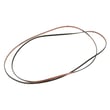
| Drum not turning | Belt and idler system | Drive belt WE03X29897, idler pulley WE03X31620 |
| Loud noise | Drum support surfaces | Slide drum WE03X37317, felt WE09X27634 |
| Won’t start | Door circuit | Door switch WE4M415 |
| Overheats or no heat | Temperature control | Dryer operating thermostat WE4M216 |
Why it matters
Dryer problems often start small (a slipping belt, restricted venting, a worn drum slide) and quickly lead to bigger failures like motor strain, overheating, or repeated shutdowns. Addressing the root cause restores safe airflow, stable drum support, and consistent heat.
Last updated: March 2026
Why is my Hotpoint dryer not working?
For a Hotpoint NBXR453EV0WW electric dryer that is not working at all, the most common causes are a power supply problem (tripped breaker or blown fuse), a door not fully latching, or a failed door switch. We also recommend checking airflow and lint buildup to prevent overheating-related shutdowns.
Quick checks (no tools)
- Confirm the dryer is plugged in firmly.
- Reset the house breakers; most electric dryers use two breakers/fuses.
- Close the door firmly and try starting again.
- Clean the lint screen and check the vent hood outside for a strong airflow.
- Verify the cycle and timer knob are set to a running position (not “off”).
What to check next (basic troubleshooting)
If the dryer still will not run, these are the most common components to inspect:
| Symptom | Most likely area | What it points to |
|---|---|---|
| No lights, no response | Power supply | One breaker/fuse open, bad outlet/cord |
| Runs only with door held | Door circuit | Door switch or latch issue |
| Hums but won’t start | Drive system | Belt jam, idler pulley issue, motor problem |
| Starts then stops | Airflow/overheat | Restricted venting, lint buildup, safety device trip |
For model-specific safety and “before you call for service” steps, use the NBXR453EV0WW owner's manual.
Parts that commonly cause a “won’t start” condition
- Door switch WE4M415 if the door closes but the dryer acts like it is still open
- Start switch or timer (if the knob turns but the motor never engages)
- Drive motor (if you hear humming and the drum will not begin turning)
- Drive belt and idler pulley (if the drum is jammed or the belt is broken)
Why it matters
A dryer that will not run is often a simple electrical or door-safety issue, but restricted venting can also trigger overheating protection and shorten the life of heating and motor components. Keeping the lint screen and vent path clear improves safety and drying performance.
Last updated: February 2026






