 Owner’s manual
 Error Codes



How to tell cubic feet of Kenmore refrigerator by model number?
For Kenmore model 59665232400, the model number alone usually does not state the exact cubic-foot capacity. The most reliable way is to look up the capacity in the 59665232400 owner's manual or estimate it by measuring the usable interior space and converting cubic inches to cubic feet.
- Check the manual first: capacity is typically listed in the specifications section of the 59665232400 owner's manual.
- Use the model tag to confirm the full model: the manual notes the model/serial sticker is inside the fresh food section on the left wall.
- Estimate by measuring interior space (good for a close approximation):
- Measure usable width x depth x height of the refrigerator compartment (in inches)
- Multiply to get cubic inches
- Divide by 1,728 to convert to cubic feet
- Do not rely on model-number “patterns”: some Kenmore prefixes (like 596) identify the manufacturing source, not the size.
Use this formula:
- Cubic feet = (W x D x H) / 1,728
| What you measure | Units | What it tells you |
|---|---|---|
| Interior width x depth x height | inches | Usable compartment volume |
| Divide by 1,728 | conversion | Approximate cubic feet |
Tip: Measure only the usable space (exclude thick door bins, air channels, and fixed housings) so your estimate matches how manufacturers rate capacity.
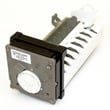
Cubic feet helps us match the right parts and accessories (like shelves, bins, and ice maker components) and it also helps set expectations for cooling load and food storage. If you are comparing refrigerators, capacity is the most consistent size metric.
Last updated: January 2026
What is the bottom part of a refrigerator called?
The bottom area of a refrigerator is commonly called the machine compartment (or compressor compartment). On Kenmore model 59665232400, this is the rear lower section where major cooling components sit, and the front lower trim is typically the toe grille. See the 59665232400 owner's manual for model-specific access and removal steps.
Most bottom compartments house the parts that move heat out of the refrigerator and keep the sealed system running.
- Compressor (pumps refrigerant through the sealed system)
- Condenser (releases heat to the room)
- Condenser fan (moves air across the condenser on many designs)
- Drain pan (catches defrost water for evaporation)
- Wiring and controls (varies by model)
Different people use different terms depending on what they are looking at.
| Term | What it usually refers to | Where you see it |
|---|---|---|
| Machine compartment | The lower rear compartment that houses cooling components | Back, near the floor |
| Toe grille | The front bottom grille or kick plate | Front, near the floor |
| Bottom hinge cover | Cover over the lower door hinge area | Front bottom corner |
| Drain pan | Pan underneath that collects defrost water | Under the cabinet, often rear |
Knowing the correct name helps you find the right instructions and parts. For example, the manual for 59665232400 calls out clearance behind the machine compartment cover for airflow, and it also describes removing the toe grille during door removal.
If the issue is damage to the front lower trim or you need access for cleaning, these parts are commonly involved:
- Toe grille WP67002224 (front bottom grille)
- Leveling legs and hinge area hardware (varies by configuration)
- Condenser area components (cleaning access depends on installation)
Last updated: January 2026
Why is my Kenmore Elite freezer not freezing?
If your Kenmore 59665232400 bottom-mount refrigerator freezer is not freezing, the most common causes are incorrect temperature control settings, poor airflow from overloading, dirty condenser coils, or a door that is not sealing. Start by verifying the freezer is at 0°F and that the unit is not stuck in a defrost cycle (wait 40 minutes). See the 59665232400 owner's manual for the control adjustment steps and troubleshooting checks.
- Put an appliance thermometer between frozen packages and recheck after 24 hours; target is 0°F (-18°C).
- Make sure the freezer is at least two-thirds full for best efficiency (add water jugs if needed).
- Leave space between packages so cold air can circulate; avoid blocking vents.
- Confirm the door closes fully; check for drawers, bins, or oversized items preventing closure.
- Inspect and clean the door gaskets so they seal tightly.
- If the compressor is not running, wait 40 minutes; the refrigerator may be in defrost mode.
| What you notice | Most likely issue | What to do |
|---|---|---|
| Freezer temp above 0°F but unit runs a lot | Dirty condenser coils or airflow problem | Clean coils, improve airflow, reduce warm food load |
| Temp rises after frequent openings | Normal heat load | Limit door openings; avoid storing ice cream on door shelves |
| Door pops open or won’t shut | Obstruction or gasket not sealing | Re-seat drawers, level items, clean/inspect gasket |
| Compressor not running but lights are on | Defrost cycle | Wait 40 minutes, then recheck cooling |
If the basic checks do not restore freezing, these model-compatible parts are often involved in cooling failures:
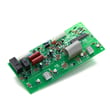
- Refrigerator control board WPW10503278 (can affect compressor and defrost operation)
- Refrigerator temperature sensor 12002355 (can misread temperature and reduce cooling)
- Refrigerator compressor W10309989 (sealed system cooling component)
A freezer that stays above 0°F can thaw food and force the refrigerator to run longer, which increases energy use and can lead to frost buildup or temperature swings. Correct settings, good airflow, and a tight door seal are the fastest fixes.
Last updated: January 2026
Why is my Kenmore refrigerator leaking underneath?
Water under your Kenmore refrigerator model 59665232400 usually comes from a defrost drain issue (clogged or frozen) or a water supply connection that is seeping and running down to the floor. We recommend checking the drain path inside the cabinet and then inspecting the water line and valve connections using the steps in the 59665232400 owner's manual.
- Clogged or frozen defrost drain: Water from defrost cannot reach the drain pan, so it spills and ends up underneath.
- Water line connection leak: Loose fittings, cross-threaded nuts, or damaged tubing can drip and track to the front.
- Low water pressure or wrong shutoff valve: The manual notes water pressure should be 35 to 100 PSI, and saddle valves can restrict flow and contribute to problems.
- Cracked or mispositioned drain pan: Water reaches the pan but then leaks onto the floor.
- Door not sealing: Warm air causes excess frost, leading to more defrost water than the drain can handle.
| What you see | Most likely source | What to do next |
|---|---|---|
| Water appears after a defrost cycle, puddle near center | Defrost drain clogged/frozen | Clear the drain with warm water and remove debris |
| Water near the back wall or under the water line area | Water connection seep | Inspect tubing, fittings, and valve area for drips |
| Ice buildup in freezer then water later | Drain restriction or door seal issue | Check gasket seal and clear drain |
- Unplug the refrigerator before any inspection or cleaning.
- Check inside for a blocked drain: look for ice or debris near the drain opening; flush with warm water until it flows freely.
- Inspect the water hookup: confirm you have copper tubing (recommended), fittings are snug (hand-tight then wrench snug), and tubing is not kinked.
- Verify water pressure: keep it in the 35 to 100 PSI range for proper valve operation.
- Look at the drain pan underneath: confirm it is seated correctly and not cracked.
A small leak can quickly turn into floor damage and can also lead to ice buildup, poor cooling, and repeated defrost drain overflows. Fixing the source early helps protect the sealed system and keeps temperatures stable.
Last updated: January 2026





