Installation guide
 Owner’s manual
 Error Codes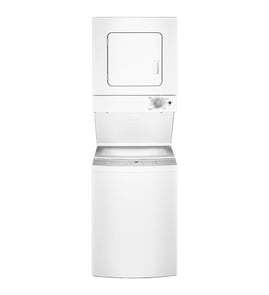





What is the capacity of the Kenmore dryer model 11081442710?
The Kenmore stacked laundry center model 11081442710 uses a compact, stacked-style dryer; this design is typically about 4.0 to 5.9 cu. ft. (not the 6.5+ cu. ft. size found in many full-size standalone dryers). For the exact spec used for your unit, confirm it in the 11081442710 use and care guide.
Stacked laundry centers are built to save space, so the dryer drum is smaller than a standard 27-inch dryer.
- Most stacked laundry center dryers run roughly 4.0 to 5.9 cu. ft.
- They dry best when loads are not packed tightly
- Bulky items (comforters, heavy blankets) often need extra time or multiple cycles
- Overloading commonly causes damp clothes and long dry times
- Proper venting has a bigger impact on results than small capacity differences
Use these practical guidelines to prevent poor tumbling and overheating:
- Fill the drum loosely to about 1/2 to 2/3 full
- Dry towels and jeans in medium loads, not “stuffed” loads
- Dry bulky items one at a time
- Clean the lint screen before every load
- If clothes are still damp, follow the steps in laundry center clothes still damp
| Dryer type | Typical capacity | Best for |
|---|---|---|
| Stacked laundry center dryer (like 11081442710) | 4.0 to 5.9 cu. ft. | Apartments, closets, everyday loads |
| Full-size standalone dryer | 6.5 to 9.0+ cu. ft. | Large families, bulky bedding |
Dryer capacity affects airflow and tumbling. When the drum is too full, items cannot separate; moisture stays trapped, cycles run longer, and clothes often come out damp.
Last updated: February 2026
What is the life expectancy of a Kenmore washer?
For a Kenmore washer, a typical life expectancy is 10 to 15 years with normal household use and basic maintenance. For the Kenmore stacked laundry center model 11081442710, good airflow for the dryer section and routine cleaning help reduce wear on shared components.
- Load size and balance: frequent overloading shortens bearing, suspension, and drive life.
- Detergent choice: this laundry center is designed for HE (high efficiency) detergent; using non-HE can cause oversudsing and extra strain.
- Water quality: hard water increases mineral buildup and can affect valves and wash performance.
- Drain and spin habits: repeated off-balance spins accelerate wear.
- Ventilation (dryer side): restricted venting increases heat and moisture in the cabinet, which can impact overall reliability.
Use the schedule and procedures in the 11081442710 use and care guide.
- Clean the washer interior and dispensers regularly.
- Keep loads within the cycle’s intended capacity.
- Level the unit to reduce vibration during spin.
- Check hoses for bulges, cracking, or leaks; replace as needed.
- Keep the dryer vent system clear for strong airflow.
| Usage pattern | Typical expectancy | What usually fails first |
|---|---|---|
| Light (1 to 3 loads/week) | 12 to 15 years | Hoses, lid/door wear items |
| Average (4 to 7 loads/week) | 10 to 13 years | Drain components, drive parts |
| Heavy (multiple loads/day) | 8 to 10 years | Drive system, bearings, controls |
Knowing the expected lifespan helps you decide whether to maintain, repair, or plan a replacement. Many “end of life” symptoms are actually fixable issues like vibration from poor leveling, restricted venting, or worn mechanical parts.
Last updated: February 2026
How do I find the model number on my 11081442710?
Your Kenmore stacked laundry center’s model number is printed on the appliance’s rating label; use that exact number (for example, 11081442710) when ordering parts or checking specifications in the owner's manual. On this unit, the manual also references the model series 81442710.
Check these common label locations first (power off the unit before reaching into tight areas):
- Inside the washer lid area, around the top rim of the washer opening
- On the back panel of the laundry center cabinet
- Behind the dryer door opening, along the door frame area
- On a side panel near the lower washer section
- On the inside edge of the control console area (less common)
Record both the model number and serial number exactly as shown. They matter because:
- The model number matches you to the correct diagrams and part list
- The serial number helps identify production changes that can affect fit
- Small differences (extra digits or letters) can point to different components
| Item | What it looks like | Used for |
|---|---|---|
| Model number | 11081442710 | Finding the correct parts and manuals |
| Serial number | A longer mix of letters and numbers | Identifying the production run |
Laundry centers often share a similar cabinet, but internal washer and dryer components (like a timer, belt, or switch) can vary by model. Using the exact model number prevents ordering the wrong replacement part.
Last updated: March 2026