Installation guide
 Owner’s manual
 Error Codes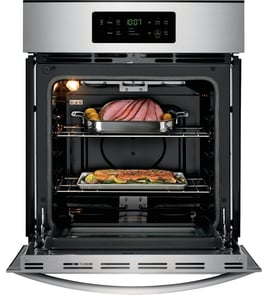



Are wall ovens 110 or 220?
Most electric wall ovens, including Kenmore Elite model 79048143801, are wired for 208/240 volts (commonly called “220V”). They connect to a hardwired junction box, not a standard 120-volt outlet; this higher voltage is required to power the bake and broil heating elements.
Your installation instructions call out a 208/240 volt junction for a built-in oven. Use the wiring and breaker guidance in the installation guide to match your home’s electrical supply.
- Voltage: 208/240 VAC
- Connection: hardwired to a junction box
- Circuit: dedicated circuit (no other major loads)
- Breaker: commonly 30A to 50A depending on oven rating
- Wire: sized to the breaker and local electrical code
| Feature | 120V (standard outlet) | 208/240V (wall oven circuit) |
|---|---|---|
| Common use | small appliances | electric wall ovens, ranges |
| Connection | plug-in receptacle | hardwired junction box |
| Heating power | limited | high output for bake/broil |
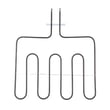
Using the correct voltage prevents weak heating, nuisance breaker trips, and wiring overheating. A proper 208/240V supply is also essential for accurate temperature control, especially when the oven is driving high-wattage parts like the oven element 318601604 or oven element 318255807.
- Check your electrical panel for a 2-pole breaker labeled “oven”
- Look for a junction box in or near the cutout (not a receptacle)
- Confirm the cutout and electrical placement details in the installation guide
- If wiring looks damaged or overheated, stop and have it corrected before installing
Last updated: February 2026
How to clean a Kenmore wall oven?
For your Kenmore Elite wall oven model 79048143801, clean most surfaces with hot, soapy water, rinse, and dry. Clean the door frame and front with soap and water; use glass cleaner only on the outside door glass. Follow the owner's manual for self-clean steps.
- Turn the oven OFF and let it cool completely.
- Wipe up spillovers promptly to prevent baked-on residue.
- Use hot, soapy water and a soft cloth for general cleaning.
- For built-up grease on painted or plastic areas, apply liquid detergent to the soil for 30 to 60 minutes, then wipe, rinse, and dry.
- Clean the top, sides, and front of the oven door with soap and water; rinse well.
- Use glass cleaner only on the outside door glass; keep liquids out of door vents.
- Do not clean the oven door gasket; do not rub it or use cleaners on it.
- Do not use abrasive cleaners, cleaning powders, or harsh scrubbers on the door exterior or control panel.
- Do not line the oven cavity or racks with aluminum foil.
- Remove broiler pan, insert, utensils, and any foil.
- Remove excessive spillovers first with hot, soapy water (large spills can smoke heavily).
- Keep children away during self-clean; exterior surfaces get very hot.
| Area | Use | Avoid |
|---|---|---|
| Door exterior and frame | Soap and water | Abrasives; liquids into vents |
| Outside door glass | Glass cleaner (outside only) | Spraying into vents |
| Oven cavity | Self-clean; wipe heavy spills first | Foil liners; cleaning the gasket |
Correct cleaning protects the door seal, prevents scratches and stains, and reduces smoke during self-clean so baking and broiling stay consistent.
Last updated: February 2026
What are the parts of an electric oven?
An electric wall oven like the Kenmore Elite 79048143801 is built around heating elements, airflow parts, and electronic controls that work together to bake, broil, and manage temperature. Your exact feature set can vary by version, so we recommend confirming locations and names in the owner's manual.
- Electronic oven control (EOC) and timer (the control “brain”)
- Broil element (top heat for broiling)
- Bake element (bottom heat for baking; some models hide it under a cover)
- Oven temperature sensor (reports oven temperature to the control)
- Convection fan and fan blade (moves hot air for more even cooking on convection models)
- Cooling fan/blower (cools electrical and electronic components; can run after shutoff)
- Oven vent (releases warm air; typically at the upper front frame)
- Oven racks and rack supports
- Oven light/lamp and lens/cover
- Door system (door glass, hinges, handle, and on self-clean models, a door latch)
If you are troubleshooting uneven baking, temperature swings, or fan noise, these model-compatible parts are common suspects:
| Symptom | Part to check | Example part on this model |
|---|---|---|
| Oven temp seems off | Temperature sensing | Frigidaire range oven temperature sensor 316217002 |
| No bake heat or weak bake | Bake heating circuit | Oven element 318601604 |
| Convection noisy or not running | Fan blade or motor | Fan blade 318398302 |
| Fan runs after cooking | Cooling fan operation | Range oven cooling fan assembly 318073028 |
| Oven dead or intermittent power | Power connection | Terminal block 5304409888 |
Knowing the main oven parts helps you narrow down the problem faster. For example, the installation and use guidance notes that the cooling fan may keep running after the oven is turned off to protect internal components, and convection fans typically stop when the door is opened.
Last updated: February 2026
Where can I find my Kenmore 79048143801 oven model number?
For Kenmore Elite wall oven model 79048143801, the model and serial number are printed on the serial plate located along the interior side trim of the oven; you can see it when you open the oven door. For the exact label location illustration, check the installation guide.
- Open the oven door fully.
- Look at the vertical trim area just inside the oven frame (left or right interior side trim).
- Find the serial plate label and record the model number, serial number, and any lot number/letter.
- Take a clear photo of the label for future reference.
- Use the recorded model number when ordering wall oven parts.
Having the full label details helps us match the correct Kenmore Elite wall oven parts list and avoid ordering the wrong component.
| Label item | What it helps with |
|---|---|
| Model number (79048143801) | Identifies the exact wall oven configuration |
| Serial number | Confirms production run details |
| Lot number/letter (if shown) | Helps narrow down version-specific parts |
Many wall oven parts (for example, an oven temperature sensor, bake element, or control board) can vary by production run. Using the serial plate information helps ensure the replacement part fits and functions correctly.
Last updated: February 2026