Owner’s manual
 Error Codes


How do I read my Kenmore refrigerator model number?
Your Kenmore refrigerator model number is the full identifier on the model and serial label inside the fresh food (refrigerator) compartment. For model 10659569990, we use that complete number to match the correct parts, diagrams, and service information in the 10659569990 owner's manual.
On Kenmore side-by-side refrigerators like 10659569990, the label is typically located in one of these spots:
- Inside the refrigerator compartment on an interior side wall
- Inside the door area near the lower bins
- Behind the lower crisper drawer area (on the liner wall)
- Near the base grille or kick plate area (less common)
When you copy the model number, use every digit in order. Even one missing digit can pull up the wrong Kenmore 106-series parts.
- Write the model number exactly as printed (example: 10659569990)
- Record the serial number too; it helps identify production details
- Use the model number first when ordering parts like an ice maker, water inlet valve, or door gasket
- Keep the information with your purchase records for faster service
| Item | What it tells us | Used for |
|---|---|---|
| Model number | The exact refrigerator design | Correct parts lookup and diagrams |
| Serial number | The unit’s production identifier | Service history and manufacturing details |
- Dropping digits (for example, writing 106.59569990 or 1065956999)
- Mixing up the serial number with the model number
- Using only “106” (that is a prefix, not the full model)
Kenmore 106-prefix refrigerators were built in multiple variations. Using the full model number ensures we match the correct components and avoid fit issues when replacing parts.
Last updated: February 2026
How to replace an ice maker in a side by side refrigerator?
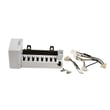
To replace the ice maker in your Kenmore 10659569990 side-by-side refrigerator, we shut off power, remove the ice bin or bucket for access, disconnect the wiring harness, swap the ice maker, then restore power and water so it can cycle and refill. Follow the 10659569990 owner's manual for the exact access method used on your unit.
- Unplug the refrigerator or switch off the breaker.
- Turn off the household water shut-off valve to the refrigerator.
- Remove the ice bin or door bucket to clear your work area.
- Keep towels handy for small drips.
- Reinstall all covers and panels before running the refrigerator.
- Disconnect power.
- Remove ice storage:
- Interior bin style: remove the covering panel, lift the wire shut-off arm to OFF (up), then lift and pull out the bin.
- Door bucket style: press the release button and lift the bucket up and out.
- Open the ice maker cover or service door.
- Unplug the ice maker wiring harness.
- Remove the mounting screws, lift the ice maker off the mounts, and remove it.
- Install the new ice maker, reconnect the harness, and reinstall the cover.
- Reinstall the bin or bucket, turn water back on, then restore power.
If you are replacing the complete assembly, use the ice maker assembly 4317943.
- Confirm the ice maker is ON (switch ON, or shut-off arm down depending on style).
- Seat the bin or bucket fully; the dispenser will not work if it is not pushed in all the way.
- Allow time for production.
| Ice production mode | Typical output |
|---|---|
| Normal | 7 to 9 batches per 24 hours |
| Maximum (if equipped) | 10 to 14 batches per 24 hours |
Correct installation prevents leaks, protects the wiring connection, and ensures the bin or bucket engages properly so the dispenser and automatic shut-off work normally.
Last updated: February 2026
How wide is a Kenmore side by side refrigerator?
Most Kenmore side-by-side refrigerators are about 33 to 36 inches wide; for Kenmore model 10659569990, confirm the exact cabinet width and required clearances in the 10659569990 owner's manual.
Side-by-side refrigerator widths vary by capacity and whether the unit is standard-depth or counter-depth.
- 33 in.: common for narrower kitchens and smaller capacities
- 35 to 36 in.: most common “full-size” side-by-side footprint
- 42 in.: less common, usually higher-capacity models
Even if the cabinet is 33 to 36 inches wide, you need extra room for airflow and door swing. The manual guidance for this style of Kenmore side-by-side calls for:
- 1/2 in. space on each side and at the top for ventilation
- Extra space behind the refrigerator if an ice maker/water line is connected
- 2 in. minimum next to a fixed wall (depending on the model) so doors can swing open
| What you’re measuring | What to include | Why it matters |
|---|---|---|
| Cabinet width | Refrigerator body only | Confirms it fits between cabinets |
| “Fits in opening” width | Cabinet width + side clearance | Prevents overheating and noise |
| Door swing space | Clearance near walls | Lets bins and shelves open fully |
- Measure the opening at the front and back (walls can be out of square)
- Measure the refrigerator cabinet (not just the doors/handles)
- Check for trim, baseboards, and water line routing behind the unit
- Plan a path through doorways for delivery and service access
Width is only part of fit. Proper clearance helps the condenser and evaporator airflow work correctly, reduces temperature swings, and prevents door alignment and gasket sealing problems.
Last updated: February 2026
What does er if mean on kenmore elite refrigerator?
On Kenmore model 10659569990, the Er IF code points to an ice fan (ice maker compartment fan) airflow problem. That fan pushes freezer air through the door ducts to keep the ice maker area cold; when airflow or the fan circuit fails, the control displays Er IF.
- Power reset: unplug the refrigerator (or switch off the breaker) for 5 minutes, then restore power.
- Freezer door closure: confirm the door seals fully and nothing is holding it open.
- Ice buildup: look for frost or ice blocking vents near the ice maker area.
- Airflow blockage: avoid overpacking the freezer; keep vents clear.
- Temperature: set freezer near 0°F and refrigerator near 37°F (typical targets).
| Likely cause | What you may notice | Typical fix |
|---|---|---|
| Ice fan not running | No air movement to ice maker area, warm ice room | Clear ice obstruction; test/replace fan motor if needed |
| Frost/ice blocking ducting | Fan may run but airflow is weak | Defrost blockage; check defrost system components |
| Door not sealing | Frost patterns, moisture, intermittent code | Adjust door, inspect gasket and door alignment |
| Control or wiring issue | Code returns quickly after reset | Inspect harness connections; service diagnosis |
If you confirm the fan is running but airflow is restricted by heavy frost, the defrost system is a common place to look:
- Refrigerator defrost bi-metal WPW10225581 (opens/closes the defrost circuit based on evaporator temperature)
- Refrigerator heater WP2323198 (melts frost off the evaporator during defrost)
For model-specific troubleshooting steps and safety guidance, follow the 10659569990 owner's manual.
When the ice fan cannot move cold air, the ice maker compartment warms up. That leads to slow ice production, clumping, or melting and refreezing, and it can also increase frost buildup and strain cooling performance.
Last updated: February 2026
What is the cubic foot of my Kenmore refrigerator model 10659569990?
The Kenmore side-by-side refrigerator model 10659569990 has an approximate total capacity of 21.9 cubic feet. This is the overall interior storage volume for both the fresh food and freezer sections combined; see the 10659569990 owner's manual for model-specific feature details.
Capacity is the combined usable space inside the refrigerator and freezer compartments. It helps you compare storage size across Kenmore side-by-side models.
- Total capacity: 21.9 cu. ft. (fresh food + freezer)
- Not the same as exterior size: cabinet width and depth can vary by design
- Usable space varies: shelves, ice bin, and door bins reduce open volume
- Ice maker impact: an installed ice maker and bin take up freezer space
| Measurement | What it tells you | Best use |
|---|---|---|
| Cubic feet (capacity) | Interior storage volume | Comparing how much food fits |
| Width x height x depth | Exterior footprint | Checking fit in your kitchen |
| Shelf/bin layout | How space is organized | Planning storage and accessibility |
Knowing the cubic feet helps you decide if the refrigerator is the right size for your household and makes it easier to shop for comparable replacements or plan storage (especially if you use an ice maker and ice bin).
If you are troubleshooting ice production or freezer space concerns, the ice maker assembly 4317943 and the ice bin are common components that affect usable freezer room.
Last updated: February 2026
What's the average lifespan of a Kenmore refrigerator?
Most Kenmore refrigerators last 10 to 15 years on average; a Kenmore 10659569990 side-by-side can often reach that range when it is operated and maintained as described in the 10659569990 owner's manual. Regular cleaning, good door sealing, and quick fixes for cooling or ice maker issues are what extend real-world life.
A refrigerator’s lifespan is mostly driven by heat management (condenser cleanliness), airflow, and how hard the sealed system has to work.
- 10 to 15 years is the typical household average for refrigerators
- 15+ years is common when condenser coils stay clean and doors seal tightly
- Frequent warm temps, heavy ice maker use, and dirty coils shorten compressor life
- Power interruptions and repeated restarts add wear over time
- Preventive maintenance helps you avoid “run all the time” conditions
The manual for this model includes care topics like cleaning, light bulb changes, and vacation care; following those routines is the simplest way to protect the compressor and sealed system.
- Clean condenser area and keep airflow clear around the cabinet
- Keep door gaskets clean and fully sealing (no gaps, no folds)
- Set stable temperatures (avoid turning controls colder than needed)
- Replace clogged water filters on schedule if your unit uses a filter system
- Address ice maker or dispenser slow-fill issues early (often water supply related)
| What you notice | What it usually means | What to do first |
|---|---|---|
| Runs constantly | Dirty coils, warm air leaks, airflow issue | Clean coils, check door seal, verify vents clear |
| Frost buildup in freezer | Defrost system or door sealing problem | Check gasket seal, look for blocked vents |
| No ice or slow ice | Water supply or ice maker issue | Check supply, then inspect ice maker assembly - refrigerator ice maker by whirlpool 4317943 |
| Warm fridge, cold freezer | Airflow/damper or fan issue | Confirm vents clear and fan is running |
When a refrigerator runs longer to hold temperature, it puts extra load on the compressor and sealed refrigeration system. Keeping coils clean and doors sealing properly reduces run time, lowers energy use, and helps your Kenmore 10659569990 reach the full 10 to 15 year lifespan.
Last updated: February 2026
Where is the model number on a Kenmore side by side refrigerator?
On Kenmore side-by-side refrigerator model 10659569990, the model and serial number label is located inside the refrigerator compartment on an inside wall. Use that label to record the full model number and serial number for parts lookup and service.
- Open the fresh food (refrigerator) door, not the freezer door
- Check the inside side walls first (left and right)
- Look near the upper area around the control housing and shelves
- Also check near the crisper drawer area on the liner wall
- Use a flashlight; the label can be small and easy to miss
The label typically includes both identifiers. We recommend recording:
- Model number (for this unit, it starts with 106.)
- Serial number (unique to your refrigerator)
- Purchase date (helpful for maintenance and service records)
| Item | What it’s used for | Example format |
|---|---|---|
| Model number | Matching the correct Kenmore parts diagrams and parts | 106.XXXXXXXXXX |
| Serial number | Identifying production details for service | Letters and numbers |
Using the exact model number from the label prevents ordering the wrong refrigerator water filter housing, ice maker assembly, or door gasket. Even small model variations can change which parts fit and how they install.
For the exact wording and location description used by Kenmore for this model series, check the 10659569990 owner's manual.
Last updated: February 2026
Why is there water leaking from the bottom in my Kenmore refrigerator?
Water leaking from the bottom of your Kenmore side-by-side refrigerator model 10659569990 is usually caused by defrost water not draining correctly into the drain pan (often from a clogged or frozen defrost drain) or by a water supply issue such as a kinked line, a clogged filter, or a leaking inlet valve.
- Unplug the refrigerator or turn off power at the breaker.
- Look for ice buildup on the freezer floor or under the crisper drawers (a common sign of a blocked defrost drain).
- Check the water line behind the refrigerator for kinks or pinches.
- If you have a water filter installed, reseat it and flush the dispenser for a few minutes.
- Inspect the drain pan area for cracks, overflow, or water trails.
| What you notice | Most likely cause | What to do next |
|---|---|---|
| Water appears after a defrost cycle | Defrost drain clogged or frozen | Thaw the drain area with warm water; clear the drain tube so water reaches the drain pan |
| Puddle near the front, no ice inside | Water line or connection seepage | Tighten fittings; correct kinks; check for slow drips |
| Leak seems tied to ice maker or dispenser use | Inlet valve not sealing, filter issue, or air in lines | Flush lines; check valve for seepage; replace valve if it weeps |
If the leak is related to the ice maker or dispenser water supply, these model-matched parts are common fixes:
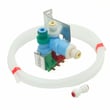
- Refrigerator inlet valve W10408179 (controls water flow to the ice maker and dispenser; can seep or fail to close)
- Refrigerator water tube 8201597 (can crack, loosen, or leak at connections)
Water at the bottom can lead to slippery floors, warped flooring, and ice buildup inside the freezer. Fixing the drain path or water supply leak restores normal defrost drainage and prevents repeat puddles.
For water supply checks (shut-off valve, kinks, filter installation, and dispenser dripping), follow the troubleshooting steps in the 10659569990 owner's manual.
Last updated: February 2026