Installation guide
 Owner’s manual
 Error Codes


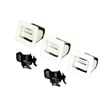
Is it worth repairing a dryer that won't spin?
Yes, it’s often worth repairing a Whirlpool LER7620LW0 dryer that won’t spin when the problem is a common wear item (like a broken belt or worn drum support). If the drive motor is failed, the repair cost is higher and replacement becomes more practical.
Quick decision checklist (most common “won’t spin” causes)
- Drum belt broken or slipped: dryer runs but drum does not turn; repair is usually cost-effective.
- Worn drum support parts: squealing, thumping, or drum hard to turn by hand; repair is often worthwhile.
- Door switch issue: dryer may not run at all; typically a straightforward fix.
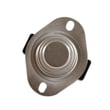
- Thermal cut-off or high-limit thermostat problem: dryer may stop mid-cycle or not heat; fix the overheating cause too.
- Drive motor failure: humming, no drum movement, or intermittent running; higher-cost repair.
Parts that commonly fix a no-spin condition on LER7620LW0
If your dryer powers on but the drum will not tumble, these model-matched parts are the first places we look:
| Symptom | Likely part | When it’s usually “worth it” |
|---|---|---|
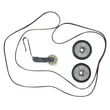
| Motor runs, drum does not turn | Dryer drum belt 341241 | Almost always (low cost, common failure) |
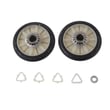
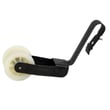
| Loud squeal or thump, poor tumbling | Dryer repair kit 4392065 | Often (bundles common wear items) |
| Dryer will not run unless door is held | Dryer door switch WP3406107 | Often (simple electrical switch) |
| Hums, won’t start turning, trips breaker | Motor 279827 | Depends (higher cost, more labor) |
Why it matters
A dryer that won’t spin is usually a mechanical drive issue (belt, support rollers, idler) rather than a “whole dryer is done” situation. Fixing the root cause restores airflow and drying performance, and helps prevent secondary problems like overheating.
Before you decide: do these safe checks
Follow the safety guidance in your owner's manual, then:
- Unplug the dryer before inspecting anything.
- Try to turn the drum by hand; if it’s very stiff or noisy, suspect support parts.
- If the dryer will not start, confirm the door is closed and the controls are set to run (the installation instructions list basic start checks). See the installation guide.
- If you smell overheating or the dryer shuts down, clean lint buildup and check venting; restricted venting can cause repeated thermal failures.
Last updated: February 2026
How do I find the cubic feet of my dryer?
To find the cubic feet (capacity) of your Whirlpool LER7620LW0 dryer, we calculate the drum’s internal volume from its measurements, then convert that volume to cubic feet. The most accurate way is to use the drum diameter and drum depth listed in your owner's manual.
Steps to calculate dryer capacity (cubic feet)
- Unplug the dryer for safety.
- Measure the drum diameter (D) in inches (straight across the inside of the drum).
- Measure the drum depth (L) in inches (front-to-back inside the drum).
- Use the cylinder formula:
- Volume (cubic inches) = π × (D/2)² × L
- Convert to cubic feet:
- Cubic feet = Volume (cubic inches) ÷ 1728
Quick example (use your measurements)
- If D = 27 in and L = 18 in:
- Volume = 3.1416 × (13.5)² × 18 ≈ 10,305 in³
- Cubic feet = 10,305 ÷ 1728 ≈ 6.0 ft³
Measurement tips (so the number is accurate)
- Measure inside the drum, not the cabinet.
- Measure to the metal drum wall, not to baffles (lifters).
- Take each measurement twice and average them.
- If the front opening flares, measure the main drum cylinder, not the lip.
- If you cannot access the drum easily, use the drum specs in the owner's manual.
Typical capacity ranges (for context)
| Dryer type | Typical capacity range |
|---|---|
| Compact electric dryer | ~3.4 to 4.0 ft³ |
| Standard electric dryer | ~5.5 to 7.0 ft³ |
| Large capacity dryer | ~7.0+ ft³ |
Why it matters
Knowing cubic feet helps you match your dryer to your washer load size, compare replacement models, and avoid overloading (which increases dry time and can strain wear parts like the dryer drum belt 341241).
Last updated: February 2026
What is the average lifespan of a whirlpool dryer?
A Whirlpool dryer typically lasts 10 to 13 years. With consistent maintenance on your Whirlpool LER7620LW0 (especially lint and vent cleaning) and avoiding overloads, it commonly reaches the upper end of that range.
Typical lifespan and what affects it
Most dryers wear based on heat, airflow, and drum support friction. These factors have the biggest impact:
- Venting and airflow: restricted exhaust raises heat and stress on components
- Lint buildup: lint in the cabinet and vent increases heat and reduces drying performance
- Load size and frequency: frequent heavy loads accelerate belt, rollers, and motor wear
- Electrical supply: weak power can cause poor heating and longer run times
- Basic upkeep: cleaning and periodic inspection prevent small issues from becoming major repairs
Maintenance schedule we recommend for LER7620LW0
Your owner's manual calls out periodic lint removal inside the cabinet and inside the exhaust vent (commonly about every 2 years, more often with heavy use). Use this simple schedule:
| Task | How often | Why it matters |
|---|---|---|
| Clean lint screen | Every load | Keeps airflow strong and drying times down |
| Check vent hood flap outside | Monthly | Confirms the dryer is exhausting properly |
| Clean the full vent run | At least yearly (more if long vent) | Prevents long dry times and overheating |
| Internal cabinet lint cleaning | About every 2 years | Reduces heat buildup and wear |
Parts that commonly determine “end of life” (and can be replaced)
If the dryer still has a solid cabinet and drum, replacing wear parts often extends life significantly:
- Dryer drum belt 341241 if the drum stops turning or squeals
- Dryer repair kit 4392065 when you hear thumping, rumbling, or scraping (common wear items)
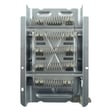
- Dryer heating element 279838 if the dryer runs but does not heat
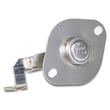
- Dryer thermal cut-off fuse kit 279816 if the dryer will not heat due to an overheat event
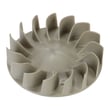
- Dryer blower wheel WP694089 if airflow is weak or you hear a loud rattling from the blower housing
Why it matters
A dryer that takes longer to dry is not just inconvenient; it usually indicates restricted airflow or a failing heating or drive component. Fixing those issues early reduces run time, lowers stress on the motor and heater, and helps your LER7620LW0 reach its normal lifespan.
Last updated: February 2026
How do I reset my Whirlpool dryer sensor?
On the Whirlpool LER7620LW0 dryer, the practical “sensor reset” is a power reset: turn the dryer off, unplug it for 5 to 10 minutes, then plug it back in and start a new cycle. This clears the control’s temporary state and restores normal operation.
Quick reset steps
- Turn the Cycle Control knob to OFF.
- Unplug the dryer from the grounded outlet.
- Wait 5 to 10 minutes.
- Plug the dryer back in.
- Select a new cycle and temperature.
- Push START.
If the dryer still dries poorly after the reset
A “sensor” complaint is often airflow, heat, or cycling related. Check these basics first:
- Clean the lint screen before every load.
- Confirm the vent is not crushed or kinked behind the dryer.
- Run a timed, full-heat cycle and check for heat after about 5 minutes.
- Avoid overloading; loads need room to tumble freely.
- Match cycle and temperature to the fabric care label.
What to check next (common causes and related parts)
If the dryer tumbles but has weak heat, no heat, or shuts off early, these parts are common suspects:
| Symptom | What it often points to | Example part for LER7620LW0 |
|---|---|---|
| No heat or heat cuts out | Overheat protection opened | Dryer thermal cut-off fuse kit 279816 |
| Heat is inconsistent | Temperature limit control issue | Dryer high-limit thermostat WP3977767 |
| Runs but takes too long to dry | Restricted airflow or weak blower | Dryer blower wheel WP694089 |
| Drum will not turn | Belt or drum support wear | Dryer drum belt 341241 |
Why it matters
Moisture-sensing and cycle performance depend on stable heat and strong airflow. A simple power reset can clear a temporary control issue, but venting problems or a failing thermostat or thermal cut-off can keep the dryer from drying correctly.
For cycle operation details (start/stop, restarting, and cycle selection), follow the LER7620LW0 owner's manual.
Last updated: February 2026