Owner’s manual
 Error Codes


How do I know if my Kenmore dryer thermal fuse is blown?
A blown thermal fuse on your Kenmore electric dryer model 11082826101 usually shows up as a dryer that will not run at all, or a dryer that tumbles but has no heat. The sure way to know is to unplug the dryer and test the fuse for continuity with a multimeter.
Quick symptoms to look for
- Dryer will not start (no motor run, no tumbling)
- Dryer runs but produces no heat (clothes stay damp)
- Cycle seems normal, but drying performance suddenly drops
- You recently had poor airflow (lint buildup, crushed or kinked vent)
Confirm it with a continuity test (best check)
- Unplug the dryer (or switch off the breaker) before opening any panels.
- Access the thermal fuse location shown in the 11082826101 owner's manual.
- Remove at least one wire from the fuse terminal.
- Set your multimeter to continuity or lowest ohms.
- Test across the fuse terminals.
How to read the meter
| Meter result | What it means | What to do next |
|---|---|---|
| Beep or near 0 ohms | Fuse is good | Keep troubleshooting heat or run issues |
| No beep or OL/infinite | Fuse is blown | Replace the fuse and fix the airflow problem |
What usually causes the thermal fuse to blow
A thermal fuse is a one-time safety device; it opens when the dryer overheats. Overheating is most often caused by restricted venting.
- Lint screen clogged
- Exhaust vent or outside hood clogged
- Vent crushed or kinked behind the dryer
- Long vent run or poor vent material restricting airflow
The manual also notes that electric dryers can use two household fuses or breakers, so the drum may turn but you still have no heat if one side of the supply is out.
Why it matters
Replacing a blown fuse without correcting airflow often leads to repeat overheating and another blown fuse. Restoring proper vent airflow protects the heating circuit and improves drying times.
Last updated: February 2026
How much does it cost to replace a heating element in a Kenmore dryer?
Replacing the heating element in a Kenmore electric dryer model 11082826101 typically costs $70 to $120 for the part and $200 to $450 total if you hire a technician (parts plus labor). If the dryer has no heat, we also check power supply and airflow first because those can mimic a bad element.
Typical cost breakdown
| Cost item | Typical range | Notes |
|---|---|---|
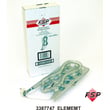
| Heating element part | $70 to $120 | Common OEM-style element pricing for this model class; example part: dryer heating element WP3387747 |
| DIY supplies (optional) | $0 to $25 | Vacuum, nut driver, work gloves, vent tape/clamps if needed |
| Professional labor | $130 to $330 | Varies by region and access to the heater housing |
| Total installed | $200 to $450 | Higher if multiple safety parts are replaced together |
Before you buy a heating element
The 11082826101 manual recommends a quick heat check after the dryer runs about 5 minutes; if there is no heat, it also calls out that many electric dryers use two fuses or circuit breakers, so we confirm both sides of the 240V supply are present. See the 11082826101 owner's manual for the model’s operating checks and troubleshooting steps.
- Verify both dryer breakers are ON (or both fuses are good)
- Clean the lint screen and confirm strong airflow at the outside vent hood
- Make sure the cycle and temperature setting are not set to Air dry / no heat
- If the drum turns but there is no heat, test heater circuit safety parts
Parts that are often replaced with (or instead of) the element
A heating problem is frequently caused by a failed safety device or airflow restriction. These parts are commonly involved:
- Dryer thermal fuse WP3390719 (opens if the dryer overheats)
- Dryer high-limit thermostat WP3391914 (limits heater temperature)
- Dryer thermal cut-off fuse kit 279973 (heater safety cut-off components)
- Exhaust venting and lint buildup (restriction causes overheating and repeat failures)
Why it matters
Replacing only the heating element when the real issue is restricted venting or a blown thermal fuse can lead to repeat no-heat problems and extra cost. Confirming power and airflow first helps the repair last.
Last updated: February 2026
What size dryer is a Kenmore 80 series?
Most Kenmore 80 Series dryers like model 11082826101 are full-size machines; typical drum capacity is about 6.0 to 7.0 cu. ft. (the exact capacity varies by the specific 110.xxxxxxxx model). For exact specs tied to your unit, use the 11082826101 owner's manual.
How to confirm your exact “size” (capacity and physical dimensions)
Capacity (cu. ft.) is not always printed on the cabinet, so we recommend confirming using your model’s documentation and measurements.
- Check the model tag to confirm 11082826101 matches your dryer
- Look in the specifications section of the 11082826101 owner's manual
- Measure the cabinet if you are planning a closet or alcove install
- Plan for venting space behind the dryer (most installs need clearance for the exhaust elbow)
- Allow extra space for easier service access and reduced noise transfer
Typical dimensions and spacing you should plan for
The manual’s installation diagrams show a 27-inch class dryer and call out clearance needs behind the unit for venting.
| What you’re planning for | Typical for Kenmore 80 Series (110 models) | What to verify |
|---|---|---|
| Drum capacity | 6.0 to 7.0 cu. ft. | Specs in the manual |
| Width class | 27 in. | Your measured width |
| Rear clearance for vent elbow | About 5 1/2 in. minimum | Your vent route and elbow |
| Closet install | Requires door vent openings | Closet door style |
Why it matters
Choosing the right “size” affects drying performance and installation fit. A full-size drum handles larger loads (towels, jeans, bedding) better, and correct clearances help prevent long dry times caused by restricted airflow.
Last updated: February 2026
Where is the part number on a Kenmore dryer?
On Kenmore electric dryer model 11082826101, the model and serial number label (the information you need to identify the correct parts) is located at the top inside the dryer door well. Use that label when ordering replacement parts or requesting service; see the 11082826101 owner's manual.
What to look for on the label
The label typically lists several identifiers. Record them exactly as shown.
- Model number (for this dryer: 11082826101)
- Serial number
- Purchase date (often written in by the owner)
- Electrical ratings (helpful for troubleshooting)
How to find it (quick steps)
- Open the dryer door.
- Look along the top edge inside the door opening (the door well).
- Find the sticker or metal tag with the model and serial information.
- Write the numbers down or take a clear photo before you start a repair.
Why this matters when ordering parts
Kenmore dryers can use different components across similar-looking models. Using the exact model number from the door-well label helps us match the right heating, airflow, and drum-drive parts for your configuration.
| If you’re trying to fix… | The model label helps match… | Example part for this model |
|---|---|---|
| No heat | Correct heater and temperature controls | Dryer heating element WP3387747 |
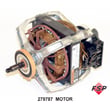
| Dryer won’t run | Correct motor and drive components | Drive motor 279787 |
| Dryer stops mid-cycle or overheats | Correct safety fuses/thermostats | Dryer thermal fuse WP3390719 |
Tip for faster troubleshooting
If your dryer displays an error code (on electronic-control versions), use the Kenmore 110 series electronic control model dryer error codes guide to narrow down the likely circuit or component before ordering parts.
Last updated: February 2026