 Owner’s manual
 Error Codes



Is a top mount or bottom mount fridge better?
A bottom-mount refrigerator like Kenmore 59662234200 is better when you want everyday fresh-food items at eye level and more organized refrigerator storage; a top-mount is better when you prioritize a lower purchase price and simpler layout. The best choice depends on how you use the refrigerator most.
Quick comparison
| Feature | Top-mount (freezer on top) | Bottom-mount (freezer on bottom) |
|---|---|---|
| Most-used section height | Freezer is easiest to reach | Refrigerator is easiest to reach |
| Organization | Typically simpler shelving | Typically more bins, drawers, and pull-out freezer baskets |
| Ergonomics | More bending for fresh food | Less bending for fresh food |
| Energy use (typical) | Often slightly lower | Often slightly higher (varies by model) |
| Cost (typical) | Often lower | Often higher |
How to decide for your kitchen
- Choose bottom-mount if you use fresh food daily and want it at a comfortable height.
- Choose top-mount if you use the freezer most and want it at eye level.
- If you meal prep or buy produce often, bottom-mount layouts usually make access easier.
- If you have limited space, compare door swing and clearances before deciding.
- If you want the most efficient operation, keep good airflow and avoid overpacking shelves.
Why it matters
The “better” style is the one that matches your habits. Bottom-mount designs reduce bending for refrigerator items, while top-mount designs keep frozen foods easiest to reach and are often the simpler, budget-friendly option.
Tips that help either style run efficiently
Our Kenmore bottom-mount use and care guidance emphasizes basics that apply to both styles:
- Allow about 1 inch of clearance around the top and sides for ventilation.
- Avoid overcrowding shelves so cold air can circulate.
- Let hot foods cool before loading.
- Do not use foil, wax paper, or paper towels as shelf liners because they restrict airflow.
For model-specific features and care tips for Kenmore 59662234200, use the owner's manual.
Last updated: February 2026
How to tell what model Kenmore refrigerator?
To identify your Kenmore refrigerator model, we look for the model and serial number sticker inside the fresh food (refrigerator) section. For Kenmore model 59662234200, the owner's manual indicates the sticker is on the left wall of the refrigerator section.
Where to look first (fastest checks)
- Inside the refrigerator compartment on the left side wall (most common for this model)
- On the ceiling area inside the fresh food section
- Behind or under a crisper drawer (if the label is placed low)
- Behind the toe grille or kick plate area (some designs place labels there)
- On your purchase paperwork or the manual cover page (if you saved it)
What the label usually includes
| Item on the sticker | What it’s used for | Example (format) |
|---|---|---|
| Model number | Matching the correct parts diagrams and parts | 596.62234200 or 59662234200 |
| Serial number | Identifying production run details | Letters and numbers |
| Purchase date (your note) | Warranty and service records | Month/day/year |
Why it matters
Kenmore refrigerators often share similar styling across multiple series, so the model number is the only reliable way to match the correct parts (like an ice maker, light switch, or control module) and to use the right troubleshooting steps.
Tips if the sticker is hard to read
- Wipe the label gently with a damp cloth and a drop of mild dish soap; dry it and re-check.
- Use your phone camera and zoom in; angled light can make faded print readable.
- Copy the model number exactly as shown (all digits); that ensures the parts list matches your exact refrigerator.
Last updated: February 2026
Can you still get parts for Kenmore refrigerators?
Yes. We still offer replacement parts for Kenmore refrigerators, including model 59662234200. The best match comes from using your full model number so you get the correct fit for items like the ice maker, door switch, shelves, and sealed-system components.
How to find the right part for your Kenmore model
Use the model number from the ID label inside the fresh food section (typically on the left wall) and match it to the parts list.
- Confirm the full model number: 59662234200
- Identify the symptom (no ice, warm temps, light not working, leaking)
- Look up the part by name and verify it fits your exact model
- Compare your original part to the listing (mounting points, connectors, shape)
- Use the diagrams to confirm location and related hardware
For model-specific identification details and safety information, use the 59662234200 owner's manual.
Common Kenmore refrigerator parts people replace
These are examples of parts available for model 59662234200 that often solve everyday problems:
| Problem | Likely part to check | Example part for this model |
|---|---|---|
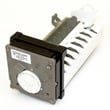
| Ice maker not making ice | Ice maker assembly, ice ejector | Refrigerator ice maker D7824706Q, refrigerator ice ejector WP627843 |
| Interior light not working | Door switch, light bulb | Refrigerator switch W11396033, bulb replcmt W11447232 |
| Not cooling properly | Compressor and start components (diagnosis required) | Refrigerator compressor W10160407, refrigerator overload WP12555902 |
Why it matters
Kenmore refrigerators are built to run for years, but normal wear items (switches, bulbs, ice maker components) can fail over time. Using the exact model number helps ensure the replacement part fits correctly and restores proper cooling, lighting, and ice production.
Last updated: February 2026
How to tell if a Kenmore refrigerator compressor is bad?
If your Kenmore 59662234200 bottom-mount refrigerator isn’t cooling and you hear repeated clicking, long run times, or the compressor never seems to start, the compressor circuit (compressor, start components, or controls) is a top suspect. Use the owner's manual to rule out normal sounds and basic power or control issues first.
Common signs the compressor (or its start circuit) is failing
- Refrigerator and freezer are warm even though the unit runs a lot.
- Repeated clicking every few minutes (often the overload protector cycling).
- Compressor is very hot to the touch after trying to run (unplug before touching).
- Compressor is silent while interior lights work and fans may run.
- You hear a high-pitched hum but temperatures do not recover (some hum can be normal).
Quick checks we recommend before condemning the compressor
- Confirm it’s not a normal cycle: The manual notes the refrigerator can be in defrost mode; waiting about 40 minutes can confirm whether it restarts normally.
- Verify power and controls: Make sure it’s plugged in, and the temperature controls are not set incorrectly.
- Clean airflow and coils: Dirty condenser coils can cause poor cooling and long run times.
- Listen for the pattern: A brief hum followed by a click points to a start problem more than a “dead” compressor.
What to test next (best done by a technician)
These checks confirm whether the compressor itself is bad versus a related part:
| Test/observation | What it suggests | Typical next step |
|---|---|---|
| Clicks, won’t start | Overload/start issue or locked compressor | Check overload/start components, then compressor |
| Runs but won’t cool | Sealed system or compressor inefficiency | Sealed system diagnosis |
| Very hot shell | Overheating from failed start or heavy load | Check condenser cleanliness, start components |
Parts that are commonly involved
If diagnosis points to the compressor itself, the model uses a specific compressor assembly: refrigerator compressor W10160407. If the compressor is trying to start but can’t, the overload device is also commonly checked: refrigerator overload WP12555902.
Why it matters
A compressor problem can look like a simple “not cooling” complaint, but the fix depends on whether the issue is airflow, controls, start components, or the sealed refrigeration system. Doing the basic checks first prevents replacing expensive parts unnecessarily.
Last updated: February 2026
What are the common problems with Kenmore 59662234200 refrigerators?
Common problems we see with the Kenmore 59662234200 bottom-mount refrigerator include warm temperatures from dirty condenser coils or blocked airflow, doors not sealing or closing correctly, long run times, moisture droplets from high humidity or frequent door openings, odors from spills, and water leaks at the water supply connection. Use the 59662234200 owner's manual for model-specific troubleshooting.
Most common symptoms and likely causes
- Food too warm: controls need adjustment, condenser coils are dirty, rear air grille is blocked, door opened too often, or warm food was just added.
- Runs too frequently: dirty coils, controls set too cold, warm room conditions, or the door not closing and sealing.
- Odors: spills, uncovered food, or a dirty compartment.
- Water droplets (inside or outside): high humidity, frequent openings, or a door gasket not sealing.
- Water leaking: water line or fitting seepage; plastic tubing connections are a common weak point.
Quick checks we recommend before replacing parts
- Confirm doors close fully; remove bins, drawers, or containers that interfere.
- Clean and inspect door gaskets; look for gaps all the way around.
- Clean condenser coils to improve cooling and reduce run time.
- Keep vents and the rear air grille clear of food packages.
- After loading groceries, allow several hours for temperatures to stabilize.
Symptom-to-fix guide (fast reference)
| Symptom | Most likely cause | What to do first |
|---|---|---|
| Too warm | Dirty coils, blocked airflow, control setting | Clean coils; clear vents; adjust controls |
| Runs constantly | Door not sealing, dirty coils, warm room | Check gasket and door closure; clean coils |
| Odor | Spills, uncovered food | Clean interior; discard odor-causing items |
| Moisture droplets | High humidity, frequent openings | Limit openings; verify gasket seal |
| Water leak | Supply line/connection issue | Inspect tubing and fittings for seepage |
When a part is more likely involved
If cleaning and airflow checks do not help, a failed component can be involved. For ice production issues, a common replacement is the refrigerator ice maker D7824706Q.
Why it matters
Most cooling and long run-time complaints start with heat removal and airflow (dirty coils, blocked grilles, or doors not sealing). Fixing those first prevents unnecessary part replacement and helps protect food temperatures.
Last updated: February 2026





