Owner’s manual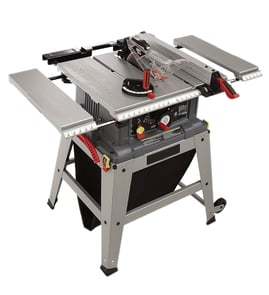

What are the common table saw mistakes?
The most common mistakes on a Tradesman 55-6883-2 table saw are skipping basic safety checks, using the wrong guiding tool for the cut, and making adjustments with the saw plugged in. These errors increase kickback risk and lead to inaccurate cuts; our 55-6883-2 owner's manual lists the key rules to follow every time.
- Not wearing safety glasses and appropriate PPE
- Plugging in the saw before reading and following the safety rules
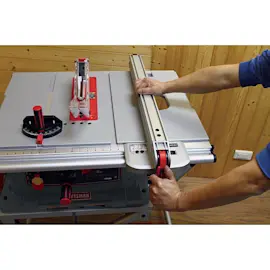
- Cutting freehand instead of using the rip fence (ripping) or miter gauge (crosscutting)
- Using the rip fence and miter gauge at the same time
- Running the saw with the blade guard and splitter not installed or not working properly
- Setting the blade too high above the workpiece (a common target is about 1/8 inch above the material for ripping)
- Feeding warped stock or stock without a straight edge against the fence
Verify these items before each use:
- Blade is tight
- Bevel angle locking handle is locked
- Rip fence is tight and parallel to the miter gauge groove and blade (for ripping)
- Miter gauge knob is tight (for crosscutting)
- Blade guard and splitter are in place and working properly
- Safety glasses are being worn
| Cut type | What it means | What to use | Common mistake |
|---|---|---|---|
| Ripping | Cutting along the length (with the grain) | Rip fence | Freehand ripping or fence not parallel |
| Crosscutting | Cutting across the width (across the grain) | Miter gauge | Using rip fence and miter gauge together |
Most “mistakes” are really setup problems. A loose bevel lock, misaligned fence, missing splitter, or freehand cut can cause binding and kickback. Good setup also improves accuracy for 45° and 90° cuts.
For replacement parts and diagrams for your Tradesman 55-6883-2, start with the parts list for this model; you can also search by model number on Sears PartsDirect.
Last updated: February 2026
What are the parts of a table saw?
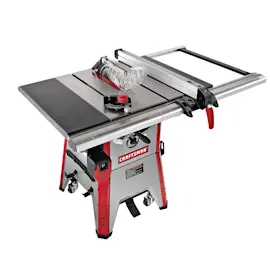
On the Tradesman table saw model 55-6883-2, the main parts include the tabletop and insert, rip fence and mitre gauge for guiding cuts, the blade and blade guard system, and the controls and adjustment mechanisms (blade elevation and bevel). For diagrams and names, use the 55-6883-2 owner's manual.
- Tabletop: the flat work surface that supports the material
- Table insert (throat plate): the removable insert around the blade opening
- Blade: the cutting tool mounted on the arbor
- Rip fence (cam-locking rip fence): guides straight rip cuts parallel to the blade
- Mitre gauge: guides crosscuts and angled cuts in the table groove
- Blade elevation handwheel: raises and lowers the blade height
- Blade bevel locking knob and bevel angle pointer: sets and locks the blade tilt angle
These parts directly affect safe operation and cut quality:
- Blade guard: covers the blade to reduce contact risk
- Splitter and splitter bracket: helps keep the kerf open to reduce binding and kickback
- ON/OFF paddle switch with safety key: allows quick shutoff and helps prevent unintended starts
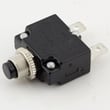
- Overload reset switch: restores power after an overload trip
| Part | What it does | When you use it |
|---|---|---|
| Rip fence | Keeps the workpiece straight for ripping | Cutting boards to width |
| Mitre gauge | Guides crosscuts and mitre cuts | Cutting to length, angles |
| Blade elevation handwheel | Sets blade height | Before every cut |
| Bevel lock and pointer | Sets blade tilt | Bevels, mitres |
| Blade guard and splitter | Helps reduce injury and kickback risk | For most through-cuts |
Knowing the correct part names helps you set up accurate ripping and crosscutting, troubleshoot issues like bad cuts or binding, and follow safe-use checks (tight blade, locked bevel, fence parallel, guard and splitter installed).
If you need help diagnosing cut problems, we recommend table saw bad cuts. For parts lookup by model number, use the model parts list first, or search by model at Sears PartsDirect.
Last updated: February 2026
Are table saw miter gauges universal?
No. Table saw miter gauges are not universal; they must match your saw’s miter gauge groove (slot) size and the way the bar slides and locks. For your Tradesman 55-6883-2, confirm the correct groove use and safe setup details in the 55-6883-2 owner's manual before buying a replacement.
A miter gauge works correctly only when it slides smoothly with minimal side-to-side play and holds accurate angles.
Check these items:
- Miter slot width and depth (many saws use 3/4 inch by 3/8 inch, but not all)
- Slot style (standard slot vs. T-slot)
- Bar adjustability (set screws or expansion discs to remove play)
- Locking knob strength (must tighten securely)
- Clearance with the blade guard and splitter during crosscuts
With the saw unplugged:
- Slide your current gauge in the groove; note wobble, binding, or rough spots.
- Measure the slot width and depth with a ruler or calipers.
- Confirm you can place the gauge in the left or right groove as required for the cut.
- Tighten the miter gauge knob and verify it holds position without slipping.
Your manual emphasizes controlled cutting: never cut freehand; use the rip fence for ripping and the miter gauge for crosscutting.
Before cutting, verify:
- Blade is tight
- Bevel angle locking handle is locked
- Rip fence is parallel to the miter gauge groove and blade (when ripping)
- Miter gauge knob is tight (when crosscutting)
| If you see this | Do this |
|---|---|
| Loose fit and no way to adjust play | Upgrade to an adjustable-bar miter gauge |
| Binding in the slot | Replace with the correct bar size/style |
| Off-angle cuts | Calibrate the gauge and blade alignment first |
A mismatched miter gauge can cause inaccurate cuts, binding, and higher kickback risk. A properly fitted gauge helps keep the workpiece flat to the table and tight to the gauge face.
For accessories and replacement items, start with the model parts list, then search by model number on Sears PartsDirect.
Last updated: February 2026
Can you use an 8 inch blade on a 10 inch table saw?
Yes; you can run an 8-inch blade on a 10-inch table saw like the Tradesman 55-6883-2 if the blade matches the saw’s arbor size and the blade can be clamped securely with the flange and arbor nut. The main tradeoff is reduced maximum cutting depth.
An 8-inch blade is a common swap, but it changes how the saw cuts and how you set it up.
- Maximum cut depth is lower, so thick stock may not cut through in one pass.
- The blade guard and table insert still must fit and operate correctly after the change.
- Feed rate and cut quality depend more on tooth count, sharpness, and alignment than diameter.
- You still need proper fence and miter gauge technique to reduce kickback risk.
We follow the same blade-mounting rules regardless of blade diameter.
- Unplug the saw; confirm the switch is OFF.
- Install the blade with the teeth pointing down toward the front of the table.
- Seat the blade firmly against the inner flange.
- Install the outer flange and arbor nut; tighten the arbor nut securely.
- Reinstall and adjust the table insert so it sits flush.
For diagrams and the exact procedure, use the 55-6883-2 owner's manual.
| Item | 8-inch blade on a 10-inch saw | 10-inch blade (typical) |
|---|---|---|
| Cutting depth | Reduced | Full design capacity |
| Best use | Thinner stock, some specialty cuts | General ripping and crosscutting |
| Setup impact | More likely to notice depth limits | Standard |
This model’s manual includes specific dado guidance: use only a stackable dado set (not adjustable or wobble types), and confirm the installed dado assembly will not strike the motor, table, or base during operation. It also notes you remove the blade guard and splitter for dado work and reinstall them when finished.
Related instructions: how to replace a table saw blade.
Blade diameter affects cutting depth and safety clearances. Correct seating of the blade, flange, and arbor nut reduces vibration and helps prevent binding and kickback.
You can look up parts and accessories by model number on Sears PartsDirect.
Last updated: February 2026
Are saw blade nuts reverse thread?
On the Tradesman 55-6883-2 table saw, the arbor nut uses a standard right-hand thread; you tighten it by turning clockwise and loosen it by turning counterclockwise. This is the blade-install direction shown in the 55-6883-2 owner's manual.
- Unplug the saw and remove the table insert.
- Raise the blade to maximum height.
- Use the two blade wrenches: one holds the arbor flats, the other turns the nut.
- Loosen: turn the arbor nut counterclockwise.
- Reinstall the outer flange and nut; tighten clockwise.
- Confirm the blade, flange, and nut are fully seated before final tightening.
| Task | Direction | Notes |
|---|---|---|
| Loosen arbor nut | Counterclockwise | Hold arbor flats with the open-end wrench |
| Tighten arbor nut | Clockwise | Tighten with the box-end wrench |
| Blade orientation | N/A | Teeth point down toward the front of the table |
Turning the nut the wrong way can round the nut, damage arbor threads, or leave the blade under-clamped. Correct tightening keeps the blade clamped between the flange and inner flange, reducing vibration and improving cut quality.
For replacement parts and diagrams for the Tradesman 55-6883-2, search by model on Sears PartsDirect.
Last updated: February 2026