Installation guide
 Owner’s manual
 Error Codes


What is the advantage of a bottom mount fridge?
A bottom-mount refrigerator like the KitchenAid KBRC36FKS00 puts the fresh-food compartment at eye level, so we reach everyday items with less bending and faster visibility. The freezer stays below, which works well when we access refrigerated foods more often than frozen foods.
Key advantages in daily use
- Less bending for fresh food: produce, dairy, and leftovers are easier to grab.
- Better organization up top: shelves and door bins are in your natural line of sight.
- Freezer space below: keeps bulk frozen items in a dedicated lower drawer area.
- Shorter door-open time: easier to find items can help reduce warm air entering.
- Good fit for built-in kitchens: bottom-mount built-in designs often prioritize a clean, integrated look.
How this layout helps performance and efficiency
When we can see and access fresh food quickly, the refrigerator door typically stays open for less time. That supports steadier temperatures and can reduce the workload on the cooling system.
Quick comparison
| Feature | Bottom-mount (KBRC36FKS00 style) | Top-freezer style |
|---|---|---|
| Most-used items | At eye/waist level | Lower shelves require more bending |
| Freezer access | Lower drawer area | Upper compartment |
| Best for | Fresh-food focused households | Frozen-food focused households |
Why it matters
Most households open the refrigerator section far more than the freezer. A bottom-mount layout is designed around that habit, improving comfort and making it easier to keep food organized.
Helpful reference for your model
For feature details (shelves, door bins, airflow guidance, and normal operating sounds), use the owner's manual.
Last updated: February 2026
Which is better, top mount or bottom mount refrigerator?
A bottom-mount refrigerator is better when you want everyday fresh-food items at eye level and a wider, more organized refrigerator section; a top-mount is better when you want a simpler layout and typically lower purchase cost. Your KitchenAid KBRC36FKS00 is a bottom-mount built-in design; use the owner's manual to get the most from its storage and controls.
Quick comparison (top mount vs bottom mount)
| Feature | Top mount (freezer on top) | Bottom mount (freezer on bottom) |
|---|---|---|
| Most-used items | Freezer is easiest to reach | Fresh food is easiest to reach |
| Organization | Often fewer drawers/bins | Often more drawers/bins for fresh food |
| Ergonomics | More bending for fresh food | Less bending for fresh food |
| Typical cost | Usually lower | Usually higher |
| Best fit for | Frozen-food heavy households | Fresh-food heavy households |
How to choose for your kitchen and habits
- Choose bottom mount if you cook often and want produce, deli items, and beverages at comfortable reach.
- Choose top mount if you use the freezer most and want a straightforward, compact layout.
- If you entertain, bottom-mount layouts usually make it easier to see and access fresh items quickly.
- If you have limited bending or lifting comfort, bottom mount is typically the easier day-to-day option.
- If you are tight on space, measure carefully; built-in units like KBRC36FKS00 are designed for a specific cabinet opening.
Why it matters for performance and upkeep
The “better” style is the one that keeps doors open for less time and fits your routine. Less door-open time helps temperatures stay stable, reduces run time, and can help prevent issues like excess noise or warm spots. Our KBRC36FKS00 Use and Care Guide also covers basics like ensuring proper air circulation and using the controls correctly, which directly affects cooling consistency.
Tips to get the most from a bottom-mount (KBRC36FKS00)
- Group similar foods together and adjust shelves to match item heights.
- Keep vents clear so cold air can circulate properly.
- Clean before first use and follow the recommended cleaning routine.
- If you use the water system, replace the filter on schedule; see how to replace the water filter in a KitchenAid refrigerator.
Last updated: February 2026
What is the most common problem with KitchenAid refrigerators?
The most common issues we see on KitchenAid refrigerators like model KBRC36FKS00 are ice maker problems, cooling/temperature swings, and water leaks. These symptoms often trace back to airflow problems (fans or coils), water supply or filtration issues, or a clogged drain/defrost system. See the owner's manual for model-specific checks and settings.
Most common symptoms and what they usually point to
- Ice maker not making ice: water supply restriction, ice maker fault, or temperature too warm
- Refrigerator not cooling well: dirty condenser area, condenser fan issue, evaporator fan issue, or sensor problem
- Water leaking or puddles: clogged defrost drain, loose water line connection, or filter housing/cap not sealing
- Frost buildup: door not sealing, frequent door openings, or defrost/drain issues
- Noisy operation: fan blade rubbing, failing fan motor, or vibration from panels/trim
Quick checks we recommend first (KBRC36FKS00)
- Confirm doors close and seal fully; warm air leaks cause frost and temperature swings.
- Verify the water supply meets typical built-in requirements; many KitchenAid units specify 30 to 120 psi water pressure and 33°F to 100°F water temperature.
- Replace the water filter on schedule; a restricted filter can reduce ice maker fill and water flow.
- Clean condenser coils and make sure airflow at the grille area is not blocked.
- Listen for the evaporator fan; weak airflow often shows up as warm fresh food section or uneven temps.
Parts that commonly solve these problems
| Symptom | Common fix | Example part for this model |
|---|---|---|
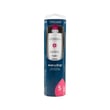
| Low ice production or slow water flow | Replace water filter; check for air in lines | Refrigerator water filter EDR5RXD1 |
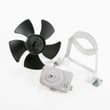
| Warm temps, poor airflow, noise | Inspect evaporator fan blade and motor | Refrigerator evaporator fan blade WP2169142 |
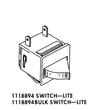
| Lights not responding to door | Check door/light switch | Refrigerator light switch W11384469 |
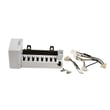
| Ice maker not cycling | Replace ice maker assembly (after basic checks) | Ice maker assembly - refrigerator ice maker by whirlpool 4317943 |
Why it matters
On a built-in refrigerator, small airflow or water-supply issues can quickly look like “major” failures (warm temps, no ice, leaks). Catching the root cause early helps protect food, reduce frost buildup, and prevent repeat part replacements.
Last updated: February 2026
What is the bottom part of a refrigerator called?
On a KitchenAid KBRC36FKS00 bottom-mount built-in refrigerator, the “bottom part” is usually the toe grille (kick plate) at the very front bottom, or the lower machine compartment behind it that contains cooling-system components like the compressor.
Common “bottom parts” people mean
- Toe grille (kick plate): the front cover at floor level
- Machine compartment: the area behind the toe grille where airflow and service access are provided
- Compressor area: the main sealed-system pump that circulates refrigerant
- Condenser fan area: moves air across the condenser for heat removal
- Drain pan: catches defrost water that evaporates
Quick identification guide
| What you see at the bottom | Common name | What it does |
|---|---|---|
| Slotted cover across the front, near the floor | Toe grille (kick plate) | Protects components and allows airflow |
| Components and wiring behind the grille | Machine compartment | Houses serviceable cooling parts |
| Black metal “can” with lines attached | Compressor | Drives the refrigeration cycle |
| Shallow pan underneath | Drain pan | Collects defrost water |
Why it matters
Using the right name helps you find the correct diagram and replacement part faster, especially for airflow issues, unusual noises, or water under the refrigerator.
Where to confirm for your KBRC36FKS00
- Check the parts diagrams and access instructions in the KBRC36FKS00 owner's manual.
- For built-in installation clearances and access panels, use the KBRC36FKS00 installation guide.
Last updated: February 2026