Installation guide
 Owner’s manual
 Error Codes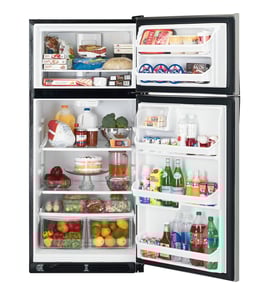





Is top mounted refrigerator better than bottom mounted?
A top-mount refrigerator like the Frigidaire FFTR1814TW6 is “better” when you want lower upfront cost, simpler design, and easy access to the freezer; a bottom-mount is “better” when you want the fresh-food section at eye level and bend less for everyday items. Use your kitchen habits to choose.
| Feature | Top-mount (freezer on top) | Bottom-mount (freezer on bottom) |
|---|---|---|
| Most-used items access | More bending for fresh food | Less bending for fresh food |
| Freezer access | Easiest access | More bending for freezer |
| Typical price | Usually lower | Usually higher |
| Complexity | Typically simpler | Typically more complex |
| Best fit for | Budget, reliability, garage/secondary fridge | Convenience for daily fresh-food use |
- You use the freezer often (frozen meals, bulk storage).
- You want a straightforward layout with fewer features to maintain.
- You want easier moving and installation planning; follow the clearance and leveling guidance in the installation guide.
- You need a dependable second refrigerator for a basement or garage.
- You prefer a lighter door load (many bottom-mounts have heavier fresh-food doors with more bins).
- You cook with fresh ingredients daily and want shelves at eye level.
- You want less bending for milk, produce, and leftovers.
- You store heavier items in the refrigerator section and want easier reach.
The “best” style is the one that matches how you open the doors every day. If you are in the refrigerator section far more than the freezer, a bottom-mount can feel more comfortable. If you rely on the freezer and want a simpler, budget-friendly design, a top-mount like the FFTR1814TW6 is a strong choice.
Last updated: February 2026
What are the disadvantages of a top mount fridge?
A top-mount refrigerator like the Frigidaire FFTR1814TW6 typically trades convenience for simplicity: the freezer is easiest to reach, but you bend more to access fresh-food items, and you usually get fewer premium organization and dispenser features than many bottom-freezer designs.
- More bending for daily items: fresh food is below eye level, so you crouch more for produce, drinks, and leftovers.
- Less “premium” organization: many top-mount models have fewer adjustable bins, dividers, and specialty drawers than higher-end layouts.
- Fewer built-in dispenser options: many top-mount refrigerators do not include an external ice or water dispenser.
- Smaller freezer access opening: bulky frozen items can be harder to maneuver in and out.
- Door-seal sensitivity: if the cabinet is not level, doors can be more likely to drift open or not seal evenly.
We recommend using the setup and leveling steps in the owner's manual and the spacing guidance in the installation guide. Proper leveling and airflow help the doors close correctly and keep temperatures stable.
- Confirm the refrigerator is level side-to-side and slightly tilted back so doors close on their own.
- Keep the toe grille unblocked for proper air circulation.
- Follow the recommended installation clearances (sides/top and rear) to avoid heat buildup.
- Set fresh-food and freezer temps after installation and recheck after 24 hours.
| Feature | Top-mount (FFTR1814TW6 style) | Bottom-freezer (typical) |
|---|---|---|
| Fresh-food access | Lower, more bending | Higher, easier daily access |
| Freezer access | Eye-level | Lower drawer/basket |
| Organization features | Often simpler | Often more flexible |
| Dispensers | Less common | More common on many models |
Most “disadvantages” come down to ergonomics and features. If your main goal is reliable cooling with straightforward controls and fewer complex components, a top-mount design can be a practical choice; correct installation and leveling make a noticeable difference in day-to-day use.
Last updated: February 2026
What is the upper part of a fridge called?
On a Frigidaire FFTR1814TW6 top-mount refrigerator, the upper section is typically called the freezer compartment (or simply the freezer). It sits above the fresh food (refrigerator) compartment and shares cooling airflow between both sections.
In manuals and parts diagrams, the “upper part” can be described a few different ways:
- Freezer compartment: the whole upper cooled space
- Freezer door: the upper door (if your model has a separate freezer door)
- Freezer shelf: the shelf inside the freezer
- Air vents/air duct: openings that move cold air between compartments
- Toe grille: the vented panel at the very bottom front (not the upper part, but often confused with “the vent”)
For the exact component names used for your refrigerator, check the labeled diagrams in the owner's manual.
Using the right term helps you match the correct part category (freezer vs. refrigerator) and avoid ordering the wrong door, shelf, or bin.
| If you mean this… | It is usually called… | Where it is |
|---|---|---|
| Upper cooled storage area | Freezer compartment | Top section inside |
| Upper outside door | Freezer door assembly | Front, top |
| Shelf inside the upper area | Freezer shelf | Inside freezer |
| Cold air opening between sections | Air vent/air duct | Back wall area |
When you are identifying the “upper part,” we recommend noting:
- Is it inside the freezer or on the door?
- Is it plastic, glass, or wire?
- Is it a shelf, bin, cover, or knob?
- Is anything cracked, warped, or not sealing?
- Do you need the matching hardware (clips, supports, bushings)?
If you are replacing a freezer shelf, one common shelf option listed for this model is the universal/multiflex (Frigidaire) refrigerator freezer shelf 240358008.
The freezer compartment is where temperatures are coldest; correct airflow and proper door sealing help the refrigerator compartment stay at safe food temperatures too.
Last updated: February 2026
What is the most common problem with Frigidaire refrigerators?
The most common Frigidaire refrigerator problem is a cooling issue: the fridge or freezer is too warm because airflow is restricted (frost buildup, blocked vents) or a fan is not moving air. For your Frigidaire FFTR1814TW6, the “Before You Call” section in the owner's manual covers the most frequent symptoms and quick checks.
- Refrigerator not cold enough: blocked air vents, dirty condenser area, or evaporator fan not running.
- Freezer cold but fridge warm: airflow problem between compartments (often frost or a stuck damper/air control).
- Frost buildup on the back wall of the freezer: defrost system issue.
- Refrigerator won’t run: control set to “0”, power supply problem, or unit in a defrost cycle.
- Odors: spills, uncovered food, or overdue cleaning.
- Confirm the temperature controls are set correctly and not at “0”.
- Make sure food packages are not blocking the air vents.
- Listen for fan noise when the compressor is running.
- Check door closing and sealing; a poor seal causes warm temps and frost.
- Give temperatures time to stabilize after changes (about 24 hours).
If your FFTR1814TW6 is running but not cooling correctly, these model-matched parts are common suspects:
| Symptom | Common cause | Example part for this model |
|---|---|---|
| Frost buildup, warming temps | Defrost heater not heating | Refrigerator defrost heater 242044008 |
| Frost buildup, erratic defrost | Defrost thermostat not closing | Refrigerator defrost bi-metal thermostat 5303918634 |
| Fridge warm, freezer OK | Weak/no airflow from evaporator | Refrigerator evaporator fan motor 242219204 |
| Warm temps, noisy or hot cabinet sides | Poor condenser airflow | Refrigerator condenser fan motor 242018301 |
| Frost around door, sweating | Leaking door seal | Frigidaire refrigerator door gasket (white) 242193206 |
Cooling problems can lead to food spoilage and heavy frost that further blocks airflow. Catching the cause early (airflow, door seal, or defrost) helps your FFTR1814TW6 recover faster and prevents repeat temperature swings.
Last updated: February 2026