Installation guide
 Owner’s manual
 Error Codes



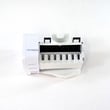
How to remove bottom grille on GE refrigerator?
On the GE GFE26GSHFSS bottom-mount refrigerator, the bottom grille (base grille) typically comes off by releasing its retaining tabs or removing a couple of fasteners, then pulling the grille straight out from the front. Use the access and safety steps in the installation guide before you start.
Safe prep (do this first)
- Unplug the refrigerator (or switch off the breaker).
- If you need more room, pull the refrigerator out from the wall.
- Protect the floor with a towel or cardboard.
- If you will move the unit far, shut off the water supply and be careful with the water line.
How to remove the bottom grille
- Look along the top edge and corners of the grille for screws (often 1/4-inch hex head) or snap tabs.
- If you see screws, remove them and set them aside.
- If it is a snap-in style, grip the grille near the ends and pull straight outward; if it resists, press in on the tabs while pulling.
- Lift the grille away and set it aside.
Reinstalling the grille
- Align the grille with the slots or mounting points.
- Push it in until the tabs seat (or reinstall the screws).
- Confirm it sits flush and does not rub the floor.
| What you see | What it usually means | What to do |
|---|---|---|
| 1/4-inch hex head screws | Screw-mounted grille | Remove screws, then pull grille off |
| No screws, visible clips/tabs | Snap-in grille | Release tabs, pull straight out |
| Grille won’t budge | Tabs still engaged or grille catching | Pull from both ends evenly; check corners for hidden fasteners |
Why it matters
Removing the base grille gives you access for cleaning and for checks in the machine compartment area. Keeping that area clear helps airflow and can prevent cooling and noise issues.
Last updated: February 2026
What are the disadvantages of a bottom freezer refrigerator?
Bottom-freezer refrigerators like the GE GFE26GSHFSS make fresh-food items easier to reach, but the tradeoffs are higher purchase cost, more bending to access frozen foods, and freezer storage that can be harder to sort in deep drawers. For model-specific use and setup details, use the owner's manual.
Common disadvantages (what owners notice most)
- More bending and lifting: you reach down for frozen foods, and heavy items can be awkward to lift out.
- Deep-drawer organization: items stack and get buried, so it is easier to lose track of what is in the freezer.
- More floor space needed to access the freezer: the drawer needs clearance to pull fully open.
- Ice access can feel less convenient: depending on your layout, you may open the freezer more often for ice.
- Drain and defrost-related messes: bottom-freezer designs can be more sensitive to drain clogs and ice buildup that lead to leaks or frost.
Bottom freezer vs. top freezer: quick comparison
| Feature | Bottom freezer | Top freezer |
|---|---|---|
| Fresh-food access | Best (eye-level shelves) | Requires more bending |
| Freezer access | Requires bending | Easier reach |
| Freezer organization | Often deep drawers | Often shelves/bins |
| Typical price | Often higher | Often lower |
Why it matters
If you use the freezer many times a day, the bending and drawer organization can be a daily annoyance. If you use the refrigerator section more than the freezer, the eye-level fresh-food layout is usually the bigger win.
Tips to reduce the downsides
- Keep heavy frozen items (meat, bulk bags) near the top of the drawer for safer lifting.
- Use small bins inside the freezer drawer to separate categories (breakfast, vegetables, snacks).
- Label and rotate: put newer items behind older ones to reduce waste.
- If you see puddles or frost, check for door seal gaps and keep vents clear.
Last updated: February 2026
What is the most common problem with GE refrigerators?
The most common issue we see with GE refrigerators like model GFE26GSHFSS is poor cooling (fresh food too warm, freezer not holding temperature). In many cases, the root cause is restricted airflow or a failed cooling component such as the evaporator fan, a temperature sensor, or a defrost-system part.
Quick checks that fix many “not cooling” complaints
- Make sure air vents inside the refrigerator and freezer are not blocked by food packages.
- Set temperatures to typical targets: 37°F for fresh food and 0°F for freezer.
- Clean dust from the condenser area (dirty coils make the compressor run longer and cool worse).
- Confirm doors close fully and seals are making contact all the way around.
- Listen for the evaporator fan in the freezer; it should run when the compressor is running.
Parts that commonly cause cooling problems on this model
If basic airflow and settings look good, these model-matched parts are frequent culprits:
| Symptom | Likely area | Example part for GFE26GSHFSS |
|---|---|---|
| Warm fridge, freezer OK or inconsistent temps | Temperature sensing/control | Refrigerator temperature sensor WR55X10025 |
| Warm fridge and freezer, weak airflow | Evaporator fan | Refrigerator evaporator fan motor WR60X26866 |
| Frost buildup on freezer back wall, warming over time | Defrost system | Refrigerator defrost heater WR51X10132 and refrigerator defrost bi-metal thermostat WR50X10108 |
Why it matters
Cooling problems usually get worse over days or weeks. Catching them early helps protect food, reduces compressor run time, and prevents secondary issues like heavy frost that blocks airflow.
When to use the installation guide
If you are accessing dispenser or door-related components during service, follow the safety steps in the installation guide (disconnect power before servicing, reconnect grounding, and reinstall panels before operating).
Last updated: February 2026