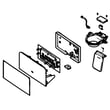
Owner’s manual
 Error Codes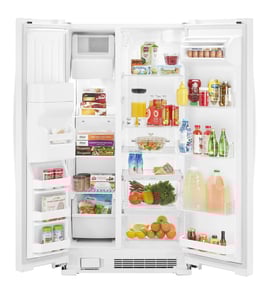


What is force defrost, RD or FD?
On Samsung model RS25H5111SR, RD typically means a forced refrigerator (fresh food) defrost, while FD means a forced full-system defrost (commonly including the freezer side). Both are service-mode options used to manually melt frost when you have icing, airflow problems, or you are doing a repair. For operating details, use the RS25H5111SR manual.
RD vs FD: what each mode is for
- RD (refrigerator defrost): Targets frost in the fresh food evaporator area.
- FD (force defrost): Runs a broader defrost intended to clear heavier or more widespread frost.
- Fans and cooling: During forced defrost, cooling operation is reduced or stopped so heat can melt frost.
- Use case: RD is more targeted; FD is the better choice when you are unsure which section is iced up.
When we recommend using forced defrost
- Heavy frost on the back wall inside the freezer or refrigerator
- Warm refrigerator section but freezer still cold (possible airflow restriction)
- Ice buildup around vents, damper area, or evaporator cover
- After replacing a defrost-related component and you need to clear remaining ice
- Ice maker area icing that is blocking airflow or ice movement
Quick comparison
| Display code | What it generally means | Best used when | What you should watch for |
|---|---|---|---|
| RD | Refrigerator-only defrost | Fresh food section icing | Water dripping inside fridge, wet shelves |
| FD | Full-system defrost | General icing, freezer icing, post-repair thaw | Water at floor, drain pan filling |
Why it matters
Forced defrost is a fast way to restore airflow and confirm whether frost buildup is the root cause of temperature swings, weak cooling, or ice maker issues. If frost returns quickly after an FD cycle, we treat that as a sign to troubleshoot the defrost system (heater, sensor, wiring, or control).
Last updated: January 2026
What is the most common problem with a Samsung refrigerator?
For the Samsung RS25H5111SR, the most common service issues we see are cooling problems (warm fridge or freezer), often tied to restricted airflow from frost/ice buildup, plus ice maker and water dispenser complaints such as low ice production or small leaks. Use the troubleshooting section in the RS25H5111SR manual to narrow the cause.
Most common symptoms (and what they usually point to)
- Fridge warm, freezer OK: airflow problem (blocked vents, frosted evaporator area, fan issue)
- Freezer warm, fridge warm: sealed system or compressor-side cooling problem
- Loud buzzing, clicking, or humming: fan hitting ice, or compressor/start components struggling
- Ice maker not making ice: water supply issue, ice maker turned off, frozen fill path
- Water under fridge or in crisper area: drain restriction or water line/filter seating issue
Quick checks we recommend first (RS25H5111SR)
- Confirm it is not in Cooling Off (Demo) mode. If you see “OFF” on the display, cooling is disabled.
- Verify temperature settings: typical targets are about 37°F fresh food and 0°F freezer.
- Check door sealing and airflow: do not block interior vents with food packages.
- Look for frost buildup: heavy frost can block the evaporator fan and air passages.
- If ice maker noises happen with no water connected: turn the ice maker off.
When the problem may be a major cooling component
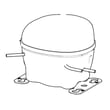
If both compartments are warm and basic checks do not help, the issue can be in the sealed system. One key component is the compressor; for this model, see the Samsung refrigerator compressor MKV190CL2BASH.
| Symptom | More likely cause | Less likely cause |
|---|---|---|
| Freezer and fridge both warm | compressor/sealed system, condenser airflow | control setting |
| Freezer cold, fridge warm | airflow/defrost-related restriction | compressor |
| Ice maker not working | water supply, ice off setting, frozen fill | compressor |
Why it matters
Cooling and airflow issues can quickly lead to food spoilage and can also trigger secondary problems like noisy operation, ice clumping, and water leaks from melting frost.
Last updated: January 2026
What size is rs25h5111sr?
The Samsung RS25H5111SR is a 36-inch-wide side-by-side refrigerator. Based on the model’s specifications in our documentation, the cabinet width is 35 3/4 in., and the width with legs is 36 1/20 in. For the full dimension chart, see the RS25H5111SR use & care manual.
Key dimensions for Samsung RS25H5111SR
These are the most commonly needed measurements for fit and clearance planning:
- Width (cabinet only): 35 3/4 in.
- Width (with legs): 36 1/20 in.
- Depth (cabinet only): 30 9/10 in.
- Depth (with door): 33 3/4 in.
- Depth (with handle): 36 1/5 in.
- Height (cabinet only): 68 3/5 in.
- Height (with hinge): 69 9/10 in.
Quick fit checklist (what to measure before delivery)
Measure these areas to avoid installation surprises:
- Doorway width and height (including trim)
- Hallway turns and stair landings
- Space for doors to swing open
- Clearance behind and above the refrigerator for airflow
- Floor levelness (important for door alignment and sealing)
Size summary table
| Measurement | RS25H5111SR spec |
|---|---|
| Nominal width class | 36 in. |
| Cabinet width | 35 3/4 in. |
| Depth with handle | 36 1/5 in. |
| Height with hinge | 69 9/10 in. |
Why it matters
Getting the correct “size” helps prevent clearance issues, improves airflow for efficient cooling, and reduces the chance of door-seal problems that can lead to temperature swings and excess run time.
Last updated: January 2026