Owner’s manual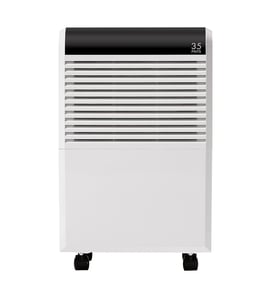



Can I sleep in a room with a dehumidifier?
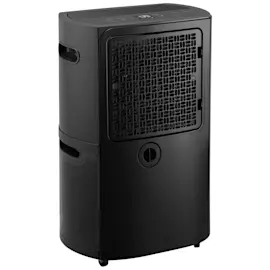
Yes, you can sleep in a room with the Haier dehumidifier model QDHR50LZW1 running as long as it’s used safely and set to a comfortable humidity level. For this model, we target about 40% to 50% relative humidity and keep the unit on a stable, well-ventilated spot (see the QDHR50LZW1 owner's manual).
- Plug the dehumidifier directly into a grounded wall outlet (no extension cords, no surge protectors).
- Place it on a smooth, level floor that can support the unit with a full bucket.
- Keep at least 18 inches of open space on all sides for airflow.
- Use it only indoors; this model is intended for indoor residential use.
- Keep the room temperature between 41°F and 90°F to reduce coil frost and performance issues.
A dehumidifier can make the room feel slightly warmer while it runs, which is normal. If the air feels too dry or you notice dry throat or skin, raise the humidity setpoint.
| What you notice overnight | What to change | Why it helps |
|---|---|---|
| Air feels too dry | Increase humidity setting | Prevents over-drying and irritation |
| Unit seems loud | Move it farther from the bed (keep airflow clearance) | Reduces perceived noise |
| Water bucket fills quickly | Empty before bed or use continuous drain if equipped | Prevents shutoff from a full bucket |
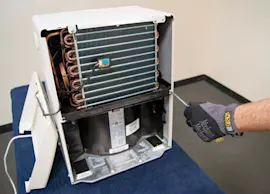
If your unit stops during the night, the bucket may be full or not seated correctly.
- Empty and reinstall the bucket fully.
- Check for cracks or warping.
- Replace a damaged bucket with the water bucket asm WK10X22286.
Keeping humidity in the recommended range helps limit musty odors and moisture problems while avoiding overly dry air. Proper clearance and correct power connection also reduce overheating and electrical risks.
Last updated: January 2026
Is it worth getting a whole house dehumidifier?
Yes, a whole-house dehumidifier is worth it when your home has persistent humidity problems that a portable unit like the Haier QDHR50LZW1 cannot manage room-to-room; it delivers steadier whole-home humidity control, better comfort, and less daily emptying.
A whole-house system is the better choice if you regularly deal with moisture across multiple rooms.
- You see condensation on windows or musty odors in several areas
- Your basement stays damp even when the dehumidifier runs often
- You want consistent humidity (typically 40% to 50%) throughout the home
- You are tired of emptying a bucket and want continuous drainage
- You want quieter operation than running multiple portable units
If the moisture issue is limited to one space, your QDHR50LZW1 style unit is usually the most cost-effective approach.
- Humidity is mainly in one room (basement, laundry room, storage area)
- You can place the unit correctly with airflow clearance
- You can keep the room temperature in the normal operating range
- You do not want HVAC modifications or professional installation
For best performance and safe setup details (clearances, temperature limits, and electrical guidance), follow the QDHR50LZW1 owner's manual.
| Feature | Portable (QDHR50LZW1 type) | Whole-house dehumidifier |
|---|---|---|
| Coverage | Single room or zone | Entire home via ducting |
| Water handling | Bucket or hose (model dependent) | Continuous drain |
| Noise | In-room | Usually quieter in living spaces |
| Upfront cost | Lower | Higher |
| Installation | DIY placement | Typically professional |
High indoor humidity can drive mold growth, odors, and comfort issues. Choosing the right type of dehumidifier helps protect finishes, reduce allergens, and keep your HVAC system from working harder than it needs to.
If your current unit is not collecting much water, a dirty air filter can reduce airflow; cleaning or replacing the filter WK85X22284 is a smart first step before upgrading.
Last updated: January 2026
What is the downside of a dehumidifier?
A dehumidifier like the Haier QDHR50LZW1 improves comfort by removing moisture, but the tradeoffs are higher electricity use, normal fan and compressor noise, and routine upkeep (cleaning the air filter and emptying or draining water). Performance also drops in colder spaces.
- Higher energy use because the compressor and fan run to pull moisture from the air
- Noise from airflow and compressor cycling
- Regular maintenance: the air filter needs periodic cleaning (see the QDHR50LZW1 owner's manual)
- Bucket handling: the unit shuts off when the bucket is full, removed, or not seated correctly
- Cold-area limitations: below 41°F (5°C), the coil can frost and moisture removal can decrease
- Coverage limits: it works best in the room where it has good air circulation
- Keep the filter clean; replace it if it is damaged (use the filter WK85X22284)
- Place the unit on a smooth, level floor and allow at least 18 inches of clearance on all sides
- If you use a garden hose for continuous drain, keep the bucket installed and fully seated
- Avoid running it where temperatures fall below 41°F (5°C)
| Downside | What you notice | Best fix |
|---|---|---|
| Higher energy use | Longer run times | Set a realistic humidity target, keep doors and windows closed |
| Noise | Fan and compressor sound | Level placement, maintain clearance for airflow |
| Maintenance | Reduced airflow, odors | Clean filter, keep bucket and grille clean |
| Cold-area performance | Frost, weak moisture removal | Use above 41°F (5°C), warm the space |
Most dehumidifier complaints come from restricted airflow, a dirty filter, or the bucket not being seated. Following the placement, temperature, and cleaning guidance helps the QDHR50LZW1 remove moisture efficiently and shut off when it should.
Last updated: January 2026
How much does it cost to run a dehumidifier 24 hours a day?
Running the Haier dehumidifier model QDHR50LZW1 for 24 hours a day typically costs about $1 to $5 per day at common electric rates, depending on the unit’s wattage and how often the compressor actually runs. Use the exact rated watts from the QDHR50LZW1 owner's manual to calculate your real cost.
Use your electricity rate and the dehumidifier’s rated watts.
- Daily cost = (Watts ÷ 1000) × 24 × (your $/kWh)
- Monthly cost = Daily cost × 30
- If you run Nonstop (NS) mode, the unit operates continuously at maximum dehumidification settings when draining with a hose, or until the bucket is full.
These examples show how much the math changes with wattage. Plug in your QDHR50LZW1 rated watts for a precise estimate.
| Power draw | $0.12/kWh | $0.20/kWh | $0.30/kWh |
|---|---|---|---|
| 300W | $0.86/day | $1.44/day | $2.16/day |
| 500W | $1.44/day | $2.40/day | $3.60/day |
| 700W | $2.02/day | $3.36/day | $5.04/day |
Even if the dehumidifier is “on” all day, the compressor cycles based on conditions.
- Humidity setting: Lower % settings increase run time.
- NS (Nonstop) mode: Runs continuously (until the bucket is full or a drain hose is used).
- Room temperature: Moisture removal works best above 41°F (5°C).
- Airflow and filter: A dirty filter or blocked airflow increases run time.
- Moisture sources: Open windows, damp basements, and laundry areas drive longer operation.
The “24/7 cost” is an energy-use calculation. Using the QDHR50LZW1 rated watts (instead of generic wattage guesses) gives the most accurate daily and monthly operating cost.
Last updated: January 2026