Owner’s manual

What not to do with a table saw?
For the Craftsman 351218331 table saw, do not cut freehand, reach over or behind the blade, or do any setup while the blade is spinning. These actions greatly increase the chance of kickback, binding, or hand contact with the blade; follow the safety rules in the owner's manual.
Never do these high-risk actions
- Never cut freehand; always guide the work with the rip fence or miter gauge.
- Never reach behind the cutting tool to hold the workpiece down, support it, or clear scraps.
- Never use the rip fence for crosscuts or the miter gauge for ripping.
- Never remove cutoffs by hand; push small pieces off the table with a long stick.
- Never adjust, change blades, or remove the insert/guard with power connected.
- Never stand in line with the blade; stand to either side to reduce kickback risk.
Safe habits that prevent kickback and binding
Kickback happens when the workpiece binds and gets thrown back toward the operator. For this model, the manual emphasizes positioning, support, and alignment.
- Use featherboards for non-through operations to keep stock tight to the fence/table.
- Support long or wide stock at the rear and sides (roller stand or outfeed support).
- If the blade stalls or jams, turn the saw OFF, disconnect power, then free the work.
- Keep the blade, spreader, and rip fence aligned and parallel as required.
Quick “do this instead” guide
| Task | Don’t do this | Do this instead |
|---|---|---|
| Ripping | Freehand | Use rip fence; use push sticks/featherboard as needed |
| Crosscutting | Use rip fence as a stop | Use miter gauge (add a facing if needed) |
| Clearing scraps | Grab pieces near blade | Use a long stick after blade stops |
| Adjustments | Adjust with blade spinning | Turn OFF and disconnect power first |
Why it matters
Most table saw injuries and damaged workpieces come from loss of control: freehand cuts, reaching near the blade, and poor support/alignment lead to binding and kickback. Following the Craftsman 351218331 operating rules keeps the work guided and your hands out of the blade path.
Last updated: February 2026
Are all table saw arbor nuts the same size?
No. Arbor nuts are not universal; the thread size and nut style depend on the saw’s arbor design. On the Craftsman 351218331 table saw, the manual specifies a 5/8-inch blade arbor and shows using the supplied wrench to loosen the arbor nut, so you should match the nut to this saw’s arbor and flange setup. See the owner's manual for the exact blade and arbor requirements.
What is standardized (and what is not)
Many 10-inch table saws use a 5/8-inch arbor hole in the blade, but that does not guarantee the arbor nut is the same across brands or models.
- Often standardized: blade arbor hole size (commonly 5/8 inch on many 10-inch saws)
- Not standardized: arbor nut thread pitch, nut thickness, flange design, and whether the nut is left-hand or right-hand thread
- Model-specific: how the arbor locks, what wrench fits, and the order of parts (nut, flange, blade)
What we know for Craftsman 351218331
From the Craftsman 351218331 documentation:
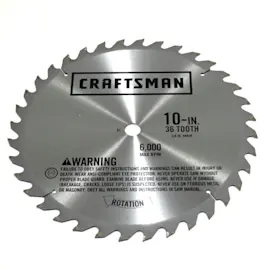
- Uses 10-inch blades
- Requires blades with 5/8-inch arbor holes
- Blade removal uses an arbor lock/locking pin and the supplied open-end wrench
- The arbor nut loosens by turning the wrench counterclockwise (standard right-hand thread)
Quick compatibility checklist before buying or swapping an arbor nut
Use this checklist to avoid cross-threading or unsafe blade mounting:
- Confirm your blade arbor hole matches the saw (5/8 inch for this model)
- Verify the nut threads start smoothly by hand (never force it)
- Make sure the blade flange seats flat and clamps the blade evenly
- Confirm the nut tightens in the correct direction for your saw
- Use only accessories designed for the saw and rated for the saw’s RPM
Common sizes at a glance
| Saw type | Typical blade diameter | Typical blade arbor hole |
|---|---|---|
| Jobsite/contractor table saw | 10 in. | 5/8 in. |
| Larger cabinet/industrial saw | 12 in. | 1 in. |
Why it matters
The arbor nut and flange are what clamp the blade to the arbor. If the nut is the wrong thread or the flange does not match, the blade can wobble, cut poorly, or loosen during operation.
Last updated: February 2026
Can an 8 dado blade be used on a 10 table saw?
Yes. On the Craftsman 351218331 10-inch table saw, we can use an 8-inch dado set as long as it matches the saw’s 5/8-inch arbor and stays within the saw’s maximum dado width; this model is designed to accept an 8-inch dado head when set up correctly (see the owner's manual).
What matters for compatibility on model 351218331
An 8-inch dado set is about diameter; fit and safe operation depend on arbor size, width, and having the right insert.
- Arbor size: This saw uses a 5/8-inch arbor, so the dado set must be 5/8-inch I.D.
- Dado diameter: This saw is set up for an 8-inch O.D. dado head
- Maximum dado width: Keep the stacked dado width at or under the saw’s rated maximum
- Correct throat insert: Use a dado insert (a standard blade insert leaves too much opening)
- Guarding changes: Dadoing is a non-through cut; the blade guard is removed for the cut and reinstalled immediately after
Quick spec check (from the manual)
| Item | What to use on Craftsman 351218331 | Why it matters |
|---|---|---|
| Arbor (shaft) size | 5/8 in. | The dado set must match the arbor bore |
| Dado outside diameter | 8 in. | Keeps the cutter within the saw’s intended setup |
| Dado width | Up to the saw’s maximum rating | Prevents overload and unsafe stack height |
| Insert | Dado insert | Supports the workpiece and reduces kickback risk |
Safe setup tips for dado cuts
- Unplug the saw before changing blades or installing a dado stack
- Use the rip fence or miter gauge; never cut freehand
- Use push sticks and featherboards to control the workpiece
- Make a shallow first pass, then increase depth as needed
- Reinstall the standard blade, blade insert, and blade guard right after finishing
Why it matters
A dado stack removes more material than a standard 10-inch blade, so correct arbor fit, the right insert, and controlled feeding help prevent binding, kickback, and overload trips while keeping your grooves and rabbets accurate.
Last updated: February 2026
Are craftsman table saws any good?
Yes. Craftsman table saws like model 351218331 are a solid choice when you want dependable, accurate cutting for typical DIY and shop projects; this contractor-style saw is built for continuous service and is designed to deliver precise cuts when it is assembled, aligned, and maintained per the owner's manual.
What “good” means for the Craftsman 351218331
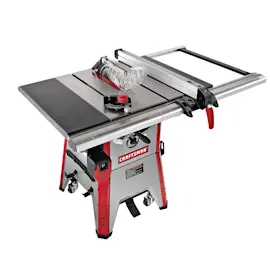
This model is a 10-inch contractor table saw with a cast iron table, a precision rip fence system, and key safety features (riving knife, clear blade guard, anti-kickback). Those features support repeatable rip cuts and crosscuts when the fence and blade are set correctly.
Strengths you can expect
- Cast iron table helps stability and smoother feeding
- Designed for continuous service (good for frequent use)
- Rip fence rail is calibrated (inches and millimeters) for setup accuracy
- On-board storage for fence, miter gauge, push stick, and blades
- 4-inch dust port supports dust collection with a vacuum hose
Where performance usually falls short (and how to fix it)
Most “table saw isn’t good” complaints come from setup, alignment, or blade choice, not the brand name.
- Cuts not square or angles drift: verify blade-to-miter-slot and fence alignment; use the how to adjust a table saw blade guide.
- Rough cuts or burning: switch to the correct blade type and keep it clean and sharp.
- Vibration: check the stand/floor is level and inspect the blade for damage.
- Slow blade or stalling: reduce feed rate and confirm the blade is appropriate for the material; see table saw blade spins too slow.
Quick checklist: is your saw “good” for your job?
| Your typical work | 351218331 fit | What matters most |
|---|---|---|
| DIY furniture, shelving, trim | Good | Alignment, sharp blade, fence setup |
| Sheet goods and long boards | Good with support | Outfeed/side support, safe handling |
| Heavy daily production ripping | Good when maintained | Blade selection, dust control, periodic tune-ups |
Why it matters
A table saw’s real value is safe, repeatable accuracy. With the riving knife and guard installed, the correct 10-inch blade, and proper alignment, this Craftsman contractor saw delivers the kind of consistent results most woodworkers need.
Last updated: February 2026