Installation guide
 Owner’s manual
 Error Codes




How to reset LG gas oven?
To reset an LG gas range with double oven model LDG3016ST, restore power by turning the range’s circuit breaker OFF for 1 to 3 minutes, then turning it back ON. This clears many control glitches and lets the electronic ignition system restart.
Quick reset steps (safe and effective)
- Turn all oven and surface burner knobs to OFF.
- Switch the range’s circuit breaker OFF (or unplug the power cord if accessible).
- Wait 1 to 3 minutes.
- Turn the breaker ON (or plug back in).
- Set Bake and press Start to confirm normal operation.
What to check after the reset
If the display comes back but the oven still will not heat, use these checks:
- No ignition during a power outage: this model uses electrical ignition and will not light bake or broil without power.
- Normal ignition delay: bake or broil ignition can take 30 to 90 seconds before the burner heats.
- Door position: broil typically requires the door closed to operate normally.
- Gas supply: confirm the household gas shut-off valve is open (the installer should have identified its location).
| Symptom after reset | Most likely cause | What we recommend |
|---|---|---|
| Display is blank | No power to range | Check breaker, outlet, and grounding per the LDG3016ST installation guide |
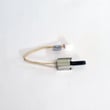
| Clicking but no flame | Ignition or gas flow issue | Verify shut-off valve is open; if ignition is weak, inspect the LG range oven burner igniter MEE61841401 |
| Oven lights late | Normal ignition timing | Allow up to 90 seconds before assuming a failure |
Why it matters
A reset restores the control board to a clean startup state, which helps the oven manage gas valve timing and the electronic igniter sequence correctly. It also helps you separate a simple control glitch from a true ignition or gas supply problem.
Last updated: February 2026
What model is my LG range?
For this LG gas range with double oven, the model number you need for parts is printed on the appliance ID label; once you find it, match it exactly (letters and numbers) to order the correct parts for your range. For this page, the model is LDG3016ST; confirm your label matches before buying parts.
Where to find the model number on the range
Most LG ranges place the model and serial information on an ID label around the oven door area.
- Check the frame around the oven opening after you open the upper oven door
- Look along the door jambs and the front frame (left or right side)
- Check the lower oven door frame area on double-oven models
- Wipe the label gently; grease can hide characters like 0/O and 1/I
- Write the model number exactly as shown, including any suffixes
For diagrams and label-location details specific to this series, use the LDG3016ST installation guide.
How to confirm you have the right model for parts
A single character difference can change burner, igniter, knob, or control board compatibility.
| What you see | What it means | What to do |
|---|---|---|
| LDG3016ST | Base model number | Use this to start your parts lookup |
| LDG3016ST/00 (or similar) | Version/revision code | Match it when selecting parts |
| Serial number | Production identifier | Keep it for service and warranty records |
Why it matters
Using the exact model number helps us match the correct LG range parts (for example, an oven igniter, surface burner knob, or control board) so the repair fits, mounts correctly, and works safely with your gas range’s ignition and controls.
Last updated: February 2026
What is the life expectancy of an LG range?
Most LG gas ranges, including the LG LDG3016ST double-oven range, typically last 10 to 15 years with normal household use and basic maintenance. You can often extend service life by keeping burners clean, fixing ignition issues early, and following the care guidance in the LDG3016ST owner’s manual.
What affects how long an LG range lasts
A range’s lifespan is usually limited by wear parts (ignition and controls) rather than the oven cavity itself.
- Cooking frequency and high-heat use (daily baking, broiling, long simmering)
- Cleaning habits (spills left to bake on, harsh cleaners on knobs and finishes)
- Gas quality and proper regulator pressure (important for stable flames)
- Early repair of ignition problems (clicking, delayed ignition, weak glow)
- Ventilation and heat exposure around the control area
Typical lifespan by component (what usually fails first)
These are common service-life patterns for gas ranges.
| Component | Typical issue | What you notice |
|---|---|---|
| Oven ignition system | Igniter weakens over time | No bake, delayed ignition, gas smell before lighting |
| Surface burner controls | Valve/knob wear | Hard-to-turn knob, uneven flame control |
| Electronic controls | Heat or power surge damage | Dead display, erratic temps, buttons not responding |
| Door hardware | Hinge wear | Door won’t close evenly, heat loss |
When to repair vs. replace
We recommend repairing when the range is heating safely and the fix is limited to a common wear part.
- Repair makes sense when the issue is isolated (igniter, knob, light, grate)
- Replace makes sense when multiple major systems fail (controls plus gas valve plus wiring)
- If the oven will not ignite reliably, address it promptly; ignition problems can worsen quickly
Helpful model-specific part example: A weak oven igniter is a frequent cause of “won’t bake” symptoms; for this model, the LG range oven burner igniter MEE61841401 is a common replacement part.
Why it matters
Knowing the 10 to 15 year expectation helps you plan maintenance and avoid downtime. Catching small problems early (especially ignition and flame stability) reduces stress on the gas valve, wiring, and control board.
Last updated: February 2026