Installation guide
 Owner’s manual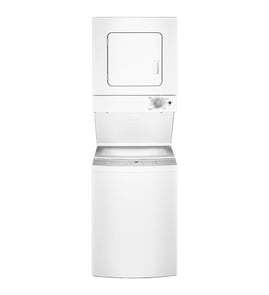

What are the most common issues with FLEB8200FS1?
For the Frigidaire FLEB8200FS1 stacked laundry center, the most common problems are dryer no-heat or overheating, dryer noise from drum support wear, and washer draining or spinning issues. Many of these symptoms trace to airflow restrictions, worn drum-support parts, or a failing drain component; use the owner's manual for model-specific checks.
Common symptoms and what they usually point to
- Dryer runs but no heat: restricted venting, a failed thermal safety, or a heat-control component.
- Dryer shuts off or overheats: clogged lint path, crushed vent, or a high-limit safety opening.
- Squealing, scraping, or thumping in dryer: worn drum support parts such as a bearing or glide.
- Washer will not drain or leaves water: drain restriction, kinked hose, or a weak drain pump.
- Washer will not spin or spins poorly: belt wear, load imbalance, or drive system wear.
Parts that commonly solve these issues (when diagnosis confirms)
If your symptoms match, these are frequently replaced on this model:
- Dryer lint filter 5304516871 (airflow and drying performance)
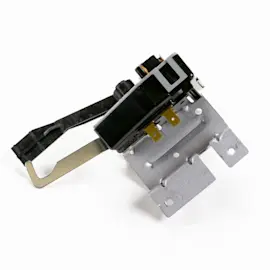
- Dryer thermal limiter 134120900 (no-heat or heat-safety trips)
- Kelvinator dryer high-limit thermostat 3204267 (overheating protection)
- Dryer drum bearing 131825900 and dryer drum glide 137513300 (noise and drum support)
- Pump 137221600 and electrolux washer drain hose 134592700 (drain problems)
- Electrolux washer drive belt 134511600 (spin and agitation issues)
Quick checks we recommend before ordering parts
- Clean the lint filter and confirm strong airflow at the outside vent hood.
- Verify the dryer vent is short, not crushed, and free of lint buildup.
- For washer drain issues, check the standpipe for clogs and confirm the drain hose is not kinked.
- For spin complaints, redistribute the load and run a spin-only cycle.
- Unplug power before inspecting internal components.
Symptom-to-part cheat sheet
| Symptom | Most common cause category | Example parts to check |
|---|---|---|
| No heat | Heat safety/control | Thermal limiter, high-limit thermostat |
| Overheats | Airflow restriction | Lint filter, venting |
| Loud dryer noise | Drum support wear | Drum bearing, drum glide |
| Won’t drain | Drain path/pump | Pump, drain hose |
| Won’t spin | Belt/drive | Drive belt |
Why it matters
Catching airflow and drum-support problems early prevents repeat thermal cutoffs, long dry times, and additional wear on the drum and motor. On the washer side, resolving drain issues quickly helps prevent odors and poor spin performance.
Last updated: March 2026
What does E1 mean on a Frigidaire?
On the Frigidaire FLEB8200FS1 stacked laundry center, an E1 code on the washer side points to a water fill or water level (pressure) sensing problem, and it can also show up when the unit detects an overflow condition. The most common causes are the water inlet valve and the water level (pressure) sensor system.
What to check first (fast, no parts)
- Turn off power to the laundry center, then restore power to clear a temporary control glitch.
- Confirm both water supply valves are fully open and the hoses are not kinked.
- Clean the inlet hose screens at the washer water valve (sediment can slow filling).
- Make sure the drain hose is not shoved too far down the standpipe (siphoning can confuse water level sensing).
- Run a fill portion of a cycle and listen: steady fill sound vs. pulsing or no fill.
Likely causes and what they look like
| Likely cause | What you may notice | Typical fix |
|---|---|---|
| Restricted water supply (valve closed, kinked hose, clogged screen) | Slow fill, long fill time, E1 early in cycle | Restore flow, clean screens |
| Water inlet valve not opening correctly | No/weak water flow even with good supply | Replace inlet valve (model-specific part from the parts list) |
| Water level (pressure) sensing issue (hose off, pinched, or sensor problem) | Overfilling, stopping mid-fill, or incorrect water level | Reseat/inspect pressure hose; replace sensor if needed |
| Drain siphoning or drain restriction | Fill and drain at the same time, unstable water level | Correct drain hose setup; clear drain path |
When E1 is paired with overflow symptoms
If the tub level rises too high or you see water continuing to enter when the washer should stop filling, shut off the water supply valves immediately. Then focus on the inlet valve and the pressure sensing hose/switch path.
Helpful model-specific resources
- Use the FLEB8200FS1 installation guide to confirm the correct drain hose routing and standpipe setup; improper drain setup is a common reason water level errors repeat.
- For code definitions and quick diagnostic direction, use Frigidaire laundry center -washer error codes.
Why it matters
E1 is not just an “annoying code”; it protects the washer from running with the wrong water level. Fixing the root cause prevents poor cleaning, repeated cycle stops, and potential overflow.
You can order replacement parts for your Frigidaire FLEB8200FS1 from the parts list for this model, or search by model number on Sears PartsDirect.
Last updated: February 2026
What is the capacity of the Frigidaire FLEB8200FS1?
The Frigidaire FLEB8200FS1 stacked laundry center capacity is best described by its washer and dryer sections separately. In the documentation we have for this model, the dryer is rated for 5.7 kg (12 lb) of dry clothes; for the washer tub capacity (cubic feet), use the spec section in the owner's manual for the exact value.
Capacity at a glance (washer vs. dryer)
Here is how capacity is typically stated on a laundry center like the FLEB8200FS1:
- Dryer capacity is often listed as a weight limit (lb/kg of dry clothes).
- Washer capacity is often listed as tub volume (cubic feet).
- Overloading either side can cause poor results (damp clothes, long dry times, vibration).
- If you are comparing models, always compare washer cu. ft. to washer cu. ft. and dryer lb/kg to dryer lb/kg.
| Section | How capacity is stated | What we can confirm for FLEB8200FS1 |
|---|---|---|
| Dryer | Weight of dry clothes | 5.7 kg (12 lb) |
| Washer | Tub volume (cu. ft.) | Check the owner's manual specs |
How to use the dryer capacity correctly
Staying near the rated dryer load helps prevent overheating and shutdowns.
- Load items loosely; do not pack the drum tight.
- Clean the lint screen every load; a damaged screen can be replaced with the dryer lint filter 5304516871.
- Use lower heat for delicate loads; use Air Fluff/No Heat for foam, plastics, or rubber-like materials (per the manual).
- If clothes are still damp, reduce load size and confirm the exhaust vent is clear and not crushed.
Why it matters
Correct capacity prevents common laundry center problems like clothes still damp, long dry times, and excess wear on the drum support system (rear bearing, glides, and felt seals).
Last updated: February 2026