Error Codes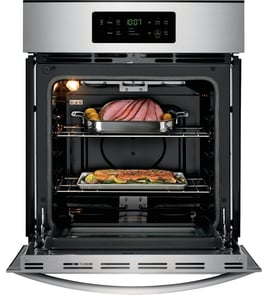




How to reset a GE wall oven?
To reset your GE JKP13GP2BG electric wall oven, we recommend power-cycling the oven at the home electrical panel: turn the breaker OFF for about 1 minute, then turn it back ON. This resets the electronic control and clears many temporary glitches.
- Turn the oven OFF.
- At your home breaker panel, switch the oven circuit breaker to OFF.
- Wait 60 seconds.
- Switch the breaker back to ON.
- Set the clock (if needed) and test Bake and Broil.
A reset fixes control lockups, but it will not fix a failed heating or sensing part. These checks help narrow it down:
- Bake not heating: inspect and test the bake element WB44K5013.
- Broil not heating: inspect and test the GE range broil element WB44K5009.
- Temperature is inaccurate (overheats or underheats): test the oven temperature sensor WB21X5301.
- Look for loose, burned, or broken wiring at the element terminals.
- If the breaker trips again, stop and have the circuit and oven wiring checked.
| Symptom | Reset likely helps? | Most common next part to check |
|---|---|---|
| Display frozen or unresponsive | Yes | Control-related (power cycle first) |
| Oven heats sometimes, then stops | Sometimes | Sensor WB21X5301 |
| No bake heat, broil works | No | Bake element WB44K5013 |
| No broil heat, bake works | No | GE range broil element WB44K5009 |
The electronic control in a wall oven can latch into an error state after a power surge or brief interruption. A 1-minute breaker reset restores clean power to the control; if heating still fails, the issue is usually a heating circuit part (element, sensor, wiring) rather than the reset itself.
Last updated: February 2026
What does F200 mean on an oven?
On a GE JKP13GP2BG electric wall oven, the F200 error code points to an oven temperature sensor circuit problem, most commonly a shorted sensor or a wiring issue between the sensor and the control. The first practical step is checking the sensor and its harness.
- Power reset: turn the breaker off for 1 minute, then back on; see if F200 returns.
- Look for obvious wiring damage: melted insulation, pinched wires, loose connectors at the sensor plug.
- Check for heat damage near the rear oven wall where the sensor wiring routes.
- Confirm the oven door closes fully; excessive heat escaping can stress wiring and connectors.
- Shut off power at the breaker (wall ovens are 240V).
- Access the sensor connector (often from inside the oven cavity or from the rear, depending on installation).
- Test the sensor with a multimeter (ohms) and inspect the harness for shorts to chassis ground.
- If the sensor tests bad or the connector is heat-damaged, replace the sensor.
A common replacement for this model is the sensor WB21X5301.
Most GE-style oven RTD sensors read close to these values:
| Oven temperature | Typical resistance (approx.) |
|---|---|
| Room temp (70°F) | ~1,080 ohms |
| 250°F | ~1,450 ohms |
| 350°F | ~1,650 ohms |
| 550°F | ~2,200 ohms |
If the meter shows near 0 ohms (short) or OL/infinite (open), the sensor circuit is faulty.
When the control cannot trust the temperature signal, it may shut heating down, overheat, or lock out bake/broil to prevent unsafe operation. Fixing the sensor circuit restores accurate temperature control and normal baking performance.
Last updated: February 2026
How to disable control lock on GE wall oven?
On a GE JKP13GP2BG electric wall oven, Control Lock is turned off by using the same Control Lock key or touchpad you used to turn it on; on most GE wall ovens, you press and hold that Control Lock pad for about 3 seconds until the lock indicator turns off.
- Press and hold the Control Lock pad (sometimes labeled Lock Controls).
- Keep holding for about 3 seconds.
- Wait for a beep or for the lock icon or “LOC” to disappear.
- Try a simple function (like Bake) to confirm the keypad responds.
Control Lock can stay on if the control is not sensing the keypress correctly or if the oven is in a state that prevents changes.
- Make sure the control panel is dry and clean; grease or moisture can block touchpads.
- Press firmly and hold the pad continuously (do not tap repeatedly).
- If the oven is in Self-Clean and the door is locked, let it cool; the lock may not release until the temperature drops.
- Reset power: turn the breaker off for 1 minute, then back on.
- If the keypad still will not unlock, inspect the door lock system; a failing lock motor can keep the control “thinking” it is locked (see lock motor WB49T10020).
| What you see on the display | What it usually means | What to do |
|---|---|---|
| “LOC” or lock icon lit | Control Lock is on | Press and hold Control Lock for ~3 seconds |
| “LOCKED” during/after clean | Door lock engaged | Allow cooling; then try unlocking |
| No change when holding pad | Keypad not registering or control glitch | Clean panel, then reset power |
Control Lock prevents accidental key presses, but if it will not turn off it can also point to a control-panel input issue or a door lock circuit problem. Addressing it early helps avoid being unable to use Bake or Broil when you need it.
Last updated: February 2026
Why is my GE oven not powering on?
If your GE JKP13GP2BG electric wall oven is completely dead (no display, no lights, no heat), the cause is usually a power supply issue (breaker, wiring, terminal connections) or a failed control-related circuit. Start by confirming the oven is receiving the correct voltage before replacing parts.
- Reset the double-pole breaker for the wall oven (turn it fully OFF, then ON).
- Confirm the oven has power at the junction box (most wall ovens require 240 VAC; many controls also need a solid 120 VAC leg).
- Check for a tripped GFCI (if your installation uses one) and reset it.
- Look for a loose or burned wire connection at the junction box or terminal area.
- If the display is on but the oven will not heat, skip to the heating circuit checks below.
If the clock/display works but Bake or Broil will not start, a failed heating component or sensor can stop operation.
- Inspect the bake element for visible breaks or blistering; test for continuity.
- Inspect the broil element for damage; test for continuity.
- Test the oven temperature sensor for resistance consistency (a sensor that reads open/short can prevent heating).
Helpful model-matched parts to consider:
| Symptom | Most likely area | What to do next |
|---|---|---|
| No display, no response | Power supply, wiring, control feed | Verify breaker and voltage at junction box |
| Display works, no heat | Elements, sensor, control output | Continuity test elements; check sensor |
| Works sometimes, then shuts off | Loose connection, overheating, failing control | Inspect wiring connections; check for heat damage |
An electric wall oven can appear “not powering on” when it is actually missing one leg of power or has a loose connection; that can also damage wiring and components over time. Verifying power first prevents unnecessary part replacement.
Last updated: February 2026