Owner’s manual
 Error Codes



What are the advantages of bottom mount refrigerators?
Bottom-mount refrigerators (like the LG LFX33975ST) keep the fresh-food section at eye and waist level, so you reach everyday items with less bending. The freezer sits below, which helps many kitchens feel more organized for daily use; see the LFX33975ST owner's manual for layout details.
Key advantages you will notice day to day
- Easier access to fresh foods (produce, drinks, leftovers) because they are higher up
- Less bending for common tasks like grabbing milk, condiments, and snacks
- Freezer drawer style storage can make bulky frozen items easier to stack and sort
- Better visibility of refrigerated items, which can reduce forgotten food and odors
- Often more flexible refrigerator shelving and door bin configurations
Bottom-mount vs top-freezer: quick comparison
| Feature | Bottom-mount refrigerator | Top-freezer refrigerator |
|---|---|---|
| Fresh-food access | Higher, easier reach | Lower, more bending |
| Freezer access | Lower drawer | Upper swing door |
| Organization style | Drawer-based freezer, wide storage | Shelf-based freezer, compact |
| Best for | Heavy fresh-food users | Heavy freezer users |
Tips to get the most benefit from a bottom-mount design
- Keep most-used items on the middle shelves for fastest access
- Use door bins for frequently grabbed condiments and beverages
- Group freezer foods by type (meals, meats, ice cream) to reduce door-open time
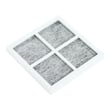
- Replace filters on schedule to keep air and water fresh; the LG refrigerator air filter ADQ73214408 supports odor control
Why it matters
Most households open the refrigerator section far more than the freezer. A bottom-mount layout puts the most-used space where it is easiest on your back and knees, while still giving you full freezer capacity below.
Last updated: January 2026
What is the most common problem with LG fridges?
For LG refrigerators like model LFX33975ST, the most common customer-reported issue is loss of cooling, often tied to the sealed cooling system (compressor-related) or airflow/defrost problems. Ice maker performance and water leaks are also frequent complaints in bottom-mount designs.
What we see most often (and what to check first)
- Not cooling or warm temperatures: verify temperature settings, condenser airflow, and door sealing.
- Ice maker not making ice: check freezer temperature, ice room door sealing, and water supply.
- Water leaking or puddles: inspect the defrost drain path and water tubing connections.
- Frost buildup: points to a defrost sensor, heater, or airflow restriction.
- Odors: usually solved with cleaning and replacing the air filter.
Quick triage by symptom
| Symptom | Most likely area | Common next step |
|---|---|---|
| Fresh food warm, freezer OK | Airflow between compartments | Clean vents, check fan operation |
| Freezer warm too | Sealed system or condenser airflow | Clean condenser area, confirm fans run |
| Puddles under fridge | Defrost drain or water line | Clear drain, inspect tubing |
| Frost on back freezer panel | Defrost system | Test sensors and defrost components |
| Bad smells | Air filtration and food spills | Replace air filter, deep clean |
Model-specific parts that often help
If odors or airflow issues are part of the problem on LFX33975ST, these model-matched parts are commonly replaced during maintenance or repairs:
- LG refrigerator air filter ADQ73214408
- Refrigerator defrost sensor assembly 6615JB2005R
- Refrigerator drain tube 5251JA3003D
Why it matters
Catching cooling, defrost, and leak symptoms early helps prevent food spoilage, ice buildup, and water damage. Routine maintenance (filters, door sealing, condenser airflow) also reduces strain on the compressor and fans.
For model-specific operating details, error displays, and maintenance intervals, use the LFX33975ST owner's manual.
Last updated: January 2026
How big is the LG lfx33975st?
The LG LFX33975ST is a large-capacity French door, bottom-mount refrigerator; it’s commonly listed at about 32.5 cu. ft. total capacity. For the exact exterior dimensions and clearance requirements for your kitchen, use the specs in the LFX33975ST owner's manual.
What “big” means (capacity vs. dimensions)
Capacity (cubic feet) tells you how much food the refrigerator can hold; dimensions tell you whether it fits your space and opens properly.
- Capacity: commonly listed around 32.5 cu. ft.
- Fit: measure width, height, and depth (including handles)
- Door swing: allow room for French doors to open fully
- Airflow clearance: leave space around the cabinet for ventilation
- Water line space: allow room behind the unit if you use the dispenser/ice maker
Quick sizing checklist (what to measure)
Use a tape measure and record these before ordering or moving the refrigerator:
- Opening width at front and back
- Opening height to the lowest cabinet/trim point
- Opening depth to the wall (note baseboards)
- Pathway widths (doorways, hallways, turns)
- Space for the doors and freezer drawer to pull out
Typical spec items to compare
| Spec item | What to check | Why it matters |
|---|---|---|
| Total capacity (cu. ft.) | Listed capacity | Storage planning |
| Width | Cabinet and door clearance | Fit between cabinets |
| Height | With hinges | Fit under upper cabinets |
| Depth | With handles and doors | Aisle clearance |
Why it matters
A refrigerator can match your capacity needs but still be “too big” if the doors hit a wall, the freezer drawer can’t extend, or ventilation clearance is tight. Confirming the exact dimensions in the manual prevents delivery-day surprises.
Last updated: January 2026