Owner’s manual
 Error Codes



What is the advantage of a bottom mount fridge?
A bottom-mount refrigerator like the GE CYE22UP2MCS1 keeps the fresh-food compartment higher, so everyday items are easier to see and reach without bending. The freezer stays in the lower drawer, which works well for bulk and long-term storage.
- Less bending for frequently used fresh foods (milk, produce, leftovers)
- Better visibility at eye level, so food is less likely to get forgotten
- Wider fresh-food shelves and door bins are often easier to organize
- Freezer drawer can hold larger frozen items and stacks well
- Good fit for kitchens where you open the refrigerator section more than the freezer
| Feature | Bottom mount refrigerator | Top mount refrigerator |
|---|---|---|
| Fresh food access | Higher, easier reach | Lower, more bending |
| Freezer access | Lower drawer | Upper swing door |
| Best for | Daily fresh-food use | Frequent freezer use |
| Organization style | Drawer-style freezer bins | Shelf-style freezer |
Bottom-mount designs typically use a pull-out freezer drawer. That layout helps with capacity and organization, but it also means you want the refrigerator level and stable so the drawer glides smoothly.
- Keep the unit level using the front leveling legs
- Avoid overloading the top freezer basket so it closes fully
- Make sure packages are not blocking the drawer rails or gasket
Most households access fresh food far more often than frozen food. Putting the refrigerator section at a more natural height reduces strain and makes it easier to keep food organized, which can help cut down on waste.
For model-specific features and layout details, use the CYE22UP2MCS1 owner's manual.
Last updated: January 2026
How to remove bottom grille on GE refrigerator?
On the GE CYE22UP2MCS1 bottom-mount refrigerator, the bottom grille (base grille) typically comes off by releasing its retaining clips or removing a couple of screws (model variations exist). We recommend following the exact access steps in the CYE22UP2MCS1 owner's manual to avoid cracking the grille or scratching the finish.
- Unplug the refrigerator (or switch off power at the breaker) for safety.
- Pull the refrigerator straight out a few inches if you need more hand clearance.
- Look along the top edge of the grille for retaining clips; pull the grille outward to release.
- If your grille uses screws, remove them with a Phillips screwdriver, then pull the grille forward.
- Set the grille aside on a towel to prevent scuffs.
Removing the grille is often done to clean, inspect airflow, or access components.
- Vacuum dust from the front air intake area.
- Check for signs of water dripping or a puddle forming under the front.
- Listen for unusual fan noise that could point to airflow issues.
- Make sure the refrigerator is level before pushing it back.
| What you see at the grille | What to do | Tool needed |
|---|---|---|
| No visible fasteners | Release clips by pulling outward evenly | None |
| 1 to 2 visible screws | Remove screws, then pull grille forward | Phillips screwdriver |
A loose, blocked, or damaged bottom grille can restrict airflow and reduce cooling efficiency. Keeping that area clean helps the compressor and fans run normally and can prevent temperature swings.
Last updated: January 2026
What is the most common problem with GE profile refrigerators?
The most common issue we see with GE Profile refrigerators like model CYE22UP2MCS1 is a cooling problem (fresh food or freezer not staying at the set temperature). Cooling complaints often trace back to airflow, defrost performance, or a sensor/control issue rather than a single “one-size” failure.
- Refrigerator not cooling or temperature swings
- Ice maker not making ice or slow ice production
- Water dispenser flow is weak (often after a filter change)
- Unusual noises (fan-related or airflow-related)
- Water leaking or puddles (defrost drain or water supply related)
- Confirm settings: Verify the temperature set points in the controls (see the CYE22UP2MCS1 owner's manual).
- Check door sealing and loading: Overpacked shelves can block vents and reduce airflow.
- Listen for fans: A failed evaporator fan can cause warm temps and odd noises.
- Look for frost buildup: Heavy frost on the back wall inside can point to a defrost problem.
- For water/ice issues: Replace the filter on schedule and purge air after installing a new filter.
| Problem area | What you notice | Parts commonly involved on CYE22UP2MCS1 |
|---|---|---|
| Temperature sensing | Temps drift, food freezing, inconsistent cooling | Refrigerator temperature sensor WR55X10025 |
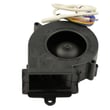
| Airflow in freezer | Warm fridge, noisy fan, weak cooling | Refrigerator evaporator fan motor and blade WR60X10352 |
| Defrost system | Frost blanket, warm temps, fan noise from ice | Refrigerator defrost heater WR51X10131, refrigerator defrost bi-metal thermostat WR50X10108 |
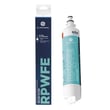
| Water and ice supply | No ice, weak dispenser flow, slow fill | GE refrigerator water filter RPWFE, refrigerator water inlet valve WR57X10098 |
Cooling problems can quickly lead to food spoilage and can also cause secondary issues like excessive frost, noisy operation, and poor ice production. Catching airflow, defrost, or filter-related issues early usually prevents bigger repairs.
Last updated: January 2026