Owner’s manual
 Error Codes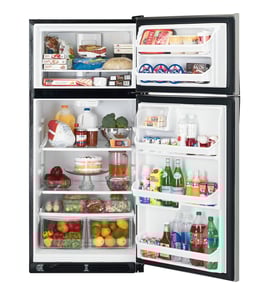


What are the disadvantages of a top mount fridge?
A top-mount (top freezer) refrigerator like the Kenmore 79575313900 typically costs less and is simple to use, but the main disadvantages are less convenient fresh-food access (more bending), fewer premium storage features, and fewer built-in dispenser options compared with many bottom-freezer or French door models.
Common disadvantages (what you will notice day to day)
- More bending for fresh food: the refrigerator compartment is lower, so you reach down more often.
- Less “at-a-glance” organization: many top-mount designs have fewer wide drawers and door bins than larger styles.
- Fewer dispenser features: some top-mount models do not include an external water or ice dispenser.
- Odors can transfer between sections: because air circulates between freezer and refrigerator, smells can move from one section to the other.
- Airflow is easier to block: overpacking can block vents and cause temperature and moisture issues.
What to do to minimize the downsides
We recommend these practical habits for the 79575313900:
- Keep everyday items at eye level on the upper refrigerator shelves.
- Avoid blocking freezer and refrigerator vents with food packages.
- Wrap or cover foods tightly to reduce odor transfer.
- Clean both compartments when you notice odors.
- Make sure doors close easily and align correctly; poor closing increases temperature swings.
Quick comparison: top-mount vs. bottom-freezer
| Feature | Top-mount (top freezer) | Bottom-freezer |
|---|---|---|
| Fresh-food access | Lower, more bending | Higher, easier access |
| Storage layout | Often simpler | Often more “premium” |
| Dispenser options | Less common | More common |
| Cost and complexity | Often lower, simpler | Often higher, more complex |
Why it matters
Convenience and temperature stability affect food freshness and energy use. In this style of refrigerator, keeping airflow paths clear and doors sealing well helps prevent warm spots, moisture buildup, and odor issues.
For model-specific use and care details (controls, airflow, storage features, door alignment), follow the 79575313900 owner's manual.
Last updated: February 2026
What is the top part of a refrigerator called?
In a Kenmore top-mount refrigerator like model 79575313900, the top compartment is the freezer compartment (often just called the freezer). It is the section designed to keep foods frozen and it also supplies cold air that helps cool the fresh food section.
What the freezer does in a top-mount design
In this style of refrigerator, we typically see the freezer doing more than just freezing food:
- Produces and holds freezing temperatures for long-term storage
- Sends cold air down to the refrigerator section through vents
- Works with the airflow system; blocked vents can cause temperature and moisture issues
- Can cause the refrigerator door to “push back” slightly if you close it forcefully (air pressure equalizing)
- Shares air between compartments, so odors can transfer if food is not wrapped
For model-specific compartment layout and vent locations, use the 79575313900 owner's manual.
Quick terminology guide
| What you see | Common name | What it means |
|---|---|---|
| Top compartment | Freezer compartment | Freezes food; primary cold source in many top-mount units |
| Bottom compartment | Refrigerator section (fresh food) | Keeps food cold but above freezing |
| Openings between sections | Air vents/diffuser | Pathways that move cold air between compartments |
Why it matters
Knowing the correct name helps when you are troubleshooting cooling problems or ordering parts. For example, if the freezer vents are blocked, airflow is interrupted and both sections can warm up or develop moisture problems.
If you are dealing with puddles or water under the unit, a clogged defrost drain can be involved; the refrigerator drain tube 5251JA3003D is one of the parts commonly associated with draining water away properly.
Last updated: February 2026
What model Kenmore fridge do I have?
Your Kenmore refrigerator’s model number is printed on the identification label inside the fresh food (refrigerator) compartment. For Kenmore model 79575313900, the manual specifies the label is located on the right-hand side of the refrigerator compartment; match that number exactly when ordering parts or looking up service info in the 79575313900 owner's manual.
Where to look for the model and serial label
Check these common spots first (use a flashlight and look along the cabinet walls):
- Right-hand side wall inside the refrigerator compartment (most common for this model family)
- Near the top interior liner (close to the ceiling area)
- Near the crisper drawers (side wall or frame area)
- Door frame area (open the refrigerator door and inspect the cabinet edge)
- Behind the base grille or kick plate (less common, but worth checking)
How to read the number correctly
Kenmore model numbers must be copied exactly; one missing digit can pull up the wrong parts list.
- Write down the full model number and serial number
- Keep leading digits and punctuation if shown (for example, “795.” may appear in some documentation)
- Use the full model number when searching parts: 79575313900
Quick example
| What you see on the label | What it means | What to do next |
|---|---|---|
| Model: 79575313900 | Exact refrigerator model | Use it to match diagrams and parts |
| Serial: (letters and numbers) | Production identifier | Helpful for service and date coding |
Why it matters
Using the exact Kenmore model number ensures we show the correct refrigerator door gasket, water valve, shelves, and other model-specific parts that can vary by revision.
Last updated: February 2026
What's the average lifespan of a Kenmore refrigerator?
Most Kenmore refrigerators, including model 79575313900, typically last 12 to 15 years with normal household use. Consistent cleaning, good airflow around the cabinet, and quick fixes for cooling or water leaks help you reach the high end of that range.
What affects refrigerator lifespan the most
- Condenser airflow and cleanliness (dust buildup makes the compressor run longer)
- Door seal condition (warm air leaks force longer run times)
- How often doors are opened and how long they stay open
- Room temperature (hot garages and tight enclosures shorten life)
- Defrost drain health (clogs can cause water, ice buildup, and fan issues)
Maintenance checklist we recommend
- Vacuum the condenser area and keep ventilation space clear (see 79575313900 owner's manual).
- Keep doors closing fully; clean the gasket with mild soap and water.
- Set stable temps and avoid frequent control changes.
- Clear food packages away from air vents inside the refrigerator and freezer.
- If you see water under the unit, inspect the defrost drain path; a damaged drain component such as the refrigerator drain tube 5251JA3003D can contribute to recurring puddles.
Quick guide: what “normal” looks like
| Item | Normal for many refrigerators | What shortens lifespan |
|---|---|---|
| Compressor run time | Cycles on and off; longer in warm rooms | Constant running from dirty coils or air leaks |
| Door sealing | Even contact all around | Gaps, torn gasket, door not aligned |
| Water under fridge | None | Clogged/iced drain, misrouted drain tube |
Why it matters
A refrigerator that runs longer than necessary uses more energy and puts extra wear on key components like the compressor, fans, and start devices. Simple airflow and sealing checks often prevent the “runs all the time” pattern that ages a refrigerator early.
Last updated: February 2026
How to read Kenmore refrigerator model number?
On Kenmore refrigerator model 79575313900, the model number is printed on the appliance identification label inside the fresh food (refrigerator) compartment, typically on the right-hand side wall. Use that full number when ordering parts, checking the manual, or scheduling service.
Where to find the model number label
Check these common label locations first (in this order):
- Inside the refrigerator compartment on the right-hand side wall (most common)
- On the inside wall near the crisper area (you may need to remove drawers for a clear view)
- Behind the lower kick plate or base grille area (less common)
For diagrams and feature callouts that help you orient yourself, use the 79575313900 owner's manual.
How to read the number you see
Kenmore model numbers are usually a full string of digits (and sometimes punctuation on the manual cover). For this refrigerator family, you may see it written like 795.7531 in documentation, but you should record and use the complete model number from the label: 79575313900.
Quick reference table
| Where you see it | Example format | What to use for parts lookup |
|---|---|---|
| Rating label inside fridge | 79575313900 | 79575313900 |
| Manual cover/model family | 795.7531 | Use to confirm series only |
Why it matters
Using the exact model number ensures we match the correct Kenmore top-mount refrigerator parts and specifications. Small differences within the 795 series can change door parts, water line fittings, and internal components.
Tips before you write it down
- Copy the model number exactly as printed on the label
- Record the serial number too; it helps with age and production variations
- Take a clear photo of the label for future reference
Last updated: February 2026
Where is the temperature sensor on a Kenmore refrigerator?
On Kenmore model 79575313900, the temperature sensing components are located in the airflow path between the freezer and fresh food sections; you typically access them from inside the compartment near the air vents and control area. Use the 79575313900 owner's manual to confirm the exact access steps for your configuration.
Common sensor locations on this top-mount design
On this style of Kenmore top-mount refrigerator, temperature sensing is usually tied to where air moves and where temperature is controlled.
- Freezer section: near the freezer air outlet vents or close to the freezer temperature control area
- Refrigerator section: near the top vent where cold air enters the fresh food compartment
- Behind an interior cover: sometimes clipped to a liner, duct, or housing so it reads air temperature accurately
- Near the damper area: where airflow is metered between compartments (if equipped)
How we remove it safely (typical steps)
Always unplug the refrigerator before handling wiring.
- Unplug the refrigerator (or switch off the breaker)
- Empty the area around the vent or control housing for access
- Remove the interior cover (usually screws or locking tabs)
- Release the sensor from its clip or holder (do not pull on the wires)
- Disconnect the wiring connector at the plug
Quick check: what you should see
| What you find | What it usually means | What to do next |
|---|---|---|
| Small probe or plastic capsule with 2 wires | Temperature sensor/thermistor style | Unclip and unplug at the connector |
| Sensor buried in foam or sealed wall | Not serviceable from that side | Access from the duct/cover side instead |
| Heavy frost blocking the vent area | Airflow issue can mimic a bad sensor | Clear frost and restore airflow first |
Why it matters
The sensor helps regulate compressor run time and airflow between sections. If it is out of position, iced over, or has a loose connector, you can see warm temperatures, freezing in the refrigerator section, or inconsistent cooling.
Last updated: February 2026
How many cubic feet is my Kenmore refrigerator model 79575313900?
The exact cubic-foot capacity for Kenmore model 79575313900 is listed on the product identification label and in the specifications section of the 79575313900 owner's manual. For Kenmore 795 top-mount (top freezer) refrigerators, capacity is commonly in the 20 to 22 cu. ft. range.
How to find the exact capacity on your refrigerator
Check these two places first:
- Owner's manual specs: Look for “Specifications” or “Capacity” in the 79575313900 owner's manual.
- Model and serial label: The manual notes the identification label is on the right-hand side of the refrigerator compartment.
- Product record section: Many Kenmore manuals include a product record area that matches the label information.
- Do not use “795” as capacity: “795” is a model prefix (often LG-built for Kenmore), not the size.
Typical capacity ranges (what to expect)
If you are planning space, shelving, or food storage, these ranges are a reliable guide for this style.
| Refrigerator style | Typical capacity range |
|---|---|
| Top-mount (top freezer) | 18 to 22 cu. ft. |
| Bottom freezer | 20 to 25 cu. ft. |
| Side-by-side | 22 to 28 cu. ft. |
Why it matters
Capacity affects how much food you can store and how you set expectations for cooling performance and organization (shelf layout, crisper space, freezer bin use). It also helps when comparing replacement models or ordering interior parts.
Related tips for this model
- Maintain proper airflow and avoid overpacking so cold air can circulate.
- If you are troubleshooting temperature issues, start with control settings and airflow guidance in the 79575313900 owner's manual.
- For water and ice concerns, our guide how to prevent water dispenser and ice maker problems helps you check common causes (water supply, filter, valve, frozen lines).
Last updated: February 2026
What are the common problems with Kenmore Elite refrigerators?
Common problems we see in Kenmore Elite refrigerators (including Kenmore model 79575313900) are weak or uneven cooling, water leaks, ice maker or water dispenser issues, doors not sealing, and a compressor that runs too much. Many of these trace back to airflow restrictions, dirty condenser coils, or a clogged defrost drain; use the 79575313900 owner's manual to match symptoms to checks.
Most common symptoms and what usually causes them
- Not cooling well or warm spots: blocked air vents, dirty condenser coils, evaporator fan issues, or a damper problem
- Compressor runs a lot: warm room, frequent door openings, recently plugged in (cooldown can take up to 24 hours), dirty coils, or doors not fully closed
- Water on the floor or inside the fridge: clogged defrost drain, cracked or misrouted drain tube, or water line/valve seepage
- Ice tastes bad or smells: old ice, unwrapped food odors, dirty ice bin, or water quality issues (a filter can help)
- Doors will not close completely: unit not level, bins/shelves out of position, food packages blocking, or sticky gaskets
Quick checks we recommend before replacing parts
- Confirm doors seal and close: push doors firmly shut; clean gasket surfaces and reduce obstructions.
- Clean condenser coils: dirty coils reduce heat transfer and make the compressor work harder.
- Check airflow: keep vents clear in both compartments; avoid overpacking.
- Look for defrost drain issues: if you see puddles, inspect the drain path and drain pan area.
- Power and lights: unplug before service; replace bulbs with the same wattage, size, and shape if needed.
Parts that commonly solve leak and airflow complaints (when diagnosis points there)
| Symptom | Part to consider | Notes |
|---|---|---|
| Water pooling under/inside | Refrigerator drain tube 5251JA3003D | Helps when the defrost drain outlet is damaged or not draining correctly |
| Warm fridge, freezing issues, temp swings | Refrigerator air damper motor 4681JB1027N | Damper problems can restrict cold air flow into the fresh food section |
| Water dispenser/ice maker not filling | Refrigerator water valve 5220JB2010T | A weak or leaking inlet valve can cause fill problems or seepage |
Why it matters
Most “big” refrigerator complaints (cooling failure, leaks, constant running) start as simple airflow, sealing, or drain problems. Fixing those early protects food temperatures, reduces energy use, and prevents water damage.
For model-specific troubleshooting tables (doors not closing, compressor run time, ice odor, lights), follow the steps in the 79575313900 owner's manual.
Last updated: February 2026
How to tell if a Kenmore refrigerator compressor is bad?
On Kenmore refrigerator model 79575313900, a bad compressor usually shows up as poor or no cooling while the unit keeps trying to run (often with clicking or unusual humming), or the compressor never starts at all. Before condemning the compressor, we confirm airflow, power, and start components using the checks in the 79575313900 owner's manual.
Quick symptoms that point toward a compressor problem
- Refrigerator and freezer both warm, even though the unit seems to run often
- Repeated clicking from the compressor area (start attempt then shutoff)
- Compressor is very hot to the touch after repeated start attempts (unplug first, then check)
- Compressor is silent and not vibrating when it should be running
- Cooling is weak and temperatures drift up even with doors closed
Rule out common look-alikes first (fast checks)
Many “bad compressor” calls are actually power, airflow, or normal-operation noise.
- Confirm power: Make sure the cord is firmly plugged into a live outlet (the manual troubleshooting section calls this out).
- Listen for normal clicks and fan sounds: Defrost timer and controls can click; fans and refrigerant flow can make gurgling or pulsating sounds.
- Check door sealing: A leaking gasket can make the compressor run longer and still struggle to hold temp.
- Check for heavy use conditions: Hot room temps, frequent door openings, or adding a lot of food can make the compressor run 40% to 80% of the time (or more in warm conditions).
What a technician tests to confirm a bad compressor
These checks separate a failed compressor from a failed start device or control issue.
| Test/observation | What it helps confirm | Typical outcome if compressor is bad |
|---|---|---|
| Start attempt then click-off | Overload trip or locked rotor | Repeats every few minutes |
| Amp draw at startup | Locked rotor vs normal start | Very high then trips |
| Winding continuity and shorts to ground | Electrical failure | Open winding or short to ground |
| System cooling performance | Sealed system or compressor issue | No pressure change, no cooling |
Parts that are commonly involved
If the compressor is not starting, we often inspect the start components and related hardware first.
Why it matters
A compressor diagnosis affects cost and repair approach. Confirming the basics (power, normal run-time expectations, door seal, and fan noises) prevents replacing major parts when the issue is actually a gasket, airflow problem, or normal operating behavior.
Last updated: February 2026
How do you fix a refrigerator that is not cooling on top?
When a Kenmore refrigerator model 79575313900 is not cooling on top (fresh food section), the most common fix is restoring airflow: clear blocked vents, confirm the doors seal and close fully, and make sure the unit is level so the doors close correctly. Use the 79575313900 owner's manual for control setting and airflow details.
Quick checks that fix most “warm top” complaints
- Move food packages away from the air vents in the fresh food section and freezer.
- Push both doors firmly shut; reorganize items that keep a door from closing.
- Let the refrigerator cool: after plugging in or loading a lot of food, cooling can take up to 24 hours.
- Clean the condenser coils (dirty coils reduce heat transfer and cooling performance).
- Verify temperature controls were not accidentally changed.
Airflow and temperature basics (what’s happening)
Cold air is made at the evaporator and circulated by fans; the refrigerator section depends on that airflow. If vents are blocked, the damper is stuck, or a door is leaking warm air, the top section warms up first.
Symptoms and likely causes
| What you notice | Most likely cause | What to do first |
|---|---|---|
| Freezer cold, fridge warm | Air vent blockage or air damper issue | Clear vents; listen for fan airflow |
| Fridge warm after grocery load | Normal recovery time | Wait up to 24 hours |
| Frost or water near bottom/vents | Defrost drain issue | Inspect drain area and tube |
| Doors pop open or don’t self-close | Unit not level or overloaded shelves | Level unit; rearrange food |
Model-specific steps from the manual: leveling and door closing
If the doors do not close easily, warm air leaks in and the top section warms up.
- Remove the base grille.
- Adjust the two front leveling screws so the front is slightly higher than the rear.
- Recheck that both doors close easily.
Parts that commonly relate to “warm top” or airflow problems
If basic checks do not restore cooling, these model-matched parts are often involved:
- Refrigerator air damper motor 4681JB1027N (controls cold air flow into the refrigerator section)
- Refrigerator evaporator fan blade 5901JJ1003A (moves air across the evaporator and through vents)
- Refrigerator drain tube 5251JA3003D (helps prevent water/ice buildup from a clogged drain)
Why it matters
A warm top section is usually an airflow or door-seal problem, not a lack of refrigerant. Fixing vent blockage, door closing, and coil cleanliness restores normal temperatures and helps prevent food spoilage and compressor overwork.
Last updated: February 2026