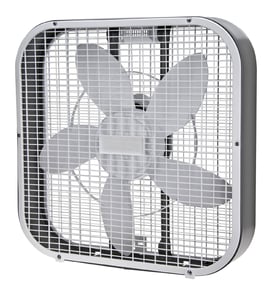

Do you leave windows open when using a whole-house fan?
Yes. When running an Emerson WH30FM0 whole house fan and shutter system, we leave windows open (and interior doors open) to create a clear path for outside air to flow through the home and out through the attic. With everything closed, airflow drops sharply and the fan can strain.
How many windows should be open?
We aim for enough open window area to match the fan’s airflow so the house can “breathe” without whistling doors or hard-to-open rooms.
- Open windows in the rooms you want to cool first (typically upstairs bedrooms).
- Start with 2 to 4 windows opened a few inches, then adjust.
- Keep interior doors open so air can move room to room.
- Avoid opening only one window far away from the fan; spread openings out.
- If you hear loud rushing air at a door, open another window to reduce restriction.
Quick setup checklist (best practice)
- Confirm attic vents are clear and unobstructed.
- Open the target room windows first.
- Open interior doors along the airflow path.
- Turn the fan on low, then increase speed as needed.
- After the house cools, shut the fan off and close windows.
What to do in common situations
| Situation | What we recommend | What it prevents |
|---|---|---|
| Cooling upstairs at night | Open upstairs windows; keep bedroom doors open | Hot spots and weak airflow |
| Only one room needs ventilation | Open that room’s window and the door | Stale air trapped in the room |
| Doors slam or are hard to open | Open more windows (or open existing ones wider) | Excess negative pressure |
| You smell attic or dusty air | Stop fan; check attic venting and shutter sealing | Pulling air from unwanted spaces |
Why it matters
A whole-house fan works by moving large volumes of air. Open windows and open doors provide the make-up air the fan needs, improving cooling performance, reducing noise, and lowering stress on the motor and shutter system.
For parts lookups and model-based searching, we use the Emerson WH30FM0 parts list first, or search by model on Sears PartsDirect.
Last updated: February 2026
Can you buy replacement parts for ceiling fans?
Yes. You can buy many replacement parts for fans, and for an Emerson WH30FM0 whole house fan and shutter system that typically includes common service items like switches/controls, shutters, motor components, and mounting hardware. We recommend matching parts by exact model number to ensure fit and safe operation; start with the parts list for WH30FM0, or search by model on Sears PartsDirect.
What parts are commonly replaceable?
Most household fan repairs involve a few high-wear or high-failure items:
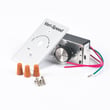
- Wall switch or speed control (fan won’t turn on, wrong speed)
- Capacitor (hums but won’t start, slow start)
- Motor (overheats, trips breaker, won’t run)
- Shutter components (stuck open/closed, rattling)
- Wiring connectors and terminals (intermittent power)
- Mounting hardware and vibration isolators (excess noise)
How to make sure you’re buying the right part
Because fan parts are not universally interchangeable, we use the model number to narrow the correct diagrams and part listings.
| What to match | Why it matters | What to check |
|---|---|---|
| Model number: WH30FM0 | Ensures correct fit and electrical rating | Rating label on the fan housing or frame |
| Electrical rating (volts/amps) | Prevents overheating and nuisance trips | Old part markings, wiring, breaker size |
| Mounting style and dimensions | Avoids vibration and shutter binding | Bracket style, hole spacing, shutter size |
Quick troubleshooting before ordering parts
These checks often pinpoint the failed component:
- Confirm the breaker is on and the wall control is set correctly
- Listen for a hum (often points to a capacitor or stuck shutter)
- Check for a stuck shutter (mechanical bind can prevent startup)
- Inspect wiring for loose, burned, or broken connections
- Test for power at the fan (only if you’re comfortable working safely)
For electrical testing basics, we recommend how to use a multimeter to test electrical parts video.
Why it matters
Whole house fans move a lot of air; using the correct Emerson WH30FM0 replacement part helps prevent vibration, noise, overheating, and repeat failures, and it keeps the shutter system opening and closing properly.
Last updated: February 2026
Is it cheaper to run a whole-house fan or AC?
In most homes, it’s cheaper to run a whole-house fan than central air conditioning because the fan motor typically draws far less electricity than an AC compressor. For your Emerson WH30FM0 whole house fan and shutter system, the biggest savings come from using the fan during cool, dry outdoor conditions.
Typical operating cost comparison
Actual cost depends on your local electric rate, fan size, and AC tonnage, but these ranges are common:
| System | Typical power draw | What that means for cost |
|---|---|---|
| Whole-house fan | ~200 to 700 watts | Low to moderate hourly cost |
| Central AC | ~2,000 to 5,000+ watts | Higher hourly cost |
When a whole-house fan is the cheaper choice
A whole-house fan is usually the best value when you can flush heat out of the house and pull in cooler air.
- Run it in the evening or early morning when outdoor air is cooler than indoor air
- Open several windows a few inches to create steady airflow
- Use higher speed briefly to purge heat, then lower speed to maintain comfort
- Turn it off if outdoor humidity is high or outdoor air is warmer than indoors
- Make sure attic vents are clear so hot air can exhaust properly
When AC can be the better choice
AC can cost more per hour, but it can be the right tool when conditions are not fan-friendly.
- Hot nights where outdoor air does not cool down
- High humidity (AC removes moisture; a fan does not)
- Smoke, heavy pollen, or poor outdoor air quality
- Homes that need tight temperature control for comfort or health
Why it matters
Using the whole-house fan at the right times reduces how long your AC has to run. That lowers energy use and can reduce wear on major components like the AC compressor and blower.
Parts and support
If you’re maintaining or repairing your Emerson WH30FM0, start with the model’s parts list; you can also search by model number on Sears PartsDirect to find diagrams and compatible replacement items.
Last updated: February 2026
How many CFM is a typical house fan?
A typical whole house fan (including systems like the Emerson WH30FM0) moves about 1,500 to 7,000 CFM. The right CFM for your home depends on your home’s square footage, ceiling height, and how much attic exhaust ventilation you have.
Typical CFM ranges you’ll see
Most whole house fans fall into these practical ranges:
- 1,500 to 3,000 CFM: smaller homes, lighter cooling needs
- 3,000 to 5,000 CFM: mid-size homes, common “sweet spot”
- 5,000 to 7,000+ CFM: larger homes or faster air changes
Quick sizing rule of thumb
A common sizing approach is to target about 2 to 4 air changes per hour (ACH) for whole house fan cooling. That translates to this quick estimate:
- CFM ≈ (home volume in cubic feet × ACH) ÷ 60
Example sizing table
| Home size (sq ft) | 8 ft ceilings (volume) | Typical target (2 to 4 ACH) | Approx CFM range |
|---|---|---|---|
| 1,500 | 12,000 cu ft | 24,000 to 48,000 cu ft/hr | 400 to 800 CFM |
| 2,000 | 16,000 cu ft | 32,000 to 64,000 cu ft/hr | 530 to 1,070 CFM |
| 2,500 | 20,000 cu ft | 40,000 to 80,000 cu ft/hr | 670 to 1,330 CFM |
Note: Many whole house fans are intentionally sized higher than these minimums to deliver stronger “breeze” cooling and faster evening flush-out, which is why 1,500 to 7,000 CFM is so common in real installations.
Why attic ventilation matters
Your fan can only move as much air as your attic can exhaust. If attic venting is undersized, you can get poor airflow, hot attic air recirculation, or backdrafting.
- Make sure attic vents are open and unobstructed
- Confirm shutters/dampers open fully
- Check for crushed ducting (if your system uses ducts)
- Keep screens and louvers clean
Parts and next steps
If you’re matching a replacement motor, shutter, or control to your Emerson WH30FM0, we recommend using your model number to ensure fit and airflow expectations when you shop on Sears PartsDirect.
Last updated: February 2026
What is the average cost of a whole-house fan?
A whole-house fan typically costs $300 to $1,500 for the fan/shutter equipment, and $700 to $2,500 installed once electrical work and labor are included. For Emerson model WH30FM0, the exact installed price depends on your home’s opening size, attic access, and wiring; you can also search by model on Sears PartsDirect.
What usually makes the price go up or down
- Airflow capacity (CFM): higher CFM units and heavier-duty motors cost more.
- Shutter style: tighter-sealing or insulated shutters cost more than basic gravity shutters.
- Electrical scope: new circuit, switch location, timer, or speed control adds cost.
- Ceiling work: cutting/framing the opening, adding blocking, and finishing trim adds labor.
- Attic access and clearance: cramped access increases install time.
- Noise control: vibration isolation and quieter designs typically cost more.
Typical cost ranges (equipment vs. installed)
| Cost category | Typical range | What it covers |
|---|---|---|
| Fan and shutter system (equipment only) | $300 to $1,500 | Fan assembly, shutter, basic hardware |
| Installation labor and materials | $400 to $1,500 | Framing, mounting, minor finish work |
| Electrical work and controls | $150 to $800 | Switch/timer/speed control, wiring, circuit work |
Planning checklist for WH30FM0 owners
- Measure your existing ceiling opening (or planned opening) before choosing a replacement.
- Confirm attic clearance above the opening for the fan housing and shutter operation.
- Decide whether you want a timer or multi-speed control for comfort and noise management.
- If you are replacing an older unit, match the model number WH30FM0 to avoid fit and wiring surprises.
Why it matters
Whole-house fan cost is driven more by installation conditions (opening, framing, wiring, access) than by brand alone; getting those details right improves airflow, reduces noise, and helps the shutter seal properly.
Last updated: February 2026