Installation guide
 Owner’s manual
 Error Codes


What model of Whirlpool dishwasher do I have?
Your Whirlpool dishwasher model number is printed on the rating label inside the door area. On Whirlpool WDT920SADM3-STYLE dishwashers, the label is located near the door on the right-hand or left-hand side of the dishwasher interior; it lists both the model and serial number.
Where to find the model number (fast checklist)
- Open the dishwasher door fully.
- Look along the inner tub frame near the door opening.
- Check the right-hand side first, then the left-hand side.
- Find the rating label (it is usually a white or silver sticker).
- Copy the model number exactly as shown (letters and numbers).
- Copy the serial number as well; it helps match the correct parts and diagrams.
What the label typically shows
| Label item | What it’s used for | Example format |
|---|---|---|
| Model number | Matching parts and manuals | WDT920SADM3 |
| Serial number | Identifying production details | Mix of letters and numbers |
| Electrical info | Verifying power requirements | Volts/amps listed |
Why it matters
We use your exact model number to match the correct Whirlpool dishwasher parts (like a door latch, water inlet valve, or drain pump) because small design changes can affect fit and wiring.
Helpful resources
- Use the WDT920SADM3 user manual to confirm label location and record the model and serial number for future service.
Last updated: February 2026
What does F3 mean on a Whirlpool dishwasher?
On a Whirlpool dishwasher, an F3 code points to a water-heating temperature problem (the dishwasher is not sensing the expected temperature rise during heating). On your Whirlpool WDT920SADM3, this typically relates to the heater circuit, temperature sensing, or control.
What to check first (fast, no parts swapping)
- Run hot water at the sink until it is hot, then start the cycle; low incoming water temperature can trigger heating-related faults.
- Confirm options: using Heat Dry and rinse aid improves drying, but heating faults can still occur if the heater circuit is failing.
- Avoid suds: use only automatic dishwasher detergent; excess suds can disrupt washing and heating performance.
- Power reset: turn the breaker off for 1 minute, then back on; then try a normal cycle (reset steps vary by model, so follow the WDT920SADM3 user manual).
Parts commonly involved with an F3 heating fault
If the basics above do not help, these are the most common components tied to heating and temperature sensing on this platform.
| Symptom you notice | Most likely area | What we usually test/inspect |
|---|---|---|
| Water stays cool, poor drying | Heater circuit | Heater continuity, wiring, connections |
| Intermittent F3, worse when hot | Temperature sensing | Sensor/thermistor behavior, harness fit |
| Random heating errors | Control/relay | Heater relay operation, board damage |
Model-relevant parts to consider
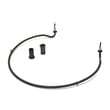
- Heating issue: the heater is part of the element assembly W10703867.
- If the unit will not run because the door is not proving closed (some cycles will not heat if the door is not latched reliably): inspect the dishwasher door latch WPW10653840.
Why it matters
Heating is what helps dissolve detergent, remove greasy soil, and dry dishes. When the dishwasher cannot heat correctly, you can see longer cycles, poor cleaning, poor drying, and repeated error codes.
Last updated: February 2026
Why is my Whirlpool dishwasher leaking at the bottom of the door?
On the Whirlpool WDT920SADM3 dishwasher, a bottom-of-door leak is usually caused by water being pushed past the seal due to oversudsing (wrong detergent or too much), a door that is not closing squarely, or a worn lower door seal. Start by correcting detergent use and checking door alignment before replacing parts.
Quick checks we recommend first
- Use only automatic dishwasher detergent; never use dish soap.
- Reduce detergent amount if you have soft water or you pre-rinse heavily.
- Confirm the door closes firmly and the latch engages without forcing.
- Inspect the bottom edge of the inner door and tub lip for food debris or detergent buildup.
- Make sure tall items are not preventing the door from sealing.
Parts that commonly fix a bottom-of-door leak
If the leak is coming from the center or corners along the very bottom of the door, the lower door seal is a common fix.
- Replace the dishwasher door seal, lower W10909089 if it is torn, hardened, or deformed.
- If the door is not staying tightly closed, inspect and replace the dishwasher door latch WPW10653840.
Symptom-to-fix guide
| What you notice | Most likely cause | What to do |
|---|---|---|
| Suds or foam inside | Oversudsing | Switch detergent, use less, run a rinse cycle |
| Leak only during wash action | Spray deflection or door not sealing | Re-load dishes, clean sealing surfaces |
| Door feels loose or pops open | Latch not holding | Check/replace latch |
| Drips from bottom center | Lower seal worn | Replace lower seal |
Why it matters
A door leak can soak the toe-kick area and flooring, and repeated leaking can lead to corrosion and electrical issues over time. Fixing detergent use and sealing problems early helps protect the dishwasher and your cabinets.
Helpful reference
For detergent guidance, loading tips, and care steps specific to your dishwasher, follow the WDT920SADM3 user manual.
Last updated: February 2026
What could be wrong with my Whirlpool dishwasher?
Several common issues can cause a Whirlpool WDT920SADM3 dishwasher to act up, including draining problems, poor cleaning, poor drying, suds from the wrong detergent, or a water-fill problem. We recommend matching the symptom to the troubleshooting steps in the WDT920SADM3 user manual.
Most common symptoms and what they usually mean
- Not draining or standing water: drain path restriction, kinked drain hose, or a failing drain pump
- Not cleaning well: loading issue, dirty or misinstalled filter, low water temperature, or wrong cycle selection
- Not drying: rinse aid missing, Heat Dry not used, or plastics holding water droplets
- Foam or suds in the tub: incorrect detergent (hand soap or laundry detergent) or too much detergent
- No fill or weak wash action: water supply issue or inlet valve problem
Quick checks we recommend (in order)
- Confirm detergent type: Use automatic dishwasher detergent only; suds can prevent proper operation.
- Check water temperature: Incoming hot water should be about 120°F (49°C) for best cleaning.
- Inspect and clean the filter: Make sure it is installed correctly and cleaned as needed.
- Review loading: Overloading or blocking spray paths reduces wash performance.
- Watch what happens at drain time: If you hear draining but water remains, the drain system needs attention.
Parts that commonly solve these problems on WDT920SADM3
| Symptom | Likely system | Model-matched part to consider |
|---|---|---|
| Won’t drain / water left in bottom | Drain system | Dishwasher drain pump WPW10348269 |
| Won’t fill / poor wash pressure | Water inlet | Dishwasher water inlet valve WPW10327249 |
| Door won’t latch or cycle won’t start | Door latch | Dishwasher door latch WPW10653840 |
Why it matters
Catching the right symptom early prevents repeat wash failures, reduces odors, and helps avoid water-related damage. For example, persistent suds from the wrong detergent can stop filling and washing, while low water temperature can cause chronic poor cleaning.
Helpful DIY references
- Use the Whirlpool dishwasher error codes guide if the control shows a fault code.
- Follow the how to reset a Whirlpool dishwasher steps if the dishwasher has power but won’t run normally.
Last updated: February 2026