Installation guide
 Owner’s manual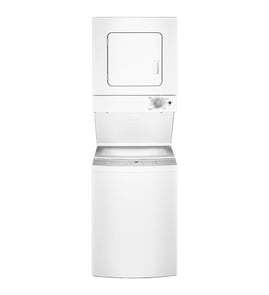



Does a washer/dryer combo need to be vented?
Yes for this model: the GE WSM2420TBAWW stacked laundry center dryer must be vented to the outdoors using a heavy metal exhaust vent. This is not a ventless condenser-style combo, so you need a proper exhaust path and an exterior hood for safe, effective drying.
Venting requirements for GE WSM2420TBAWW
We follow the installation requirements in the installation guide. Key points:
- Exhaust must go outdoors; do not vent into a wall, ceiling, chimney, or concealed space
- Use heavy metal vent only (rigid or flexible); no plastic vent and no metal foil vent
- Keep the vent run as straight and short as practical; avoid unnecessary 90° turns
- Secure joints with 4-inch clamps; do not use screws that protrude into the duct
- Make sure the vent is not crushed or kinked when the unit is pushed into place
Typical venting setups (what most homes use)
Most installations vent from the rear, but side venting can be possible with the correct conversion kit.
| Installation type | Where it exits | What to plan for |
|---|---|---|
| Standard rear vent | Back of unit to exterior wall | Straight run, exterior exhaust hood |
| Side vent (converted) | Left or right side | Extra clearance and correct kit |
Quick checklist before you install
Venting is only one part of a safe setup. We also recommend confirming these basics:
- A location that allows proper exhaust routing to an exterior wall
- A grounded outlet within about 2 ft of either side of the laundry center
- A separate 30-amp circuit (as specified for this style of unit)
- A sturdy, level floor to reduce vibration and improve dryer sensor performance
Why it matters
Proper venting protects against lint buildup and overheating, improves drying times, and helps prevent moisture damage in the laundry area. A restricted or incorrect vent is one of the most common causes of long dry times and hot cabinet temperatures.
Last updated: February 2026
How to clean a GE laundry machine?
For the GE WSM2420TBAWW stacked laundry center, we recommend cleaning the washer by wiping residue-prone areas, cleaning the washer’s manual lint filter after loads, and running an occasional hot wash to flush buildup; for the dryer, clean the lint screen every load and keep the venting clear to reduce lint accumulation.
Washer cleaning steps (WSM2420TBAWW)
- Unplug the unit before any hands-on cleaning around controls or wiring.
- Wipe the lid underside, rim of the wash basket, and control area with a damp cloth; dry with a soft towel.
- Clean the manual lint filter at the bottom of the agitator after every load (lift off the agitator barrel, wipe or wash the filter area, then snap the barrel back on).
- Run a hot wash cycle occasionally to help flush detergent residue; use the normal amount of detergent for the load size.
- Keep the lid closed when the washer is running; the washer fills but will not spin with the lid open.
Dryer cleaning steps (lint and airflow)
- Clean the lint filter before every load.
- Check that the exhaust vent is not crushed or kinked and that airflow to the outside is clear.
- Wipe the dryer drum interior with a damp cloth when needed (especially after installation or long storage).
- Plan periodic deep lint removal inside the dryer cabinet; this type of internal cleaning is typically done by a qualified person.
Quick checklist: what to clean and how often
| Area | What to do | Frequency |
|---|---|---|
| Washer manual lint filter | Wipe or wash filter area in agitator barrel | Every load |
| Washer tub and rim | Wipe residue, dry surfaces | Weekly or as needed |
| Dryer lint filter | Remove lint | Every load |
| Venting behind unit | Inspect for kinks, clear lint | Monthly |
Why it matters
Regular cleaning helps prevent odors, improves wash performance, and reduces lint buildup that can restrict dryer airflow. Good airflow also helps drying times stay consistent and reduces wear on components.
For model-specific operating and care details, follow the WSM2420TBAWW owner's manual and the WSM2420TBAWW installation guide.
Last updated: February 2026
Does a stackable washer and dryer need a 220 outlet?
No. For the GE WSM2420TBAWW stacked laundry center, you do not automatically need a 220/240-volt outlet; the required voltage and circuit size depend on the exact version (electric-dryer vs gas-dryer) and the wiring method shown in the installation guide.
How to tell what your unit needs
Use these quick checks before you plan an outlet change:
- Check the rating label on the laundry center for voltage (V) and amperage (A)
- Confirm whether your dryer section is electric heat or gas heat
- Look at the existing receptacle type (standard 120V vs dryer-style 240V)
- Verify whether the unit is cord-connected or direct-wired
- Follow the electrical requirements and grounding instructions in the installation guide
Typical electrical setups (what most homes use)
These are common configurations for stacked laundry centers:
| Dryer type | Typical outlet | Typical circuit |
|---|---|---|
| Electric dryer (most full-size) | 240V dryer receptacle | Dedicated 30-amp, 120/240V |
| Gas dryer | Standard 120V grounded outlet | 15- or 20-amp, 120V |
| Compact or specialty electric units | Standard 120V grounded outlet | 15- or 20-amp, 120V |
The key fix here is that not every electric laundry center uses a 30-amp, 240V circuit; some compact designs run on a 120V, 15- or 20-amp circuit. Always match the outlet and breaker to the unit’s rating label and the wiring instructions.
Safety and installation notes we follow
Electrical work is high-risk; use these best practices:
- Do not use extension cords or plug adapters
- Use a properly grounded outlet and correct cord type
- Do not upsize a breaker to stop nuisance trips
- Keep the receptacle within the recommended distance for the cord length
Why it matters
Using the wrong voltage or breaker size can cause no-heat drying, repeated breaker trips, or overheated wiring. Correct power requirements help the GE WSM2420TBAWW run safely and dry properly.
Last updated: February 2026